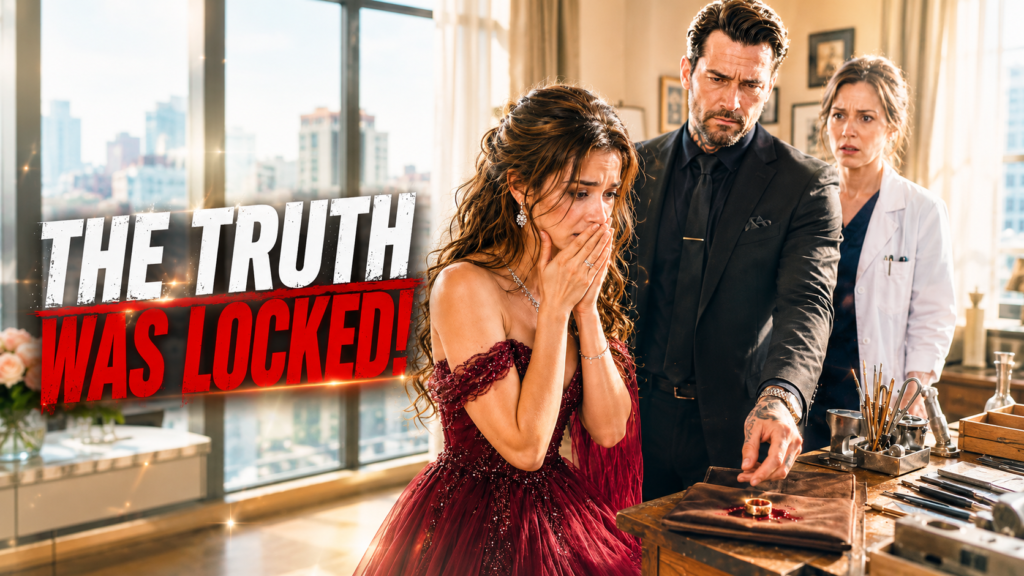
My name is Emma Brooks. I grew up in a small town outside Boise, Idaho, where people fixed things instead of replacing them. My father repaired tractors; my mother taught fourth grade. We never had much money, but we had enough: enough dinners around one table, enough laughter, enough honesty.
That changed after my parents died in a highway accident when I was twenty-two. Medical debt swallowed everything they left behind—the house, the workshop, even Dad’s old pickup. I moved to Seattle with two suitcases and a toolbox.
For the next six years, I worked as a structural fire safety engineer. My job wasn’t glamorous. I inspected aging buildings, emergency exits, sprinkler systems, and evacuation plans. If I did my job well, nobody noticed; if I failed… people died. I liked that responsibility. It made life simple: truth either held a building together… or it didn’t.
The only thing I never threw away was an old military challenge coin that my father had given me when I turned eighteen. He wasn’t a soldier, nor was I. Whenever I asked where it came from, he’d smile. “Someone earned it.” That was all he’d ever say.
Three weeks before everything collapsed, my supervisor surprised me.
“Emma. You’ve been requested personally.”
“By who?”
He handed me a formal invitation: The Armitage Foundation Annual Innovation Gala. The foundation belonged to Nathan Armitage, one of the country’s most influential defense contractors. Television called him a visionary billionaire, while business magazines called him the future of American manufacturing. I had never met him. Apparently, one of his companies wanted me to evaluate fire safety compliance at a newly restored aerospace research facility before its public unveiling. The consulting fee equaled nearly four months of my salary, so I accepted immediately.
The research complex overlooked Elliott Bay. Everything inside looked perfect—too perfect. Every hallway, every laboratory, every emergency system.
Until I reached the underground archive.
One emergency exit existed on the official blueprint, but it didn’t exist in the building—someone had sealed it behind reinforced concrete. I frowned. Construction mistakes happened, but not in billion-dollar facilities. I photographed the wall.
As I turned to leave, an elderly maintenance worker quietly spoke behind me. “You noticed it.”
I nodded. “The exit disappeared.”
He studied me for several seconds. “So did someone else.”
Before I could ask what he meant, another employee called him away. When I looked back… the old man had vanished.
That evening the gala began. Politicians, military officers, corporate investors, media personalities—the entire ballroom shimmered with money. I felt completely out of place.
Nathan Armitage stepped onto the stage to thunderous applause. Tall, calm, perfectly composed—the kind of man whose confidence filled every room before he spoke. He announced a scholarship program honoring workplace safety.
Unexpectedly… he called my name.
“Emma Brooks.”
I looked around, assuming there had been a mistake.
“There isn’t.” Nathan smiled politely. “Would you join me?”
Hundreds of eyes followed me onto the stage. He thanked me publicly for identifying “a construction oversight” before the facility officially opened. The audience applauded. Then I noticed something strange: not everyone was clapping. A man standing near the back quietly left the ballroom, never taking his eyes off me.
The ceremony ended just after ten. As I gathered my inspection files, someone slipped a folded note into my bag containing only one sentence: The exit wasn’t sealed. It was hidden. No signature, no explanation.
I rushed back toward the archive, but security stopped me immediately.
“The building is closed.”
“I left equipment downstairs.”
“No one is permitted below.”
The answer came too quickly.
Unable to reenter, I headed toward the parking garage. That’s when I heard footsteps behind me. The elderly maintenance worker from earlier stood beneath a flickering light, looking terrified.
“You need to leave Seattle.”
“What?”
“They finally know who you are.”
“I think you’ve mistaken me for someone else.”
He shook his head. “No.” He reached into his pocket and handed me a weathered envelope. “For thirty years… I’ve been waiting to give this to your father’s daughter.”
My heartbeat quickened. “You knew my father?”
Before he could answer, a black SUV sped into the garage. The old man’s face drained of color.
“Run.”
Two masked men jumped from the vehicle. The first raised a handgun fitted with a suppressor, while the second charged straight toward the maintenance worker. I grabbed his arm and ran.
Gunshots echoed through the concrete structure as car alarms exploded around us. We barely reached the stairwell before the old man shoved the envelope into my hands.
“No matter what happens… don’t let Armitage open it.”
A shot rang out, and the old man collapsed. I screamed, but he pushed me away with his final strength.
“Go!”
I stumbled down three flights of stairs before security officers flooded the garage. By the time police arrived, the shooters were gone, and so was the envelope—someone had stolen it from my hands during the chaos.
Just after midnight, detectives questioned everyone who had attended the gala. Nathan Armitage personally approached me, his suit spotless and his voice calm.
“I’m deeply sorry you experienced this.”
I stared at him. “Who was that man?”
“I’ve never seen him before.” He answered too quickly.
Then he looked down at my hand—at the old military challenge coin hanging from my keychain. His expression changed for only a fraction of a second, but it was enough for me to notice.
“You should keep that somewhere safe,” he said quietly. “Some people have killed for less.”
Before I could respond, an evidence technician hurried toward the detectives carrying a sealed plastic bag. Inside was my father’s challenge coin—except I still had mine clipped to my keys.
Which meant only one thing: there were two identical coins. And according to the detective, the second one had just been recovered from inside the dead maintenance worker’s pocket.
I couldn’t stop staring at the evidence bag: two identical challenge coins. One hanging from my keychain; the other recovered from a dead man’s pocket. That wasn’t possible. My father had always told me his coin was unique.
The detective noticed my reaction. “You’ve seen this before.”
“I…” I hesitated. “I own one just like it.”
The room became silent. Nathan Armitage slowly turned toward me. For the first time that night, the confidence disappeared from his face—only for a second, then it was gone.
The detectives asked me to surrender my coin for examination.
I refused. “It belonged to my father.”
“It may also be evidence.”
Reluctantly, I handed it over. The forensic technician placed both coins side by side. They looked identical: same scratches, same military insignia, same engraved eagle. Until he opened them.
Opened? I frowned. “They open?”
Using a tiny metal pin, he pressed the center of the coin. It separated into two halves. Hidden inside mine… was a strip of microfilm. The second coin… was empty.
Nobody in the room spoke. Nathan quietly stepped backward.
The detective immediately noticed. “Mr. Armitage. Please remain where you are.”
Nathan smiled politely. “I have an early flight.”
“No one is leaving.”
The microfilm couldn’t be viewed without specialized equipment, and the police laboratory estimated six hours. Nathan insisted on returning home, but the detectives refused. Then his attorney arrived, and within thirty minutes Nathan legally walked out of the station. Money moved faster than justice.
I watched his convoy disappear into the rain. Something told me he wasn’t running from the investigation; he was racing toward whatever was hidden inside that microfilm.
At three in the morning, I returned to my apartment. Someone had already been there. Nothing valuable was missing—television, laptop, cash, untouched. Only one thing had disappeared: my father’s old toolbox. Who steals rusty tools? Unless… they weren’t after the tools. They were searching for something hidden inside.
As I stood frozen in the doorway, my phone rang. Unknown number.
I answered.
A woman’s voice whispered, “Check the false bottom.” The call disconnected.
I drove to the police impound lot where my apartment building’s maintenance staff had temporarily stored damaged property recovered after the break-in. The toolbox hadn’t been taken, only emptied. I searched it anyway—nothing. Then I remembered the caller’s words: False bottom.
Using a screwdriver, I pried loose the wooden base. A sealed envelope slid into my hands with my father’s handwriting covering the front: For Emma. Not “If Found,” not “Open Later,” simply… For Emma.
Inside rested one photograph showing three young people standing smiling beside an unfinished bridge: my father, the murdered maintenance worker, and… Nathan Armitage, thirty years younger. Friends. I felt sick.
The envelope contained one more item: a brass locker key with no note, no explanation, only the number 214.
The forensic lab called just before sunrise; the microfilm had finally been processed. Detective Lisa Moreno asked me to come immediately.
When I arrived, the room felt different—too quiet. She closed the blinds before speaking. “You were right not to trust anyone.”
She projected the microfilm onto a screen. It wasn’t military information or engineering plans; it was accounting. Hundreds of payments, shell companies, offshore transfers, and construction contracts. Every payment linked to one project: Harbor Point Transit Tunnel—the same tunnel that had collapsed twenty-eight years earlier, killing forty-seven construction workers. Officially, it had been ruled an accident.
Detective Moreno zoomed in. One signature appeared repeatedly: Nathan Armitage. Another belonged to my father.
“No…” I whispered. “My father wasn’t corrupt.”
“I don’t think he was.” She enlarged another page. Beside my father’s signature someone had stamped one word in red ink: OBJECTED.
Every other executive had approved the unsafe materials, but my father had refused. Then another page appeared: Termination notice. Employment revoked. Security clearance canceled. Two weeks later… the tunnel collapsed.
Before we could continue, the station suddenly lost power. Emergency lights flickered on as someone shouted down the hallway: “Server breach!” Computer screens went black, and files disappeared in real time. The evidence database was being erased.
Detective Moreno grabbed a flash drive. “We’re leaving.”
“What about the FBI?”
“I already called them.” She looked directly into my eyes. “They never answered.”
We escaped through the underground parking garage. Halfway to her car… she froze. Three black SUVs blocked every exit—not police, but private security. Nathan stepped out wearing the same calm expression, looking almost disappointed.
“Emma. I warned you.”
Detective Moreno reached for her weapon. Nathan calmly raised both hands.
“I didn’t come to threaten anyone.” He looked at me. “I came to tell you the truth. No more lies.” He sighed. “Your father never worked for me. He worked against me.”
I frowned. “What?”
“The Harbor Point disaster wasn’t caused by greed. It was sabotage.”
Silence.
“My father tried to stop it.”
Nathan nodded. “So did mine.”
I stared at him. “Your father?”
Nathan’s voice became quieter. “The company belonged to my father then. He ordered cheaper materials. My father exposed him. He was murdered before he could testify.”
Everything I thought I knew shifted again. “So you’ve been investigating your own family?”
“For twenty-eight years.”
Detective Moreno never lowered her gun. “If that’s true… why hide it?”
Nathan looked exhausted. “Because the people responsible still control half the city.”
A deafening explosion interrupted him. One of the SUVs erupted into flames as gunfire exploded from a nearby rooftop. Professional shooters, not aimed at us, but at Nathan. His security team returned fire.
Moreno dragged me behind a concrete pillar. Nathan refused to run. Instead, he shouted, “Get Emma out!”
One bullet struck his shoulder; another shattered the windshield beside me. Chaos swallowed the parking garage.
Then I saw something impossible: one of the attackers wasn’t trying to kill Nathan. He was trying to steal the evidence case containing the microfilm. He grabbed it… but before escaping, his mask slipped for just a second. I recognized him instantly. The man wasn’t a hired assassin; he was the governor of Washington’s chief legal advisor—the same official who had publicly led the investigation into the Harbor Point tunnel collapse twenty-eight years earlier.
By the time anyone reacted, he disappeared into the burning garage with the evidence. Nathan looked at me through the smoke, blood soaking his shirt. His next words hit harder than the gunfire.
“Emma… your father didn’t leave you those coins to expose the past.” He coughed, struggling to stay conscious. “He left them… because one of them unlocks a vault containing the names of every living person who helped bury it.”
Nathan collapsed before he could say another word. His security team rushed him into an armored vehicle while Detective Lisa Moreno pulled me toward her sedan.
“Forget the hospital,” she said. “If he’s telling the truth, they’ll be waiting there.”
The city was waking up. Morning commuters had no idea that a gun battle had erupted beneath one of Seattle’s busiest office towers—or that the evidence behind a twenty-eight-year conspiracy had just been stolen. But Nathan’s final sentence wouldn’t leave my mind: One of the coins unlocks a vault. Not money. Not weapons. A vault.
Back at a temporary FBI field office outside Tacoma, specialists examined both challenge coins again. This time they focused on the edges. One technician noticed something unusual.
“The grooves don’t match.”
He rotated the coins until the engraved eagles faced each other. A soft click echoed through the room as the two coins locked together, their combined shape forming a six-sided metal key. Everyone stared in silence.
Detective Moreno whispered, “So that’s why there were always two.”
An engraving slowly emerged along the edge: PIER 19. LOCKER C-117.
By nightfall, the FBI quietly secured Pier 19—no television cameras, no press, no sirens, only a handful of agents, Detective Moreno, and me.
Locker C-117 looked ordinary: old paint, rusty hinges, a cheap padlock. The coin-key fit perfectly. Inside wasn’t cash, gold, or even a safe—it was a weatherproof steel case containing dozens of original engineering reports, cassette tapes, payroll ledgers, handwritten notebooks, and one sealed video cassette labeled If Emma Opens This.
My hands trembled. My father had prepared this decades before.
The tape began with static before my father appeared—older than I remembered, tired, looking directly into the camera.
“Emma… if you’re seeing this, I wasn’t able to finish what we started.”
He explained that the Harbor Point tunnel had never been an engineering failure; it had been a planned financial crime. Executives intentionally approved defective structural materials, insurance companies quietly paid billions, construction firms declared bankruptcy, and the same investors purchased the contracts for pennies, becoming even richer after the disaster than before it.
But the biggest revelation came next: Nathan’s father had discovered the fraud and secretly partnered with my father to expose it. Both men became targets; one was murdered, and the other was forced into hiding under constant surveillance. The “accident” that killed my parents years later had never been an accident—it had been staged after my father refused to surrender the evidence.
I could barely breathe. Everything I believed about my childhood collapsed in a matter of minutes.
The steel case held something even more valuable than the video: a handwritten ledger. Unlike the stolen microfilm, this ledger contained original signatures, banking authorizations, and personal notes from everyone involved in the conspiracy—judges, state officials, developers, corporate executives, and one final name: Governor Richard Lawson, the same governor who had publicly built his career promising transparency after the Harbor Point tragedy. He hadn’t covered it up afterward; he had helped create it.
Before the FBI could transport the evidence, every light inside the pier suddenly went dark.
Moreno looked at me. “They found us.”
Explosions rocked the building as someone disabled the electrical grid. Smoke filled the loading docks while gunfire erupted outside. But these attackers weren’t after me—they were after the ledger.
A helicopter hovered above the warehouse roof and its side door slid open. Governor Lawson’s chief legal advisor—the same man who stole the microfilm—shouted through a loudspeaker: “Hand over the ledger. No one else has to die.”
Moreno answered with silence. The FBI returned fire, turning the warehouse into a battlefield.
In the middle of the chaos, Nathan arrived, his shoulder heavily bandaged. Against every doctor’s orders, he had come anyway. He walked directly toward me.
“You have the ledger?”
I nodded.
He smiled for the first time. “My father would’ve been proud.” He reached into his jacket and handed me a small satellite transmitter. “Press this.”
“What is it?”
“A dead man’s insurance policy.”
Without another explanation, I activated it.
Exactly thirty seconds later, every monitor inside the FBI command vehicle lit up. My father’s files began uploading automatically—not to one location, but to hundreds: federal prosecutors, major newspapers, national television networks, engineering associations, independent investigators, and university archives. The evidence wasn’t being protected anymore; it was being released to the world. The conspiracy no longer had a single target to destroy.
Governor Lawson’s convoy arrived moments too late. He stepped from his armored SUV surrounded by attorneys. “You’ve made a terrible mistake.”
Nathan calmly faced him. “No. My father corrected one.”
Lawson laughed. “You think documents change history?”
I answered before Nathan could: “They don’t. They reveal it.”
Within minutes, FBI tactical teams surrounded the pier. This time, they weren’t responding to anonymous tips—they already possessed the uploaded evidence. Lawson looked around, and for the first time in decades, power had abandoned him. He quietly lowered his head. No dramatic speech, no escape, no last-minute deal—only handcuffs.
The months that followed became known as the Harbor Point Reckoning. Federal indictments spread across multiple states, construction executives were convicted, public officials resigned, and insurance fraud cases were reopened. Families of the forty-seven workers who died finally received the truth they had been denied for nearly three decades. The maintenance worker who sacrificed his life to protect me was publicly honored, his real name finally restored after years of being erased from official records.
Nathan resigned from every corporate position connected to his family’s company and testified voluntarily against former executives, including members of his own family. Some called him a traitor while others called him courageous, but he never answered either. He simply said, “Loyalty without truth becomes another form of corruption.”
I returned to the work I loved—not because everything was normal, but because buildings still needed people willing to tell the truth when something wasn’t safe.
One afternoon, the state historical commission invited me to a memorial at Harbor Point. Forty-seven steel pillars now stood where the collapsed tunnel had once been, each carrying the name of one victim—no executives, no politicians, only the people who paid the highest price.
I placed both challenge coins together at the foot of my father’s memorial plaque. For years I believed they were symbols of a forgotten past, but I finally understood what they really were: not military souvenirs, not family heirlooms, but promises. Promises that the truth would survive even if the people protecting it did not.
Nathan stood beside me in silence. “What happens now?” he asked.
I looked across the harbor where workers were building a new bridge under stricter safety laws inspired by the investigation. “We stop treating integrity like it’s extraordinary.”
A light breeze rolled in from Elliott Bay as construction cranes moved across the skyline. This time, every inspection report was public, every signature could be traced, and every family who lost someone finally knew why.
Some scars never disappear, but justice has a way of making sure they are never hidden again. And as the sun rose over the harbor, I realized my father had left me something far more valuable than evidence: he had left me the courage to choose the truth—no matter how powerful the lie standing in front of it.