COLD OPEN
My sister waited until Thanksgiving dinner to announce that our father had secretly handed her the company I had built since I was sixteen. Then she smiled across my own dining table and told me I was getting nothing.
I took one slow sip of bourbon, looked at Dad, and asked, “Do you want to explain what happens next, or should I?”
Eight minutes later, her husband’s phone began vibrating.
He looked at the screen.
And the celebration died.
PART 1 — THE COMPANY THEY THOUGHT THEY COULD STEAL
Brielle waited until the turkey had been carved before trying to take everything I had built.
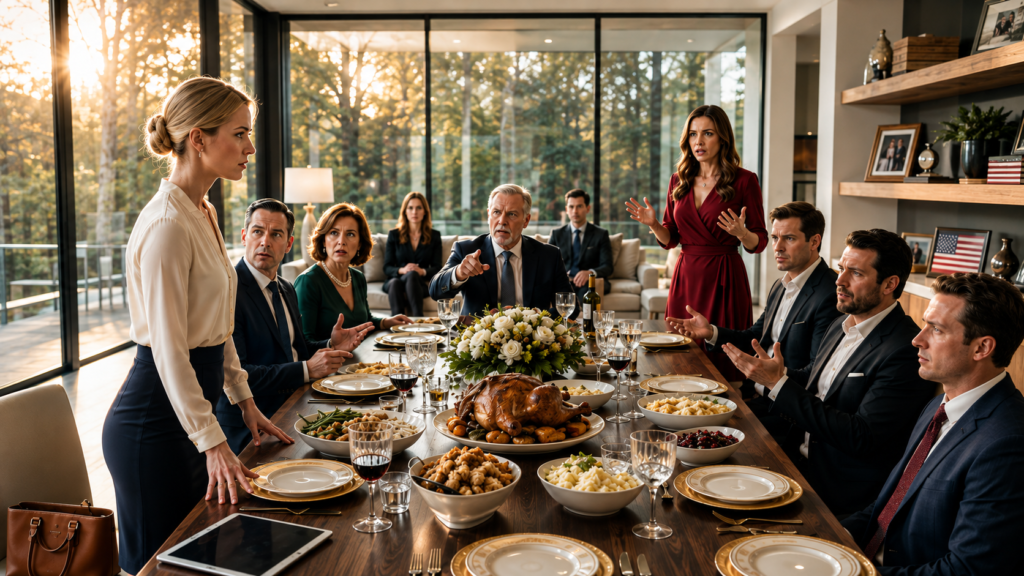
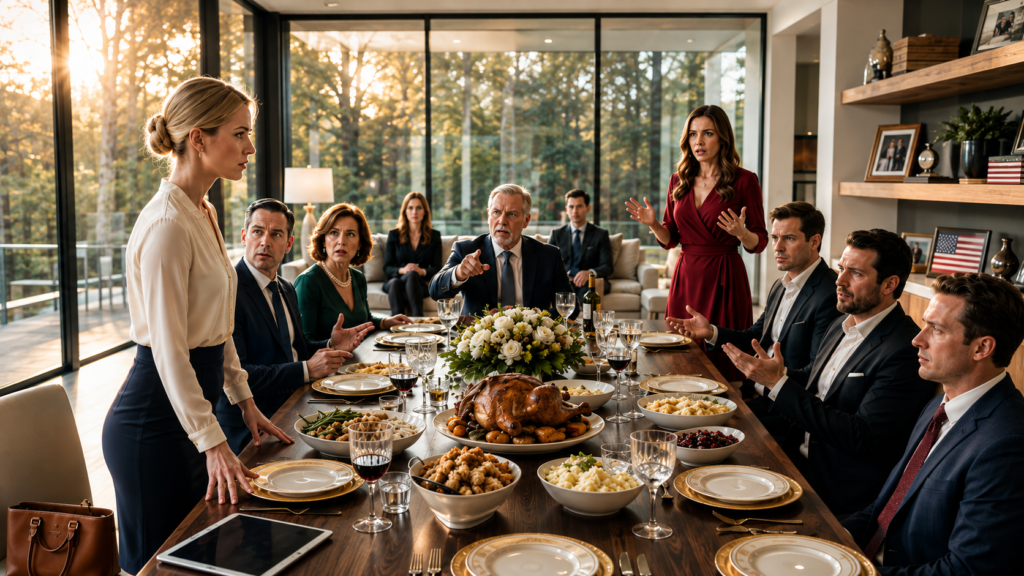
She stood at the end of my Thanksgiving table in a dark green silk dress, one hand resting on her pregnant stomach, the other holding a champagne glass.
Outside, November rain streaked the tall windows of my house in Charlotte, North Carolina.
Inside, the fireplace crackled softly. Candles reflected across the long oak table, and my parents sat at opposite ends as if they were waiting for someone to announce a royal succession.
That someone, apparently, was my sister.
“I have something exciting to share,” Brielle said.
My father, Richard, leaned back in his chair with a glass of Cabernet in his hand.
My mother, Marianne, was already smiling.
Brielle looked straight at me.
Then she lifted her glass.
“Dad has officially transferred Everly Thermal to Grant and me.”
The room went silent.
Not uncomfortable silence.
Complete silence.
Even the music playing quietly from the speakers seemed to disappear.
Everly Thermal.
The company I had started in our garage when I was sixteen.
The company I built while my classmates were going to parties and football games.
The company born from years of burned fingertips, failed prototypes, sleepless nights, and fabric samples spread across a folding table.
We specialized in temperature-regulating antimicrobial textiles used in athletic equipment and medical recovery products.
My company.
Or at least, that was what I had always believed.
Brielle smiled wider.
“Dad thinks it’s time for the company to have proper leadership,” she continued. “Grant and I are going to take it to the next level.”
Her husband, Grant, gave me a smug little smile.
Then Brielle added, almost cheerfully, “You won’t be getting the business, obviously. But Dad said you can stay involved if you want.”
I stared at her.
My mother clasped her hands.
“Oh, sweetheart. This is wonderful.”
Wonderful.
Apparently, when my family took something from me, they called it a blessing.
I turned toward my father.
He suddenly became very interested in the wine inside his glass.
That told me enough.
I didn’t yell.
I didn’t slam my fist onto the table.
I didn’t remind them that the house they were sitting in, the food they were eating, and the company they were celebrating had all been funded by my work.
Instead, I picked up my bourbon.
The ice shifted softly against the glass.
I took a slow drink.
Then I looked directly at Richard.
“Do you want to tell them now,” I asked quietly, “or should I?”
Brielle laughed.
But it sounded forced.
Grant’s expression flickered.
My father remained silent.
That was the first sign that something was wrong.
To understand why I wasn’t angry, you need to understand my family.
They had been taking from me long before tonight.
When I was sixteen, I spent almost every weekend in our garage experimenting with fabric.
While other girls my age were shopping or going to school dances, I was surrounded by rolls of material, sewing machines, chemical dyes, and notebooks filled with formulas.
I wanted to create a fabric that could hold warmth in cold conditions and release excess heat when the body became too hot.
My mother called it a phase.
Brielle thought it was hilarious.
She once kicked over an entire tray of samples and laughed while I scrambled across the garage floor trying to save them.
My father called my experiments “expensive junk.”
Then an outdoor equipment manufacturer requested one of my prototypes.
They wanted to test it.
And suddenly, Dad became interested.
Because I was still under eighteen, I needed an adult to help with the legal paperwork.
Richard volunteered.
“I’m doing this for you,” he told me.
He helped establish the first company.
Then he listed himself as the controlling owner.
I was seventeen.
I was excited.
And I trusted my father.
That mistake lasted exactly once.
When the company received its first serious payment, my family began treating the business account like an extension of their personal finances.
My college fund disappeared so Brielle could have a new convertible.
When I protested, my mother told me that family came before money.
So I learned.
Quietly.
I spent nights studying business law at the public library.
I learned about trademarks, intellectual property, holding companies, licensing agreements, corporate structures, and asset protection.
More importantly, I learned how people behave when they think nobody understands what they’re doing.
By the time Everly Thermal became genuinely valuable, my father no longer controlled the assets he thought he controlled.
He simply didn’t know it.
Neither did Brielle.
Neither did Grant.
They still saw the sixteen-year-old girl hunched over a sewing machine in the garage.
They never noticed the woman who had spent nearly two decades building protections around everything that mattered.
And now, on Thanksgiving night, they were about to discover the difference.
Grant pushed his chair back.
He stood like he was preparing to address a corporate board.
“Look, Nora,” he said, using that polished business tone he loved. “Nobody is denying that you built the foundation. But you don’t have the experience to take Everly Thermal where it needs to go.”
Brielle nodded.
“We’re going international.”
Then she looked at me with fake sympathy.
“You can still work for us if you want.”
“For you?”
She smiled.
“Something simple. Inventory, maybe. We can give you a stable position.”
Grant added, “Minimum wage to start.”
I almost laughed.
Minimum wage.
For the company I had created.
At my Thanksgiving table.
Inside my house.
I smiled.
“That sounds incredibly generous.”
My father’s eyes narrowed slightly.
He had expected tears.
An argument.
Maybe begging.
He hadn’t expected me to agree.
I reached into my leather handbag and pulled out my tablet.
I opened a secure transfer portal and placed it on the table.
Grant leaned forward.
“If you’re really ready to take over,” I said, “you should have the access tonight.”
His eyes lit up.
He didn’t ask to see the financial statements.
He didn’t ask about liabilities.
He didn’t ask which properties belonged to the operating company and which belonged to separate entities.
He saw one thing.
Ownership.
He grabbed the stylus.
“Finally,” he muttered.
He signed.
The screen turned green.
TRANSFER CONFIRMED.
My father immediately raised his glass.
“To Brielle and Grant,” he announced. “The future of this family.”
Everyone lifted their drinks.
Except me.
I glanced at the digital clock above the fireplace.
8:11 p.m.
Grant was already asking for passwords.
Bank access.
Vendor information.
Payroll credentials.
Brielle looked happier than I had seen her in years.
My mother was wiping tears from her eyes.
Dad looked proud.
8:12 p.m.
I folded my napkin and placed it beside my plate.
Then I looked at Grant.
“You should probably keep your phone nearby.”
He frowned.
“Why?”
The clock changed.
8:13 p.m.
His phone vibrated against the table.
Once.
Then twice.
Then again.
Grant picked it up, clearly annoyed.
His expression changed.
The color drained from his face.
My father stopped moving.
Brielle leaned toward him.
“What happened?”
Grant didn’t answer.
He simply stared at the screen.
I took another slow sip of bourbon.
Then I looked at my father.
“Now,” I said softly, “let’s talk about the company you thought you just gave away.”
PART 2 — THE DOCUMENTS THEY NEVER KNEW EXISTED
Grant’s phone continued vibrating in his hand.
He finally looked up.
“What did you do?”
I smiled faintly.
“Nothing tonight.”
His jaw tightened.
“Then why are my emails blowing up?”
Dad leaned forward.
“Grant, calm down. What’s happening?”
Grant turned the phone toward him.
The first notification was from the company’s outside counsel.
URGENT: CHANGE OF CONTROL DOCUMENTATION INVALID.
The second was from the bank.
AUTHORIZED SIGNATORY ACCESS SUSPENDED PENDING REVIEW.
The third came from the state business registry.
TRANSFER NOTICE REJECTED.
Brielle’s smile disappeared.
“What does that mean?”
Grant swallowed.
“It means the transfer didn’t go through.”
Dad stared at me.
“But you signed it.”
“I signed what was presented to me,” Grant said.
I placed my glass on the table.
“No. You signed what you were told was ownership.”
Everyone looked at me.
I reached for my tablet again.
“There is a difference.”
Dad’s face hardened.
“Nora, don’t play games.”
“I’ve been playing games for years.”
I opened the first document.
“When I was seventeen, you put yourself down as the controlling member of Everly Thermal because I was a minor.”
Dad nodded slowly.
“That was legal.”
“At the time, yes.”
Grant looked between us.
“But?”
“But the company changed.”
I tapped the screen.
“Three years after the original LLC was created, I formed a holding company. The intellectual property was transferred into it. The patents. The trademarks. The proprietary formulas. The licensing agreements.”
Grant’s face went pale.
Brielle whispered, “Dad?”
Richard didn’t answer.
I continued.
“The operating company you thought you controlled hasn’t owned the core technology for years.”
Grant shook his head.
“That can’t be right.”
“You should have read the documents.”
His expression tightened.
“You deliberately hid this from us.”
“No.”
I looked directly at him.
“I protected myself from you.”
The room became silent again.
My mother finally spoke.
“But Richard raised you. He helped you build everything.”
I almost laughed.
“He helped himself first.”
Dad slammed his hand onto the table.
“You ungrateful—”
“Careful.”
My voice was calm.
That seemed to anger him more than shouting would have.
“You’re sitting in my house,” I continued, “eating food I paid for, celebrating a company you don’t own, after announcing to my face that I was getting nothing.”
Brielle stood abruptly.
“You can’t do this to us!”
I turned toward her.
“Do what?”
“You’re my sister!”
“And you’re the woman who just told me I should be grateful for a minimum-wage job in my own company.”
Her mouth opened.
No words came.
Grant suddenly stood.
“We need to leave.”
Dad looked at him.
“Leave?”
“Yes.”
Grant’s voice was shaking now.
“We need lawyers.”
I nodded.
“You already have one.”
His phone vibrated again.
He looked down.
This time, his face went completely blank.
“What now?” Brielle asked.
He handed the phone to her.
She read the message.
Then she looked at me.
“What is Northbridge Capital?”
I leaned back.
“That’s the company that owns the patents.”
Dad stared at me.
“You transferred everything?”
“Not everything.”
I smiled.
“Just everything that matters.”
That was when Dad finally understood.
The Thanksgiving announcement had never been a transfer of my life.
It had been an attempted transfer of something they didn’t possess.
And I had allowed them to sign their names to the mistake.
But there was one more thing they hadn’t discovered.
I opened another file.
A folder labeled:
FAMILY LOANS — 2009–2024
Brielle’s face changed.
“What’s that?”
“Every dollar my parents took from Everly Thermal.”
Dad went still.
“Those weren’t loans.”
I looked at him.
“That’s interesting.”
I tapped the screen.
“Because you signed promissory notes.”
My mother whispered, “Richard…”
He didn’t look at her.
I continued.
“Some were repaid. Most weren’t.”
Grant sat down slowly.
“How much?”
I looked at him.
“Enough that your transfer attempt created a serious problem.”
The room seemed to shrink.
Rain continued pounding against the windows.
For years, I had imagined this confrontation happening with screaming.
Instead, it was quiet.
Almost peaceful.
Because for the first time, I wasn’t trying to convince them of my worth.
I was simply showing them the paperwork.
Dad stared at me for a long moment.
“You planned this.”
“No.”
I shook my head.
“You planned the theft.”
I closed the tablet.
“I prepared for it.”
Brielle’s eyes filled with tears.
“You’re destroying our family.”
I looked at her carefully.
“No, Brielle.”
I stood.
“You’re finally seeing what our family has been.”
Nobody answered.
Then my phone rang.
The caller ID displayed a name I hadn’t expected to see that night.
Daniel Mercer — Federal Trade Counsel.
I answered.
“Hello?”
Daniel’s voice was serious.
“Nora, I just received the documents you sent over.”
I glanced around the table.
Everyone was watching me.
“Is there a problem?” I asked.
There was a pause.
“Yes.”
My stomach tightened.
“What kind?”
He lowered his voice.
“The documents aren’t just evidence of an attempted corporate transfer.”
I waited.
“They may prove someone has been moving company money without authorization for years.”
I looked at my father.
He had suddenly gone very still.
Daniel continued.
“And Nora?”
“Yes?”
“You need to ask your family one question.”
“What question?”
“Who has been receiving the money?”
I slowly lowered the phone.
Across the table, Dad’s face had lost every trace of confidence.
And for the first time that evening, he looked afraid.
PART 3 — THE TRUTH THAT ENDED THE FAMILY’S GAME
For several seconds, nobody moved.
Rain tapped against the tall windows while the fireplace burned quietly behind us.
I looked at my father.
“Who has been taking the money?”
Richard’s face tightened.
“I don’t know what you’re talking about.”
I almost smiled.
That was his answer to everything when the truth became inconvenient.
Grant stood.
“We should get our attorneys involved before anyone says something that creates liability.”
I looked at him.
“You’re right.”
Then I turned to my phone.
“Daniel, stay on the line.”
My father’s expression changed.
“Who is Daniel?”
“The attorney who has been auditing Everly Thermal’s financial records.”
Mom looked at Dad.
“You told me everything was fine.”
Richard said nothing.
Brielle slowly sat back down.
“Dad?”
He finally spoke.
“There were some old accounts.”
“How old?”
I answered for him.
“Eleven years.”
Brielle stared at me.
“What?”
I opened the final file on my tablet.
“For eleven years, money was moved from Everly Thermal into three consulting companies.”
Grant stepped closer.
“Whose companies?”
I looked directly at him.
“Your father’s.”
Silence.
Brielle turned toward Richard.
“Dad?”
Richard’s mouth opened.
Nothing came out.
I continued.
“Some payments were legitimate. Most weren’t. And several were transferred to accounts connected to you, Brielle.”
She shook her head.
“No.”
“I have the records.”
“I didn’t know.”
“I believe you.”
That surprised her.
I softened my voice.
“You didn’t know because Dad never told you.”
My father suddenly pushed his chair back.
“You have no right to investigate my finances!”
I stood.
“And you had no right to take money from my company.”
He froze.
That was the moment everything changed.
Not because I had shouted.
Not because someone threatened him.
Because he finally realized the daughter he had spent years dismissing had become someone he could no longer intimidate.
Daniel’s voice came through the phone.
“Nora, I’ve reviewed enough to recommend immediate legal action.”
I nodded.
“Do it.”
Dad stared at me.
“You’d sue your own father?”
I looked at him for a long moment.
“No.”
His expression briefly softened.
Then I finished.
“I’d hold a business partner accountable for theft.”
His face collapsed.
Mom began crying.
Brielle looked down at the table.
Grant was already typing furiously into his phone.
Then his phone rang.
He answered.
“Yes?”
His expression changed again.
“What do you mean the lender froze the account?”
He listened.
Then whispered:
“How much?”
He closed his eyes.
I didn’t need to ask.
The company Grant had expected to inherit had just become a legal liability.
He looked at me.
“You knew.”
“I knew enough.”
“You let me sign that transfer.”
“You signed it because you wanted something you hadn’t earned.”
He looked away.
Brielle wiped her cheeks.
“So what happens now?”
I looked around the table.
For years, I had imagined my family finally recognizing what I had accomplished.
I thought I wanted an apology.
I thought I wanted Dad to say he was proud of me.
But sitting there, I realized something.
I didn’t need either.
“I am keeping Everly Thermal,” I said.
Dad looked up.
“And the house?”
“Mine.”
“The family?”
I paused.
“That depends on whether you can learn the difference between loving me and using me.”
Nobody answered.
I picked up my glass.
The ice had almost melted.
“I spent eighteen years building this company,” I said quietly. “But I spent even longer trying to earn a place at a table where I was never treated like an equal.”
I looked at Brielle.
“I don’t hate you.”
Then at Mom.
“I don’t hate you either.”
Finally, I looked at Dad.
“But I am finished proving that I deserve respect.”
I walked away from the table.
Behind me, chairs moved.
Someone started crying.
Someone else began arguing.
But I didn’t turn around.
At the front door, I stopped.
Thanksgiving dinner was still sitting on the table.
The candles were still burning.
The turkey was getting cold.
And for the first time in my life, I didn’t feel responsible for fixing the evening.
I opened the door.
Cold November air rushed inside.
My phone buzzed.
A message from Daniel.
The emergency injunction has been filed. The company and intellectual property are protected.
I stared at the screen.
Then another message appeared.
This one was from my mother.
I’m sorry.
I read it twice.
I didn’t answer immediately.
Then I typed:
I hope you mean it.
I put the phone away.
The next morning, Everly Thermal’s board met without my family.
By Monday, the attempted transfer had been formally rejected.
By Wednesday, investigators had begun reviewing the financial records.
And within three months, my father was forced to repay a portion of the money he had diverted.
Brielle eventually apologized.
Not dramatically.
Not in front of everyone.
She came to my office one rainy afternoon, stood in the doorway, and said, “I should have asked you before believing him.”
I nodded.
“That would have been a good place to start.”
Grant never apologized.
He simply disappeared from the company.
As for my parents, our relationship changed permanently.
There was no magical reconciliation.
No perfect family dinner.
No sudden transformation.
Some wounds don’t close just because the truth finally comes out.
But I stopped carrying them.
A year later, I stood inside the same garage where I had built my first prototype at sixteen.
The old sewing machine was still there.
The walls had been repainted.
The workbench had been replaced.
But one small blue stain remained on the concrete floor.
I knelt and touched it.
I remembered the girl I had been.
She had believed that if she worked hard enough, stayed quiet enough, and gave enough, her family would eventually value her.
She was wrong.
But she had built something extraordinary.
I stood and looked through the window at the headquarters of the company that little girl had started.
Everly Thermal was now worth more than I had ever imagined.
And it belonged to me.
Not because my father allowed it.
Not because my sister approved.
Not because my family finally recognized my value.
Because I had built it.
And this time, I wasn’t giving it away.
The biggest lesson I learned wasn’t about business.
It was this:
Sometimes protecting what you’ve built means accepting that the people trying to take it from you are the very people you once hoped would be proud of you.
And walking away from them isn’t losing your family.
Sometimes, it’s finally choosing yourself.
THE END.