COLD OPEN
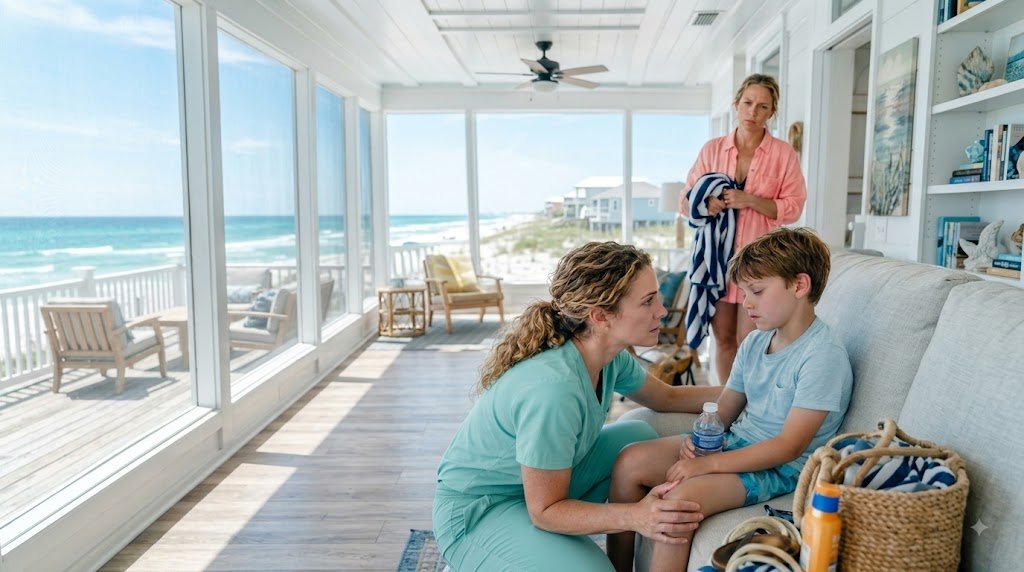
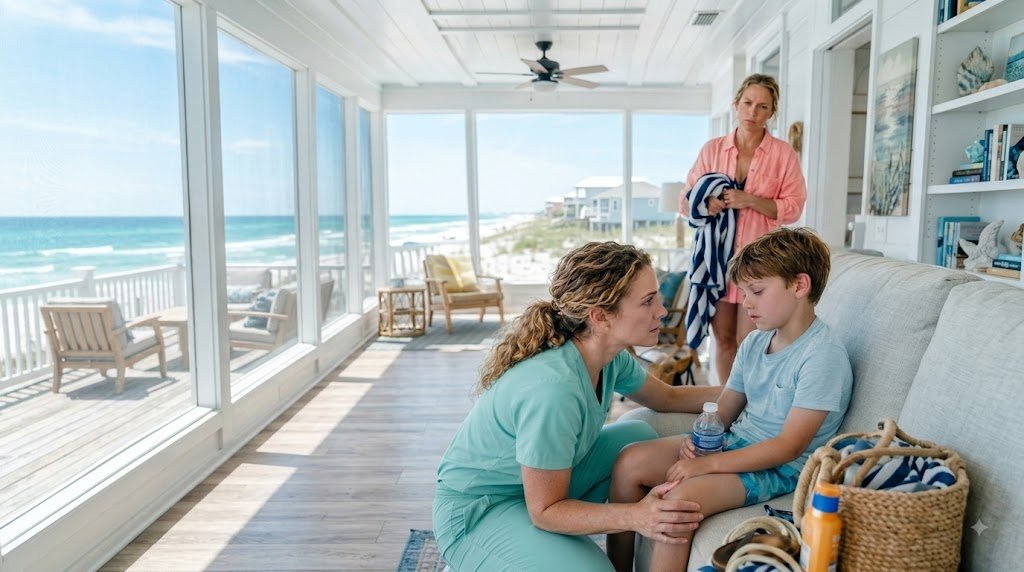
By the third day of our family beach trip, my eight-year-old nephew had stopped running toward the ocean.
He kept asking for water, using the bathroom, and saying he was too tired to play.
My sister told me, “Please be his aunt, not the ER nurse.”
That afternoon, he started breathing strangely.
I wanted to believe it was just the heat.
Then he collapsed against the bathroom sink.
And the triage nurse took one look at his vital signs and said, “We’re taking him back immediately.”
Part 1: The Warning Signs
Finn had asked for his third bottle of water before eleven that morning.
I noticed because I was the one carrying the cooler.
We were staying near Tybee Island, Georgia, with six adults and five kids packed beneath two beach umbrellas, surrounded by enough towels, chairs, sunscreen, toys, and snacks to stock a summer camp.
My sister, Marissa, was stretched out on her stomach reading a paperback.
Her husband, Colin, was helping their twelve-year-old daughter bury my father’s feet in the sand.
Finn sat beside the cooler.
Not playing.
That was strange.
He was eight years old and usually moved as if sitting still were physically impossible.
“Another bottle?” I asked.
He nodded.
“I’m really thirsty.”
I handed it to him.
Marissa glanced up from her book.
“He’s been drinking a lot all week.”
“How much?”
She shrugged.
“Enough. It’s hot.”
Finn finished nearly half the bottle in seconds.
I watched him.
Marissa noticed.
“Claire.”
“What?”
“That look.”
“What look?”
“The medical look.”
I laughed.
“I don’t have a medical look.”
“You absolutely do.”
She lowered her eyes back to her book.
“Please let us have one vacation where you don’t turn into an emergency-room doctor.”
Her words stung because there was some truth behind them.
My name is Claire Bennett.
I was thirty-seven and had spent nearly twelve years working as a pediatric emergency nurse.
That meant two things could be true at the same time.
I had learned to notice small changes other people overlooked.
And sometimes, because of what I had seen at work, I worried about things that turned out to be completely harmless.
Two summers earlier, Finn had complained of a headache after a long baseball tournament.
I immediately started asking about dizziness, nausea, neck pain, hydration, and whether he’d taken a hit to the head.
Marissa handed him a sports drink.
Twenty minutes later, he was running around the yard again.
Another time, her daughter developed a strange rash after summer camp.
I told Marissa she should have it checked.
It turned out to be a reaction to a new body wash.
Nothing serious.
After that, Marissa developed a habit of telling me:
“Sometimes I need my sister, Claire—not the nurse.”
I understood.
So during that week in Tybee Island, I had been making a real effort to leave my instincts at work.
The rental house was only a short walk from the beach.
My father had rented it to celebrate his seventy-first birthday.
Everyone had come.
Marissa and Colin with their two children.
My younger brother and his kids.
Our parents.
Me.
It was the first full-family vacation we’d managed in almost seven years.
I didn’t want anyone remembering it as the trip where Aunt Claire turned every headache and sunburn into a medical crisis.
So I said nothing about the water.
At noon, Finn went to the bathroom near the beach entrance.
At 12:40, he went again.
Around 1:15, he asked to return to the house.
Marissa closed her book.
“Already?”
“I’m tired.”
Colin looked toward the ocean.
“You were begging us to stay until sunset yesterday.”
Finn shrugged.
“Can we just go?”
Marissa placed the back of her hand against his forehead.
“No fever.”
I looked away before she noticed me watching.
Our mother volunteered to walk him back.
Finn stood.
Then paused.
Almost as though the simple act of getting up required more effort than he expected.
That bothered me.
Not enough to say anything.
Not yet.
That evening, we ordered seafood from a restaurant near the pier.
Finn normally ate shrimp so quickly that someone usually had to remind him to slow down.
That night, he took three bites of rice.
Then reached for his water.
Marissa frowned.
“Are you feeling sick?”
“My stomach hurts.”
Colin shrugged.
“Probably too much sun.”
“Maybe.”
Finn drank again.
Then went upstairs to the bathroom.
I was separating plastic forks when Marissa caught me looking toward the staircase.
“No.”
“I didn’t say anything.”
“You were thinking it loudly.”
I smiled.
“Maybe he’s overheated.”
“Exactly.”
There were reasonable explanations for everything.
The heat.
Travel.
Too much vacation food.
A different sleeping schedule.
Kids behaved strangely when routines changed.
That night, I still slept badly.
At 2:26 a.m., I heard footsteps in the hallway.
The bathroom door closed.
A few minutes later, I heard it again.
I checked the time on my phone.
Then immediately regretted checking.
At breakfast, Finn looked embarrassed.
He had wet the bed.
The first time he’d done that in years, according to Marissa.
Colin tried to make a gentle joke about Finn drinking enough water to empty the Atlantic.
Finn didn’t laugh.
Neither did I.
I made coffee and kept quiet.
Until I noticed his shorts.
They looked loose around his waist.
Not dramatically.
Just enough to catch my attention.
“Has Finn lost weight?”
Marissa slowly turned toward me.
“Claire.”
“I’m just asking.”
“He’s getting taller.”
“Probably.”
“You’re doing it again.”
“I know.”
That answer made her stop.
She studied me.
“What are you actually worried about?”
I could have listed several possibilities.
I didn’t.
“I don’t know yet.”
Marissa rubbed her forehead.
“We’ve only been here three days.”
“I know.”
“He’s exhausted because we’ve been outside constantly.”
“Maybe.”
“And he’s drinking because it’s almost ninety degrees.”
“Maybe.”
“Then what?”
I looked toward Finn.
He was stretched across the couch while his cousins argued over where to play miniature golf.
“I just want to keep an eye on him.”
Marissa stared at me.
Then she said quietly:
“Please don’t make him think something is wrong with him.”
That stopped me.
I backed off.
For most of the afternoon, Finn actually seemed better.
He ate half a sandwich.
Played cards.
Beat me twice.
By four o’clock, I was beginning to feel embarrassed about my concern.
Then he vomited in the downstairs bathroom.
Marissa stood behind him, holding his hair away from his face.
“Stomach bug,” she said.
Maybe.
Finn rinsed his mouth.
Then leaned against the sink.
I watched his chest rise.
Something wasn’t right.
He wasn’t wheezing.
He wasn’t gasping.
He wasn’t struggling for air.
His breathing was simply too deep.
Too fast.
Too deliberate.
As though his body was working harder than he realized.
My nurse instincts stopped negotiating.
“Marissa.”
She looked at my face.
“No.”
“We need to get him checked.”
“He just threw up.”
“I know.”
“He’s been in the heat all day.”
“I know.”
“Claire—”
“I’m not saying I know what’s wrong.”
Finn looked between us.
That mattered.
I lowered my voice.
“But I don’t think we should wait.”
Colin appeared in the hallway.
“What happened?”
Marissa answered before I could.
“Claire thinks we should take him to the ER.”
Colin looked at me.
“For vomiting?”
I crouched beside Finn.
“Hey, buddy. Can you sit down for me?”
He lowered himself carefully.
I asked if he felt dizzy.
“A little.”
Marissa folded her arms.
I knew that posture.
She was trying to decide whether I was being Aunt Claire again—the overprotective nurse who couldn’t turn her instincts off.
The worst part was that I was asking myself the same question.
If I’d never been wrong, maybe she would have trusted me immediately.
If I had never made her feel judged as a mother, maybe she wouldn’t hear concern as criticism.
Finn closed his eyes.
His breathing remained deep and rapid.
I stood.
“We need to go.”
Marissa’s head snapped toward me.
“He’s my son.”
“Yes.”
I paused.
Then softened my voice.
“I’m not trying to take over. I’m asking you to get him checked. I’ll drive.”
Nobody spoke.
Then Finn whispered:
“Mom… can we go?”
Marissa grabbed her purse.
Five minutes later, we were on the road.
At the emergency department, the triage nurse listened while Marissa explained the excessive thirst, frequent bathroom trips, fatigue, and vomiting.
She looked at Finn.
Then at me.
I didn’t mention that I was a nurse.
She checked his vital signs.
Then looked at the monitor.
Her expression changed instantly.
She stood.
“I’m bringing him back now.”
Marissa looked at me.
And for the first time that entire week, she didn’t say I was overreacting.
She simply whispered,
“Claire… what is happening to my son?”
Part 2: The Numbers on the Monitor
The triage nurse didn’t answer immediately.
She looked at Finn again, then at the screen beside his bed.
“Has he been unusually thirsty lately?”
Marissa nodded.
“For several days.”
“More frequent urination?”
“Yes.”
“Weight loss?”
Marissa hesitated.
“I think so.”
The nurse exchanged a quick glance with the second nurse.
That glance scared me more than anything she could have said.
“What’s his medical history?” she asked.
“Nothing significant,” Marissa replied. “He’s always been healthy.”
The nurse nodded.
“We’re going to run some blood work.”
Finn looked at his mother.
“Mom, am I in trouble?”
“No, sweetheart.”
Marissa took his hand.
“You’re not in trouble.”
The nurse wheeled him toward a treatment room.
I followed until Marissa stopped me.
“You said you didn’t know what was wrong.”
“I don’t.”
“But you knew something wasn’t right.”
I looked through the doorway at Finn.
“Yes.”
A few minutes later, a technician came in with a small glucose meter.
I watched him prick Finn’s finger.
The result appeared almost immediately.
The technician’s expression changed.
He stepped outside.
Then returned with the physician.
The doctor introduced herself as Dr. Natalie Harper.
She looked at the reading and then at Finn.
“Finn, I’m going to ask you a few questions, okay?”
He nodded.
“Have you been very thirsty?”
“Yes.”
“Even after drinking?”
“Yes.”
“Have you been waking up at night to use the bathroom?”
Finn nodded again.
Dr. Harper turned toward Marissa.
“How long?”
“Maybe a week.”
The doctor didn’t react dramatically.
That somehow made it worse.
“We need additional blood tests right away.”
Marissa squeezed Finn’s hand.
“What are you thinking?”
Dr. Harper chose her words carefully.
“His symptoms are concerning for a significant blood-sugar problem. We need to know exactly what’s happening.”
Marissa looked at me.
Her face had gone pale.
I moved closer and took her hand.
“Whatever this is, we’re here now.”
She nodded, but tears were already gathering in her eyes.
Finn looked confused.
“Does this mean I can’t go back to the beach?”
Marissa immediately leaned down and kissed his forehead.
“We’ll worry about the beach later.”
The next hour passed in fragments.
Blood was drawn.
An IV was started.
More numbers appeared on monitors.
Doctors came and went.
Every time someone entered the room, Marissa’s eyes followed them.
Finally, Dr. Harper returned.
She pulled a chair closer.
“Finn is showing signs of a serious metabolic imbalance. His blood sugar is extremely high, and he’s becoming dehydrated.”
Marissa covered her mouth.
“Is he going to be okay?”
“We caught it before it became worse,” Dr. Harper said. “But he needs to stay in the hospital.”
Marissa began crying.
Not loudly.
Just silently, as if she had been holding everything together for years and had finally run out of strength.
I wrapped an arm around her.
“You did the right thing bringing him in.”
She looked at me through tears.
“I almost didn’t.”
“I know.”
“I thought you were being paranoid.”
“I know.”
She looked toward Finn.
Then back at me.
“Thank you for not giving up.”
I shook my head.
“You’re his mother. You made the decision.”
“No.”
Her voice cracked.
“You pushed me to make it.”
Before I could answer, Finn spoke from the bed.
“Mom?”
Marissa immediately turned.
“I’m here.”
“Did I do something wrong?”
She walked over and held his face between her hands.
“No, baby.”
“Then why am I sick?”
Marissa looked at the doctor.
Dr. Harper answered gently.
“You didn’t do anything wrong.”
Finn nodded slowly.
Then his eyes moved toward me.
“Aunt Claire?”
“Yeah?”
“You knew?”
I swallowed.
“I knew something wasn’t normal. I didn’t know what.”
He thought about that.
Then whispered:
“I’m glad you came.”
Those words broke something inside me.
That night, Finn was admitted.
The beach vacation was over for all of us.
My father drove back to the rental house with the other kids.
Marissa stayed beside Finn.
I remained at the hospital.
Around midnight, I stepped into the hallway to make a phone call.
When I returned, Marissa was staring at her phone.
“What happened?”
She looked up.
“It was Lydia.”
Our younger brother’s wife.
“What did she say?”
Marissa turned the screen toward me.
There was a message.
Don’t tell Finn’s father yet.
I frowned.
“Why?”
Marissa shook her head.
“I don’t know.”
Another message appeared.
There is something you need to know about the week before we came here.
My stomach tightened.
“What does she mean?”
Marissa started typing.
Then stopped.
Another message came through.
Check the kitchen trash when you get back to the rental house. I found something strange and didn’t know how to tell you.
We stared at each other.
For several seconds, neither of us spoke.
Then Marissa whispered:
“What could be in that house that has anything to do with Finn being sick?”
I didn’t know.
But suddenly, I remembered something.
Three days earlier, before we’d gone to the beach, I’d seen Finn standing alone in the kitchen.
He had been holding an unopened sports drink.
And when I’d asked him why he wasn’t drinking it, he’d said:
“Dad told me not to.”
At the time, I hadn’t thought anything of it.
Now I couldn’t stop thinking about those words.
Marissa grabbed her jacket.
“I’m going back.”
“You shouldn’t leave Finn.”
“I won’t.”
She looked toward his hospital room.
“My mother is coming to stay with him.”
Then she looked at me.
“Claire, if someone knew Finn was getting sick before we came here…”
She didn’t finish.
She didn’t need to.
Because both of us were suddenly thinking the same thing.
Maybe Finn’s symptoms hadn’t started on this vacation.
Maybe we’d simply been the first people to notice them.
And if that was true, the question wasn’t only what was wrong with Finn.
It was who had known before us—and why they hadn’t told his mother.
Part 3: The Truth We Found
By six the next morning, Finn was stable.
His blood sugar was coming down, the dehydration was improving, and the doctors were cautiously optimistic.
But Marissa couldn’t stop thinking about Lydia’s message.
She asked our mother to stay with Finn while we drove back to the rental house.
The beach was almost empty when we arrived.
The house looked exactly as we’d left it.
Beach towels hung over chairs.
Sand covered the entryway.
Half-empty water bottles sat on the kitchen counter.
Nothing looked wrong.
Then Marissa opened the trash.
At first, there was nothing unusual.
Food wrappers.
Paper plates.
Empty drink containers.
Then she froze.
“What is that?”
I reached in and pulled out a crumpled receipt.
It was from a pharmacy three days before our vacation.
The purchase included glucose test strips, ketone strips, and a children’s electrolyte solution.
Marissa stared at the receipt.
“Finn wasn’t supposed to need any of this.”
I unfolded it completely.
The name on the receipt wasn’t hers.
It belonged to her husband.
Colin.
Marissa’s face went completely still.
“No.”
I looked at her.
“Maybe he bought them for someone else.”
She shook her head.
“He told me he hadn’t noticed anything unusual.”
We searched the kitchen.
Behind a stack of paper towels, we found an unopened box of test strips.
Then, inside the garage, Marissa found a small cooler.
There were several empty medication packets inside.
She sat down on the garage step.
“He knew.”
I didn’t answer.
She stared at the floor.
“Colin knew Finn was having symptoms.”
A car door slammed outside.
We turned.
Colin had followed us.
He stood at the end of the driveway, staring at the open garage.
“What are you doing here?”
Marissa stood.
“You tell me.”
His eyes moved to the receipt in her hand.
For a moment, he said nothing.
Then his shoulders dropped.
“I was going to tell you.”
“When?”
“I didn’t know how.”
“You knew our son was sick!”
“I knew something might be wrong.”
Marissa’s voice rose.
“You bought testing supplies!”
“I was scared.”
“So you said nothing?”
Colin rubbed both hands over his face.
“I thought it was dehydration.”
I stepped forward.
“Then why were you testing him?”
He looked at me.
“Because his father had diabetes. I was afraid Finn might have the same problem.”
Marissa stared at him.
“You knew that history mattered.”
“Yes.”
“And you still let me think Claire was imagining things?”
Colin looked ashamed.
“I didn’t want the vacation ruined.”
The silence that followed felt unbearable.
Marissa whispered:
“You were worried about ruining a vacation.”
She held up the receipt.
“Meanwhile, our son was getting sick.”
Colin had no answer.
Then he finally said:
“I was wrong.”
Marissa turned away.
“You don’t get to call this a mistake.”
We returned to the hospital together.
Colin went directly to Finn’s room.
He sat beside the bed.
“Buddy?”
Finn opened his eyes.
“Dad?”
Colin’s eyes filled with tears.
“I should have told Mom you weren’t feeling well.”
Finn looked confused.
“Why?”
“Because you needed help.”
Finn was quiet.
Then he asked:
“Are you mad at me?”
Colin shook his head.
“No. I’m mad at myself.”
Finn reached for his hand.
That small gesture nearly destroyed him.
Over the next several days, the doctors taught Marissa and Colin how to manage Finn’s condition.
There were medications.
Blood-sugar checks.
Diet changes.
Emergency instructions.
And countless questions.
It wasn’t the vacation any of us had imagined.
But Finn recovered.
One week later, we finally took him outside.
Not to the beach.
Just to the hospital garden.
He sat beneath a tree with a bottle of water beside him.
He looked at me and smiled.
“Can we still go swimming someday?”
I smiled back.
“Absolutely.”
Marissa laughed softly.
“But next time, we’re checking with your doctor first.”
Finn rolled his eyes.
“You’re both nurses now.”
We laughed.
For the first time since that terrifying afternoon, the tension finally broke.
Later, Marissa pulled me aside.
“I owe you an apology.”
“For what?”
“For telling you to stop being the nurse.”
I shook my head.
“You were scared.”
“I was defensive.”
She looked toward Finn.
“If you hadn’t noticed his breathing…”
She couldn’t finish.
I squeezed her shoulder.
“You listened when it mattered.”
She nodded.
Then she smiled sadly.
“I guess sometimes being the aunt and being the nurse can be the same thing.”
I smiled.
“Sometimes.”
The next summer, we returned to the coast.
This time, Finn was stronger.
He raced his cousins into the shallow water.
He complained about sunscreen.
He begged for ice cream.
And every time he reached for his water bottle, nobody teased him.
Because we’d all learned something that week.
Sometimes the warning signs aren’t dramatic.
They can look like thirst.
Fatigue.
Extra bathroom trips.
A child who suddenly stops running toward the ocean.
And sometimes, the person who notices first isn’t the person who expects to save the day.
It’s simply the person who pays attention.
That vacation taught our entire family that ignoring a small change can have enormous consequences.
But it also taught me something I will never forget:
Trust your instincts when something feels wrong—but more importantly, make sure the people you love feel safe enough to speak up.
Because Finn finally did.
And that simple decision may have saved his life.
THE END.