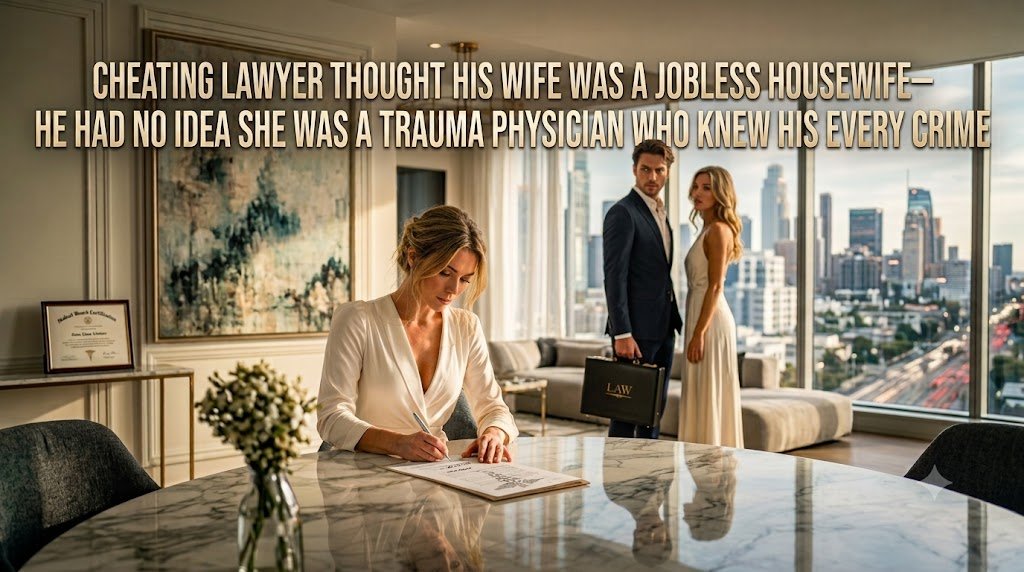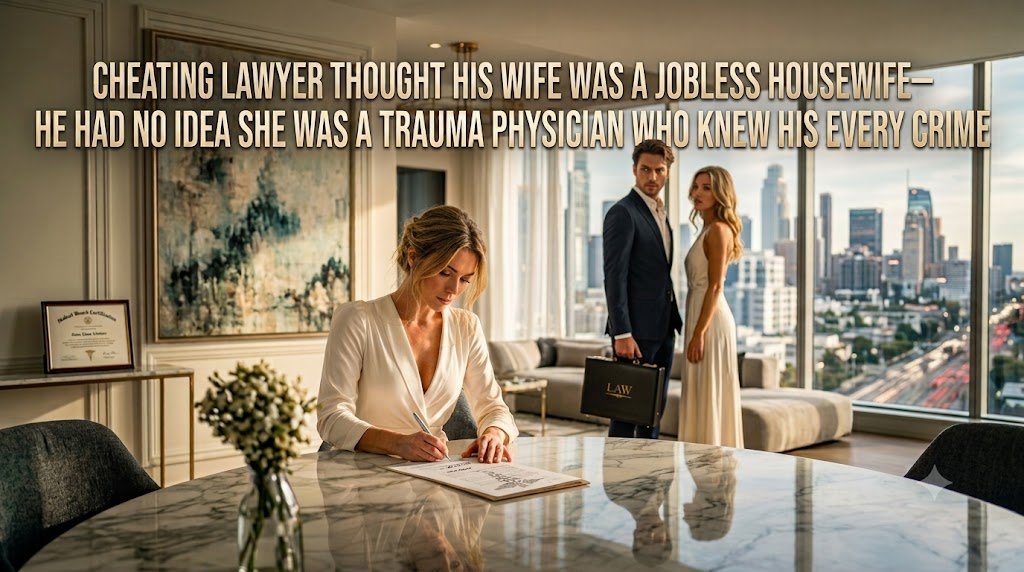
Nathan Whitmore did not raise his voice when he ended his marriage. He did not apologize, reach for his wife’s hand, or even look ashamed. He simply placed a thick ivory envelope on the marble kitchen island, pushed it toward Emily, and said twelve words with the calm efficiency of a man canceling a dinner reservation.
“Vivian came back. I want a divorce so we can be together.”
For eleven seconds, Emily Whitmore stared at the envelope.
Nathan had expected tears. He had prepared himself for accusations, pleading, perhaps even a dramatic collapse. He had probably rehearsed his patient expression in the back seat of his town car while crossing Manhattan.
What he had not prepared for was the feeling that moved through Emily’s chest.
Relief.
Not heartbreak.
Not panic.
Relief so sudden and complete that she almost laughed aloud.
“Say something,” Nathan demanded.
His gray suit was perfectly tailored. His silver cuff links caught the light. He had dressed for the occasion as carefully as he dressed for court whenever he wanted a jury to believe he was the most reasonable man in the room.
Emily looked at the papers, then at the husband she had spent ten years shrinking herself to please.
“How long?” she asked.
Nathan’s brow tightened. “How long what?”
“How long have you been planning this conversation?”
“That isn’t important.”
“You came home with a completed settlement agreement and a fountain pen.” Her voice remained steady. “Divorce attorneys don’t prepare these documents during an afternoon coffee break. How long, Nathan?”
He picked up his water glass.
“Four months.”
The number struck her with clinical precision.
Four months earlier, on Emily’s thirty-sixth birthday, Nathan had claimed an emergency client dinner would keep him out late. She had eaten a slice of chocolate cake alone at the same marble island where the divorce papers now rested.
Apparently, while she had blown out a single candle, her husband had been reconnecting with Vivian Cole.
Vivian had been Nathan’s college girlfriend, the woman his mother had always described as “the one who understood our world.” She had left for graduate school in London, and Nathan, unwilling to wait, had married Emily two years later.
Now Vivian was back.
“We saw each other at the Harbor Foundation gala,” Nathan explained. “Nothing was planned. We talked. We realized the feelings were still there.”
“For four months.”
His mouth flattened. “I didn’t want to hurt you before I knew what I wanted.”
Emily almost admired the sentence. Nathan had always possessed a remarkable ability to make selfishness sound like restraint.
“I want you to understand that this isn’t because you failed,” he continued. “You’ve been a good wife. My mother thinks highly of you.”
“Your mother has never said my name without correcting something about me first.”
Nathan exhaled impatiently. “This is exactly why I didn’t want an argument.”
“I’m not arguing.”
“The truth is, Vivian and I probably should have ended up together. Everyone knew it. The timing was wrong before, but we’re different people now.”
Emily studied him.
“No,” she said. “You’re exactly the same person.”
His eyes narrowed.
“You married me because I was safe,” she continued. “I admired you. I adjusted myself around you. I made your life easier. Now Vivian is available again, so you’re choosing the woman you always wanted because she has finally become convenient too.”
A flush rose along Nathan’s neck.
For one moment, Emily saw the version of him that existed only behind closed doors—the man who could turn cold, cutting, and cruel when he felt his control slipping.
But Nathan restrained himself.
Control mattered more to him than honesty.
“I came here to handle this with dignity,” he said. “I’m prepared to be generous. The agreement includes a monthly allowance that will let you rent somewhere comfortable. Perhaps outside the city, where you can start over privately.”
Privately.
Somewhere no one important would have to witness the discarded wife of Nathan Whitmore rebuilding her life.
“You mean somewhere your friends won’t see me.”
“That isn’t what I said.”
“You didn’t need to.”
Emily reached for the fountain pen.
For the first time that evening, uncertainty crossed Nathan’s face.
“You should read the agreement carefully.”
“I will have an attorney review the financial terms.”
“Then why are you holding the pen?”
Emily opened the document to the acknowledgment page. She was not signing away her legal rights. She was signing the statement confirming that Nathan had requested the divorce and that she had received the preliminary proposal.
Nathan had assumed she would not understand the distinction.
Once, she might not have.
But before she had become Mrs. Nathan Whitmore, Emily Carter had been a trauma physician. She had made life-and-death decisions while alarms screamed and blood pressure monitors collapsed. She understood documents, risks, timing, and consequences.
She had simply spent ten years pretending she did not.
“You’re really not going to fight for us?” Nathan asked.
There was something almost offended in his voice.
Emily placed the pen against the paper.
“You already made your choice.”
She signed her name in one clean stroke.
“Now I’m making mine.”
Nathan stared at the signature.
“That’s it?” he asked. “Ten years, and that’s all you have to say?”
“You wrote the ending, Nathan. I only signed it.”
She put down the pen.
He looked at her as though she had started speaking a language he did not understand.
Emily understood why.
For ten years, every disagreement had ended the same way. Nathan criticized. Emily apologized. Nathan withdrew. Emily tried harder.
She had apologized for working late, although she had left medicine years earlier.
She had apologized for laughing too loudly at dinner.
She had apologized when his mother disliked the flowers she selected for a charity luncheon.
She had apologized for taking up emotional space inside a marriage that existed primarily to support Nathan’s career.
Now there was nothing left in her willing to apologize.
As she looked at him, a memory opened inside her.
She was twenty-six again, standing in the emergency department at Mercer General Hospital with her dark hair tied back, giving orders during a six-car highway collision.
“Pressure is dropping.”
“Start another line.”
“Call surgery.”
“Emily, we’re losing him.”
“No, we’re not.”
She had saved that patient.
She had been good—not promising, not talented for her age, but exceptional. Attending physicians requested her on difficult cases. Nurses trusted her instincts. She had planned to join an emergency response organization serving rural communities.
Then she met Nathan at a hospital fundraiser.
He had listened when she spoke about medicine. He called her brilliant. He told everyone she was fearless.
Six months later, he proposed.
Eighteen months after the wedding, he began dismantling the qualities he had claimed to admire.
It started gently.
Her hours were too unpredictable for a partner’s wife.
Trauma medicine was too dangerous.
The emergency department left her exhausted.
His mother worried that a respected family’s daughter-in-law should not arrive at formal dinners smelling like antiseptic.
“You can always volunteer somewhere less intense,” Nathan had said. “You don’t have to prove anything anymore.”
Emily had mistaken possession for protection.
First she reduced her hours.
Then she took a leave.
Then she failed to renew her hospital appointment.
She told herself it was temporary. She would return after Nathan made partner, after the family obligations slowed, after the next fundraiser, after the next holiday season.
Temporary stretched into ten years.
During those years, Emily learned seating charts instead of emergency protocols. She memorized the allergies of judges’ wives and the birthdays of managing partners. She learned to redirect Nathan’s sharper comments before they offended valuable people.
She disappeared so gradually that she could not identify the exact day she stopped recognizing herself.
“You’re smiling,” Nathan said.
The memory released her.
Emily touched the corner of her mouth and realized he was right.
“You understand that Vivian and I plan to marry next year?”
Nathan’s tone carried the faint, rehearsed cadence of a man delivering a line he had practiced in front of a mirror. He stood by the kitchen island, his hands resting on the marble, waiting for the blow to land. He expected her to flinch. He expected her to recoil at the suddenness of his timeline.
Instead, Emily simply nodded.
“I hope it snows,” she said mildly.
Nathan blinked. “What?”
“Your wedding. I hope it snows on your wedding day. It’s supposed to be good luck.” She reached for her coffee cup, empty now, and turned it over in her hands. “Is there anything else, Nathan? Or is this the complete inventory of our dissolution?”
The calmness in her voice seemed to disorient him more than shouting would have. Nathan pulled back his hands, sliding them into his trouser pockets. A faint ridge of tension formed between his brows.
“I expected this to be harder,” he admitted, though it sounded less like a confession and more like a complaint.
“Harder for you, or harder for me?”
“For both of us. Ten years isn’t nothing, Emily.”
“No,” she agreed. “Ten years is a very long time to spend becoming someone you aren’t.”
Before Nathan could parse the sentence, the front door chimed. A soft, musical chime that echoed through the high-ceilinged foyer of the Lake Forest home. Nathan stiffened, glancing at his watch.
“That’ll be Arthur,” Nathan said, his voice dropping into professional efficiency. “I asked my attorney to drop off a copy of the secondary asset division. He’s handling the formal filing tomorrow morning.”
“How efficient of you.”
Nathan walked out of the kitchen, his leather-soled shoes clicking briskly against the hardwood floors. Emily remained at the island, the marble cool beneath her fingertips. For the first time in a decade, the silence of the house did not feel heavy. It felt empty, yes—but empty in the way an operating room is empty after a patient has been stabilized and wheeled away to recovery. The crisis had passed. The bleeding had stopped.
Voices drifted in from the hallway. Nathan’s deep, measured baritone, followed by a second voice—sharper, slightly hurried.
“I’m telling you, Nathan, the filing needs to be amended before the morning docket opens. If the partnership shares in the Mercer account aren’t decoupled by nine—”
Arthur stopped talking the moment he walked into the kitchen and saw Emily sitting quietly at the island.
Arthur Sterling was a man constructed entirely of gray flannel and cautious smiles. He had represented Nathan’s firm in half a dozen high-profile acquisitions and knew the Whitmore family dynamics better than he knew his own cholesterol levels. His eyes darted from Nathan to Emily, taking in the signed acknowledgment page resting beside the fountain pen.
“Ah,” Arthur said, adjusting his briefcase strap. “Mrs. Whitmore. I wasn’t aware you would be joining us.”
“She’s well aware, Arthur,” Nathan said smoothly, stepping up behind his attorney and placing a proprietary hand on the older man’s shoulder—a gesture meant to remind everyone in the room who held the leverage. “We’ve settled the preliminary terms. She’s signed the acknowledgment.”
Arthur looked down at the paper. His gaze lingered on Emily’s signature. For a fleeting second, something flicker-thin crossed the attorney’s eyes—not quite pity, but the quiet recognition of a surgeon looking at an amputation that had been performed without adequate anesthesia.
“Very well,” Arthur murmured, pulling a duplicate packet from his leather portfolio. “Then we simply need your signature on the asset schedule, Mrs. Whitmore, and the initial residency waiver.”
Emily didn’t reach for the papers. She looked up at Arthur, her gaze steady and devoid of the nervous flutter she used to display whenever her husband’s colleagues came to dinner.
“Tell me, Arthur,” she said, her voice carrying an easy, conversational warmth that made both men pause. “Does Nathan’s preliminary settlement offer include the medical malpractice settlement from Mercer General in 2018?”
Arthur’s hand froze mid-motion above the briefcase.
Nathan’s head snapped toward his wife. “What did you just say?”
“The settlement,” Emily repeated, tilting her head. “The one resulting from the wrongful termination and retaliatory blacklisting of Dr. Emily Carter following her refusal to falsify surgical risk data for the hospital board.”
The kitchen seemed to shrink. The hum of the Sub-Zero refrigerator suddenly sounded deafening.
Nathan’s polished composure fractured entirely. The color drained from his face, leaving him looking sickly under the recessed lighting. “How do you… what are you talking about?”
“You told me it was a confidentiality agreement, Nathan,” Emily said, her tone as light as if she were discussing the weather. “You told me the hospital paid a modest sum to ensure the ‘unfortunate misunderstanding’ regarding my medical license never went public. You told me signing it was the only way to protect your partnership track at the firm.”
Arthur cleared his throat, his face turning the color of wet cement. “Nathan… you didn’t tell her?”
“Tell me what, Arthur?” Emily asked, standing up from the barstool. For the first time all evening, she towered over her husband—not physically, but with the terrifying, unshakeable gravity of a physician who had just located the source of an internal hemorrhage.
“Tell me that the settlement wasn’t for fifty thousand dollars,” Emily whispered, stepping closer to the two men. “Tell me it wasn’t a quiet little hush-money payout to keep a whistleblowing doctor from destroying the hospital’s pediatric wing accreditation.”
Nathan backed up a half-step until his spine hit the edge of the pantry door. “Emily, stop it. You’re being irrational. That was years ago. It’s ancient history.”
“It was four point two million dollars,” Emily said.
The numbers dropped into the room like lead weights.
Arthur flinched. Nathan stared at his wife as though she had grown a second head.
“Four point two million dollars,” Emily continued, her voice never wavering. “Paid into a private corporate holding account registered under an LLC in the Cayman Islands. An LLC whose sole beneficiary, according to the state corporation commission filings I pulled three weeks ago when I started noticing the discrepancies in your tax returns, is Nathan Whitmore.”
Arthur looked at Nathan with undisguised horror. “You didn’t disclose the primary litigation award during the prenuptial asset disclosure?”
“She didn’t know!” Nathan shouted, the veneer of civil dignity finally shattering completely as he lunged forward. “She was out of medicine! She was a housewife! She didn’t have any legal standing to—!”
“I was a licensed physician, Nathan,” Emily interrupted, her voice cutting through his panic like a scalpel. “And under federal law, a concealment of marital assets derived from a pre-existing professional settlement fraudulently diverted during an active marriage constitutes grand larceny and perjury.”
She reached down, picked up the fountain pen Nathan had so carefully provided, and tapped the nib against the marble island.
“So here is my counter-proposal, Arthur,” Emily said, turning her attention fully to the trembling attorney. “You can take your preliminary agreement back to your office. You can shred it. And you can draft a new settlement—one that transfers ninety percent of all liquid assets, the Lake Forest estate, and full ownership of the Cayman holding account into my sole possession.”
Nathan let out a sound like a wounded animal. “You’re insane! You’ll ruin me! I’ll fight you in court until you’re bankrupt!”
“You won’t fight me anywhere, Nathan,” Emily said softly, stepping right up to him. She smelled of peppermint tea and absolute, unyielding freedom. “Because if you file a single motion to contest these terms, I won’t just take your money. I will walk across the street to the federal prosecutor’s office, hand them the unredacted files I left in my car, and watch them lock you away for securities fraud.”
She placed the fountain pen neatly beside Arthur’s briefcase.
“You wanted a dignified exit, Nathan,” Emily smiled, her eyes cold and bright. “I suggest you take the one I’m offering before I change my mind.”
The kitchen was so quiet that the ticking of the wall clock sounded like a drumbeat.
Arthur Sterling stood frozen, his briefcase still unlatched, staring down at the polished marble island as if it had suddenly transformed into a live grenade. The gray-haired attorney had spent thirty years navigating messy corporate divorces and high-stakes white-collar scandals, but he had never seen a tactical ambush executed with such clinical, chilling precision.
He slowly turned his head to look at Nathan.
“Is it true?” Arthur asked, his voice flat, stripped of its usual professional varnish. “Is the Cayman entity tied directly to your personal tax ID?”
Nathan didn’t answer. He couldn’t. He was pressed hard against the pantry door, his chest heaving, his mouth slightly open as he stared at Emily as though he were seeing a stranger who had stolen his wife’s skin.
The man who had entered the house twenty minutes earlier with the smug, effortless confidence of a man holding all the cards was gone. In his place stood a cornered fraudster realizing too late that he had vastly underestimated his opponent.
“Nathan,” Arthur repeated, sharper this time. “Did you conceal a four-million-dollar litigation payout?”
“She… she was out of practice,” Nathan stammered, his voice cracking into a high, defensive whine. “She didn’t need the money! She didn’t even know it existed! I used it to secure my partnership track at the firm, I built our life with that capital—!”
“You built your career on the price of my silence,” Emily corrected calmly. She reached out, picked up the preliminary divorce agreement Nathan had brought home, and slowly, deliberately, tore it in half. Then in quarters. She dropped the pieces onto the floor near his Italian-leather shoes.
“You’ve got twenty-four hours to bring me the revised terms, Arthur,” Emily said, turning her attention to the lawyer. “Ninety percent liquid, the deed to this house, and the full portfolio transfer of the Cayman holding account. Not a penny less. If it’s on my kitchen island by tomorrow at noon, I won’t make a single phone call to the U.S. Attorney.”
Arthur swallowed hard, his throat bobbing visibly. He looked at Nathan, saw the pathetic, shivering ruin of his client, and made a cold, pragmatic calculation of his own. Self-preservation always won in the end.
“I’ll… I’ll have the papers drawn up by eight o’clock tomorrow morning, Mrs. Whitmore,” Arthur said, hastily snapping his briefcase shut. He didn’t offer Nathan a parting glance. He turned and practically sprinted down the hallway, the front door clicking shut a second later.
The heavy silence returned to the kitchen.
Nathan slid slowly down the pantry door until he was sitting on the hardwood floor, his knees pulled up, his manicured hands trembling in his lap. All the expensive tailoring, the silver cuff links, the carefully rehearsed courtroom charm—none of it could save him now.
“How long did you know?” Nathan whispered, his voice cracking. “About the Cayman account? How did you find out?”
Emily poured herself a fresh cup of peppermint tea, the steam curling lazily into the air. She took a slow sip before answering.
“I didn’t know about the Cayman account until three weeks ago,” she said evenly. “When your mother complained that my grocery budget was too high, I decided to review our household tax filings myself. It turns out, when you’re a trauma physician who spends years managing complex hospital budgets, reading a fraudulent corporate ledger is remarkably easy.”
Nathan looked up, his eyes bloodshot and desperate. “And the divorce? The Vivian thing? If you knew… why didn’t you say anything? Why didn’t you fight me then?”
Emily looked down at him, her expression entirely devoid of anger, pity, or malice. It was the look of a doctor examining a case study that no longer required treatment because the patient was already terminal.
“Because I needed you to hand me the knife, Nathan,” she said softly. “If I had left you a year ago, you would have played the victim. You would have told everyone at the firm that your unstable, unsupportable wife abandoned you. You would have kept every dollar of what was rightfully mine.”
She set her teacup down on the marble island.
“Instead, you brought home the papers. You brought home the pen. You walked right into my trap, thinking you were cutting me loose.”
Nathan’s jaw worked silently. He looked like a man trying to swallow glass. “You’re ruthless.”
“No, Nathan,” Emily said, walking past him toward the hallway. “I’m just practicing medicine. And you had a massive tumor that needed to be excised.”
She walked upstairs to the master bedroom, leaving him sitting alone on the kitchen floor in the dark.
For the first time in ten years, Emily didn’t check the guest room pillows. She didn’t straighten the throw pillows on the sofa, and she didn’t worry about what Nathan’s colleagues would think when they found out their golden-boy partner had been brought down by the quiet wife he never truly saw.
She walked into the walk-in closet, pulled down two large suitcases, and unzipped them.
She didn’t pack her old clothes—the conservative pastels, the understated dresses meant to blend into charity galas and cocktail parties. She left all of that hanging in the dark.
Instead, she opened her laptop, logged into a secure medical credentialing portal she hadn’t touched in a decade, and typed her name into the renewal search bar: Dr. Emily Carter.
Her license status flashed on the screen: Active (Pending Continuing Education).
Beneath it, a notification blinked: Emergency Response Roster — Openings Available, Rural Health Initiative, Alaska.
Emily stared at the screen, a slow, radiant smile spreading across her face.
She clicked Apply.
By noon the next day, Arthur Sterling returned, sliding a thick, perfectly executed portfolio onto the kitchen island. He didn’t speak. He didn’t look her in the eye. He simply placed the signed deeds, the asset transfers, and the full banking credentials of the Cayman holding account on the marble, nodded stiffly, and left the house forever.
An hour later, Nathan was gone. He had packed a single overnight bag, driven away without a word, and checked into an extended-stay hotel downtown, desperate to hide from the impending corporate and social destruction.
The house belonged to Emily now. Every brick, every room, every square foot of the eleven-million-dollar Lake Forest mansion.
She didn’t stay to enjoy it.
She transferred the deed to a women’s shelter trust, packed her two suitcases into the trunk of her car, and locked the front door behind her for the final time.
Two weeks later, thousands of miles away from the cocktail parties of Manhattan and the marble islands of Lake Forest, a small twin-engine bush plane touched down on a gravel airstrip in the bitter cold of an Alaskan morning.
A woman stepped out onto the wing, pulling her heavy parka tight against the biting wind. Her dark hair was tied back, her eyes sharp, clear, and fully awake.
As the snow crunched beneath her boots, Emily Carter took a deep, freezing breath of the mountain air.
For the first time in ten years, she was exactly where she belonged.