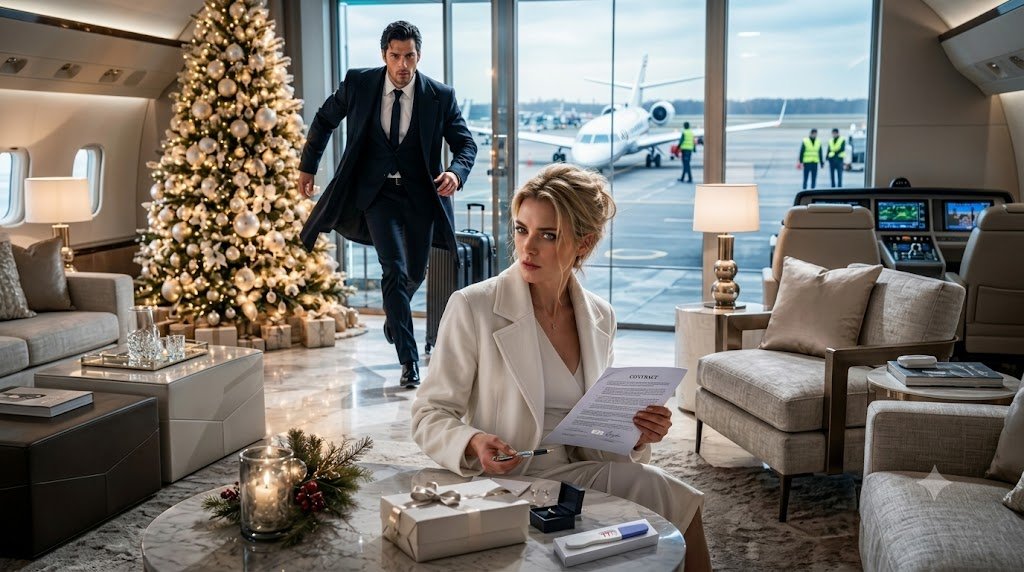
At 10:47 on Christmas Eve, Claire DeLuca placed two objects on the white marble island in her husband’s kitchen. The first was a manila envelope containing notarized divorce papers. The second was a positive pregnancy test. She left no letter. No accusation. No final attempt to explain what two years of silence had done to her. She simply picked up her suitcase, walked through the Lake Forest mansion that had cost eleven million dollars, and closed the front door behind her.
The man she was leaving was not merely her husband. Roman DeLuca controlled the most feared criminal organization in Chicago. And for the next twenty-eight minutes, he had no idea that his wife—and his unborn child—were disappearing from his life.
Claire had signed the divorce papers eleven days earlier. She had driven herself to a small legal office in downtown Chicago, sat beneath fluorescent lights, and signed her name four times while a tired notary watched without expression. She wore sunglasses through the entire appointment. Not because she had been crying. She had moved beyond crying. She wore them because she had barely slept in three days, and her eyes looked like something inside her had finally stopped asking to be saved.
Afterward, she drove home, made peppermint tea, and hid the envelope beneath a stack of auction catalogs in her study. For eleven days, she waited to see whether courage would arrive. It did not.
Exhaustion arrived instead. It was the kind of exhaustion sleep could not touch—the bone-deep weariness of loving a man who sat six feet away at dinner yet seemed to live in another country. Roman had never hit her. He had never shouted at her. He had never threatened her. That was what made the truth so difficult to explain. He was cold in the way a Chicago winter was cold. Not personal. Not dramatic. Simply indifferent to whether anything fragile survived it.
He disappeared for nights at a time. He took calls in locked rooms. He answered questions with single sentences until Claire learned that asking them only made her feel foolish. She planned weekends he canceled. She cooked dinners that went cold.
Once, fourteen months earlier, she had suggested marriage counseling. Roman had looked at her as though she had spoken in a language he did not understand.
“We don’t need a stranger discussing our private life,” he said.
“I’m not sure we still have a private life.”
His eyes had dropped to his phone. “We’re both under pressure.”
“Roman, you haven’t touched me in three months.”
His expression changed for half a second. Pain, perhaps. Or guilt. Then the wall returned. “I have work.” He left the room.
Claire stayed at the dining table until the candles burned low enough to drown in their own wax. She had not always known him that way. Three years earlier, they met at a private art preview in Manhattan. Claire was a curator specializing in nineteenth-century American paintings. Roman stood before a storm-dark landscape by an obscure New England artist, wearing a black suit and the expression of a man who had never waited for permission in his life.
“You’re the only person here who understands that painting,” he told her.
“You’re not looking at the painting.”
One corner of his mouth moved. He was not handsome in a soft or approachable way. He was sharp-featured, dark-haired, controlled. The kind of man whose stillness made everyone else seem nervous.
“I was wondering how long it would take you to notice,” he said.
Eight months later, she married him in a small ceremony overlooking Lake Michigan. She knew the DeLuca family had money. She knew people became quiet when Roman entered restaurants. She knew his companies included shipping, construction, private security, and half a dozen nightclubs. She did not know how much of the city he truly controlled. By the time she understood, she was already in love. By the time she became frightened, Roman had started shutting her out.
The pregnancy was not planned. Claire discovered it six weeks before Christmas, sitting on the bathroom floor with the test in both hands. Her first feeling was not happiness. It was not fear. It was the sudden, devastating certainty that Roman would not know how to become a father. Her second thought was worse. Neither would she, if she stayed in a house where love had become something she remembered instead of something she lived.
Claire told no one except her mother in Boston. She did not mention the pregnancy. She only said she might be coming home. Her mother was quiet for a moment.
“Do you need me to ask questions?”
“No.”
“Then I won’t. Your room is still here.”
At thirty-two years old, with a respected career and enough money of her own to survive, Claire should have hated the relief those words gave her. Instead, she nearly collapsed beneath it. She accepted a position at the fictional Calder House Museum in Boston, an offer she had declined twice because Roman always said the timing was inconvenient. She shipped several boxes east. Closed her private accounts in Illinois. Booked a one-way flight from O’Hare.
Then, on Christmas Eve, she left the truth on the marble island because she refused to disappear the way Roman had disappeared from their marriage.
A hired car carried her through neighborhoods glowing with wreaths and colored lights. Families moved behind warm windows. Children pressed their faces against glass. Snow began to fall in small, uncertain flakes. Claire watched Chicago pass without turning her head.
At O’Hare, holiday travelers crowded the terminals. She checked one suitcase, cleared security, and walked to Gate C18 with her carry-on rolling behind her. Her flight to Boston departed at 1:30 a.m. Boarding would begin in ninety minutes. She bought an overpriced cup of tea she did not drink and sat facing the windows. The runway lights blurred through the falling snow.
At 11:15 p.m., Roman DeLuca came home. The meeting that had kept him away had lasted four hours longer than expected. It involved three men, two federal agents, a hidden recording device, and the final stage of an agreement that could either free Roman from the empire he had built or place him in prison for the rest of his life. He could not have explained any of that to Claire. For nearly two years, he had told himself his silence protected her.
He entered the dark mansion, removed his coat, and set his keys on the entry table. “Claire?”
No answer. That did not immediately concern him. She often worked late in her study, surrounded by catalogs and notes. Roman had always admired her ability to build an ordered world without needing anyone’s help. Only recently had he begun to understand that he had used her independence as an excuse to neglect her.
He walked into the kitchen and turned on the lights. The envelope waited on the island. The pregnancy test rested on top of it.
Roman stopped in the doorway. He had faced men holding guns. He had watched a car explode ten seconds after he stepped out of it. He had once sat through dinner with a rival who had already paid someone to kill him before dessert. None of those moments frightened him the way that small white object did.
He crossed the room and picked it up. Two lines. His mind searched for another explanation and found none. Then he opened the envelope. He read the first page. He read it again. The petition was dated eleven days earlier.
For eleven days, Claire had walked past him carrying the end of their marriage inside her. She had eaten breakfast across from him. She had said good night. She had packed her life into boxes while Roman, a man who survived by noticing everything, noticed nothing.
He called her. The phone rang six times and went to voicemail. He called again. Voicemail.
Roman looked at the pregnancy test. Then he ran. He did not summon a driver. He did not call his security team. He grabbed his keys, shoved the divorce papers into his coat, and drove toward O’Hare with the pregnancy test clenched in his hand. Snow thickened over the expressway. Roman drove with the precise speed of a man refusing to name his panic. He did not think in full sentences. Full sentences would have forced him to confront facts.
Claire is leaving.
Claire is pregnant.
Claire believes our child will be safer without me.
He reached the terminal shortly after midnight, abandoned his car in a restricted lane, and walked inside wearing the same black suit he had worn to negotiate the destruction of his own criminal empire. He called a private airport contact.
“Claire DeLuca.”
“Boston flight. Gate C18.”
“Has boarding started?”
“They’re in the final zone,” the voice crackled through Roman’s phone. “Pre-boarding wrapped ten minutes ago. If you’re not at the gate right now, you’re not getting past the agent.”
Roman didn’t answer. He broke into a dead sprint through Terminal 3, ignoring the startled holiday travelers who leaped out of his path. His chest burned, not from the exertion, but from the terrifying geometry of the space between them. Every step forward was a desperate calculation against the clock.
He rounded the corner toward concourse C, his black coat flying behind him like the wing of a dark bird.
At Gate C18, the red digital sign flashed FINAL BOARDING.
Claire sat in the second row of the waiting area, her hands folded over her wool coat. She hadn’t checked her phone. She didn’t want to see a missed call, a dry text, or worse—nothing at all. She stared straight ahead at the jet bridge tunnel, watching passengers shuffle inward like ghosts swallowed by a machine.
“Flight 412 to Boston, final call for passenger DeLuca,” the gate attendant announced into her microphone.
Claire stood up, picked up her carry-on bag, and stepped into the queue. Her heart hammered against her ribs, a violent, bird-like thudding that felt entirely out of place in the sterile, carpeted hallway.
This is the right thing, she told herself. You are saving yourself. You are saving your child.
She handed her boarding pass to the agent. The scanner beeped a sharp, clean green.
As she stepped past the podium and onto the jet bridge, a voice shouted from the main terminal.
“Claire!”
The sound cut through the ambient roar of rolling luggage, crying children, and gate announcements with the terrifying precision of a gunshot.
Claire froze. Her fingers tightened around the handle of her carry-on until her knuckles turned white.
“Sir, you can’t go down there without a ticket!” a TSA employee yelled.
“Watch me,” Roman snarled.
He didn’t slow down. He shoved past the startled gate agent, bypassed the ticket podium, and tore down the narrow, enclosed metal corridor of the jet bridge.
Claire turned around.
Roman stood at the threshold of the jet bridge, breathing heavily, his dark hair disheveled from the run, his black suit dusted with melting snowflakes. In his right hand, illuminated by the harsh overhead lights, he held the positive pregnancy test.
The other passengers in the tunnel stepped back, murmuring in shock at the sudden intrusion.
Claire’s breath caught. The cold certainty she had carried out of Lake Forest began to fracture, splintering into a million sharp, painful pieces.
“Roman,” she whispered, though the word was swallowed by the hum of the aircraft engine parked outside.
He crossed the length of the jet bridge in three massive strides until he stopped inches from her. Up close, his eyes were bloodshot, rimmed with a raw, primal panic she had never seen in the five years they had known each other.
“You were going to get on the plane,” Roman said. His voice was barely a rasp, stripped of all its calculated authority.
“Yes,” Claire managed to say, lifting her chin to keep her voice from shaking.
He looked down at the plastic stick in his hand, then back up at her face. The silence between them stretched taut, heavier than any conversation they had ever shared in their eleven-million-dollar home.
“Is it true?” he asked.
“Look at the test, Roman. You’re a smart man. You don’t need to ask questions when the data is right in front of you.”
He flinched, as though she had struck him across the face. It was the first time she had ever seen him look defenseless.
“You left divorce papers,” he said, his voice dropping to a low, jagged tremor. “And you didn’t say a word. You packed your life away while I was sitting across a table negotiating the end of my entire life, and you didn’t even give me the chance to speak.”
“I gave you two years to speak, Roman!”
The words tore out of her throat, sharp and heavy with all the Christmases, the cold dinners, and the empty rooms she had endured. Several passengers turned around to stare, but neither Claire nor Roman cared.
“I gave you every opportunity to look at me, to talk to me, to remember that I was alive in that house!” Claire’s eyes burned with hot, furious tears. “You didn’t want a wife. You wanted an ornament that didn’t complain when you locked it in a glass box. And when I found out I was carrying a child, I realized I refused to let our baby grow up in a tomb.”
Roman stared at her, absorbing every syllable like physical blows. He didn’t interrupt. He didn’t retreat behind his walls.
Slowly, deliberately, he dropped the pregnancy test into his coat pocket. Then he reached out, his fingers trembling slightly as he touched the sleeve of her coat.
“Come home, Claire,” he whispered.
“No.”
“I’ll burn the empire to the ground tonight. I’ll walk away from every warehouse, every account, every dangerous thing I ever built. I’ll give you a quiet house. I’ll learn how to be a father. I swear to God, Claire, I will learn how to look at you.”
“It’s too late,” she said, though her voice shook, betraying the sudden, agonizing pull in her chest. “You only want me now because you’re losing control. You don’t know how to handle a variable you didn’t create.”
“That’s not true,” he said fiercely, his hand moving from her sleeve to cup the side of her face. His palm was warm, rough against her skin. “I’m terrified because for the first time in my life, I realize I’ve already lost the only thing that ever mattered.”
Behind them, a flight attendant stepped out of the aircraft door, peering down the jet bridge.
“Ma’am? Are you boarding or not? We have to close the cabin door.”
Claire looked from the attendant back to Roman.
The man who controlled Chicago. The man who had faced assassins and federal agents without blinking. Right now, he looked like a man standing over an open grave, waiting for a verdict.
Claire looked down at her carry-on bag. Then she looked into Roman’s dark, desperate eyes.
The next few seconds would decide whether she walked onto that plane toward a safe, quiet exile in Boston, or stepped backward into the beautiful, dangerous fire of a man who was finally learning how to burn for her.
“Ma’am, we really need a decision,” the flight attendant called out again, her voice echoing down the narrow metal tube of the jet bridge. “Door’s closing.”
Claire did not move.
The hum of the aircraft engines vibrated through the floorboards, a low, steady thrum urging her forward toward the safety of Boston, toward her mother’s quiet guest room, toward a life neatly divided into predictable, unbroken lines.
She looked at Roman’s hand still cupping her cheek. His skin was warm, his thumb resting just beneath her eye where a single tear had finally escaped.
“You said you’d burn the empire to the ground,” Claire said softly, her voice barely carrying over the ambient terminal noise.
“I already did,” Roman replied instantly, without a fraction of hesitation. “The federal agents, the meetings, the signatures tonight—it wasn’t about expanding. It was about walking away. I finished cutting the cords twelve hours ago, Claire. I just didn’t know you were already packing your bags.”
She searched his face, looking for the calculated stillness, the chilling detachment she had grown to despise over the last two years.
It was gone. Beneath the sharp features and the dark suit, there was only raw, unvarnished terror. He was terrified she would step past him and vanish into the cabin.
“I don’t want an empire, Roman,” she whispered. “And I won’t live in a cage, even if you leave the door wide open.”
“Then we tear down the house,” he said fiercely. “We sell the mansion in Lake Forest. We move somewhere else—anywhere you want. Vermont, Maine, a small town where nobody knows my name and nobody carries a gun. I’ll plant a garden. I’ll learn how to cook dinners that don’t go cold while I take phone calls. Just… don’t get on that plane.”
The flight attendant sighed, stepping back inside the aircraft cabin. “Excuse me, but I have to secure the door.”
A heavy, metallic thud echoed as the cabin door slid shut.
Through the small round window of the airplane door, Claire watched the interior lights turn off. The jet bridge began to retract with a low mechanical whine, separating the metal tunnel from the side of the plane by a widening span of empty, illuminated air.
The choice was no longer theoretical. The plane was leaving.
Claire lowered her gaze from the window and looked back at Roman.
He didn’t pull her. He didn’t issue an ultimatum or threaten to use his influence to stop her. He simply stood there, an apex predator brought completely to his knees by a positive line on a plastic stick and a woman who refused to be invisible anymore.
“Keep your hands in your pockets, Roman,” she said quietly.
His brow furrowed, confusion flashing across his face. “What?”
“If we’re going to tear down the house,” Claire stepped forward, her hand sliding up the lapel of his black suit to grip his tie, pulling him down an inch so their eyes were level, “you’re going to carry my luggage. And you’re going to help me check into a hotel tonight because I am not sleeping in a house that smells like divorce papers and old mistakes.”
For one breathless second, Roman stared at her.
Then, the corners of his mouth twitched, breaking into the first genuine, unrestrained smile she had seen since the day they stood together in Manhattan.
“Consider it done,” he murmured.
With his free hand, Roman reached down and grabbed the handle of her rolling carry-on bag. He didn’t let go of her tie until he had turned her around, his arm wrapping securely around her waist to pull her against his side as they walked back up the jet bridge together, away from the gate and out into the snowy Chicago night.
They didn’t speak as they rode the terminal train back toward baggage claim, nor during the silent elevator ride up to the parking garage.
The snow had stopped falling by the time they reached Roman’s black sedan. The city was quiet, blanketed in a heavy, pristine layer of white that muffled the roar of the expressway.
Roman opened the passenger door, placing her bag gently in the back seat before holding the door open for her.
As Claire slid into the warm leather seat, she reached out and touched his hand.
“Roman?”
“Yeah?” he asked, leaning down to look at her.
“If you burn the empire down… make sure you keep enough to buy a really good coffee maker.”
Roman let out a low, gravelly laugh—the sound of a man who had just survived a shipwreck and finally reached the shore.
“I’ll buy the whole store,” he said, closing the door softly.
He walked around to the driver’s side, climbed in, and started the engine. As the car pulled out of the airport and headed south toward the sleeping city, Claire rested her hand gently against her stomach.
The road ahead was uncertain, messy, and entirely unwritten.
For the first time in years, it felt like home.