
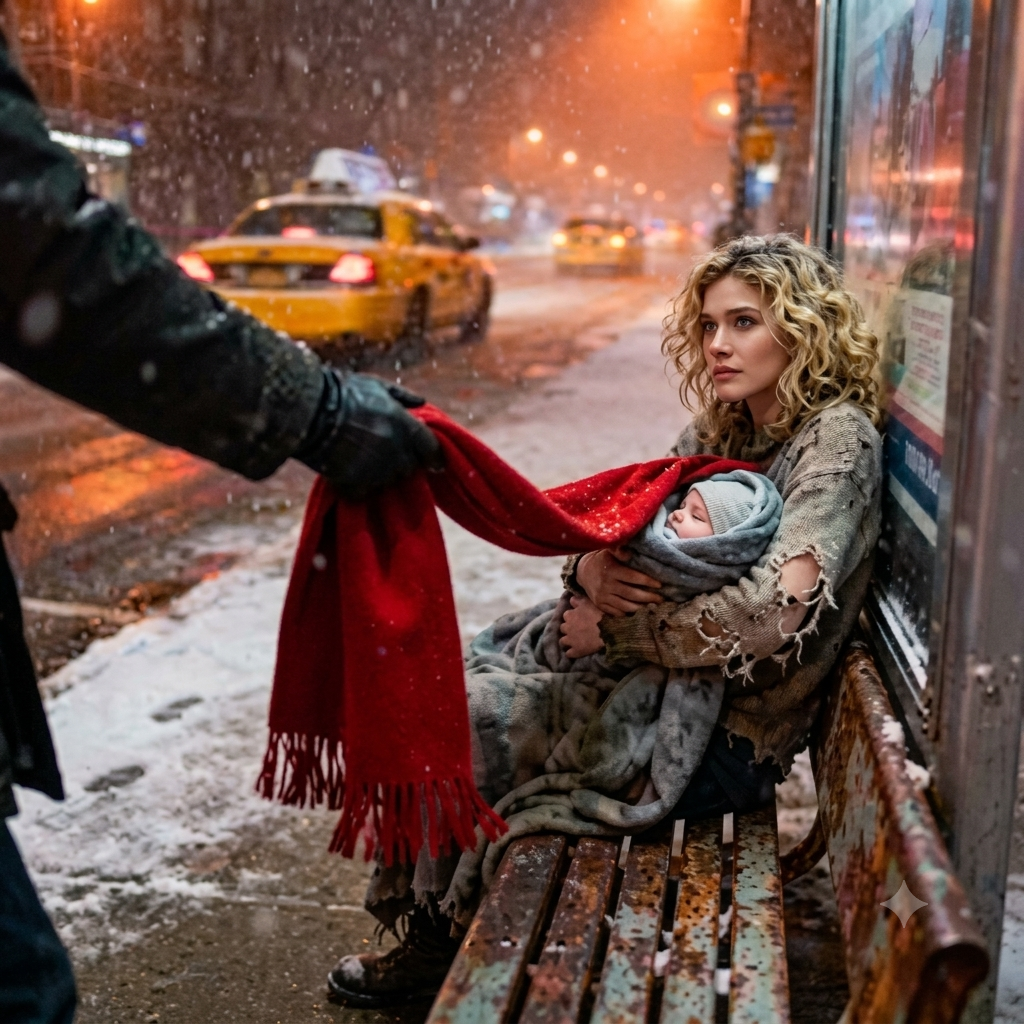
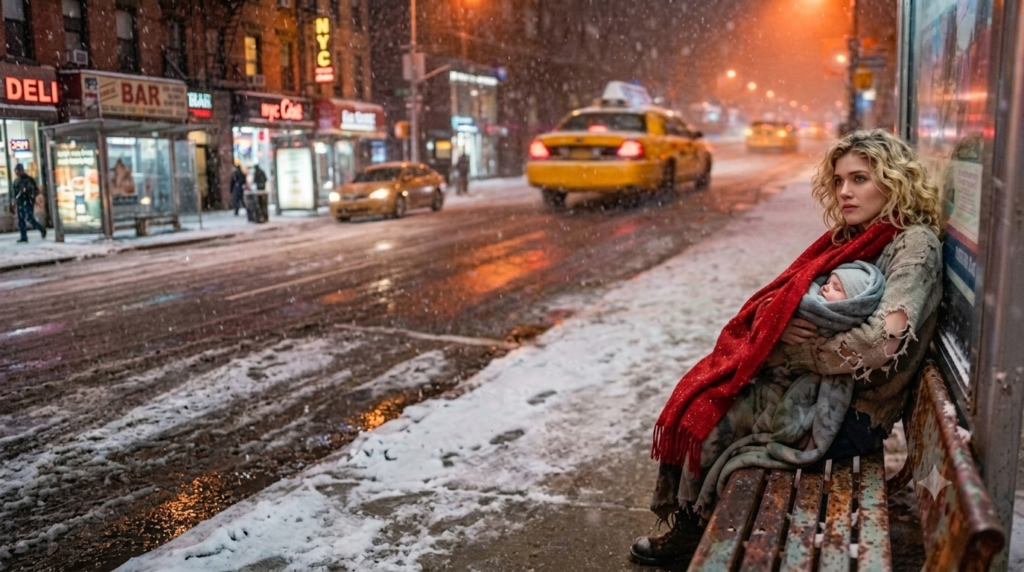
At 14°F, a young mother and her infant child were slowly freezing to death on a granite Rockefeller Center bus bench while festive Christmas crowds carelessly stepped around them as if they were mere debris on the sidewalk.
One wealthy tourist glanced down at the infant’s pale blue fingers and muttered to his companion, “Disgusting. Someone should call municipal services to move those derelicts away.”
My four-year-old daughter heard him clearly.
She instinctively tightened her warm woolen mitten around my index finger and whispered, “Daddy, look at his hands. That baby isn’t going to make it until morning.”
The onlookers surrounding us thought we were just another affluent family passing by on our way to a holiday dinner.
They had no idea that I legally owned the five-star luxury hotel towering three blocks away—or that my late wife’s final, heartbreaking promise made on her deathbed was about to drag me mercilessly to my knees in the dirty Manhattan slush.
Blaring Christmas music poured effortlessly from designer boutiques. Families posed happily beneath cascading strings of fairy lights. Heavy shopping bags brushed past the bench without slowing down for a second.
The young mother lay tightly curled around her infant as if her own shivering body were the absolute last barrier protecting him from the bitter arctic wind. Sticky snow clung stubbornly to her soaked, tangled blonde hair. Her oversized sweater was so threadbare and thin you could see the pale skin at her elbows. One of her worn sneakers had completely slipped from her heel, leaving a bare, frostbitten foot resting against the frozen stone.
The baby’s tiny, trembling fist poked out from a gray, moth-eaten blanket.
His fingertips were turning an alarming, translucent blue.
I wish I could claim that I stopped immediately to help them.
I didn’t.
My mind instantly calculated our upcoming dinner reservations at Le Bernardin. Kelly’s strict bedtime schedule. The urban risks of approaching a desperate stranger on the streets of New York City. The various homeless shelters and charitable organizations I already generously supported with corporate checks large enough to make me comfortably feel like a righteous, charitable man.
I consciously shifted my weight, preparing to keep walking.
Then Kelly forcefully pulled against my hand.
“Daddy. Please. We have to help them.”
Her voice sounded eerily, painfully exact to Sarah’s.
Suddenly, I was violently hurled back in time to the sterile hospital room where my wife had drawn her last breath, hearing electronic life-support machines breathe for her while she traced one ice-cold finger across the back of my hand.
“Promise me you’ll teach Kelly to be kind,” she had whispered, her voice failing. “True kindness matters more than wealth, status, or anything else in this world.”
I had solemnly promised her.
But making sacred promises is remarkably easy when the hospital room is warm, comfortable, and no personal sacrifice is required of you.
I looked down at Kelly’s bright red wool scarf. She had insisted on wearing it that morning because she claimed it made the falling snow look magical.
She lifted her small chin defiantly before I even had to ask.
I unwound the soft wool from her neck and dropped heavily to my knees in the freezing slush.
The mother didn’t flinch or move when I wrapped the red scarf around her infant’s exposed chest. Up close, the baby’s breathing sounded horrifyingly wrong—shallow, wet, and constantly interrupted by tiny, rattling coughs that shook his entire body.
“Miss?”
I gently touched the young woman’s frozen shoulder.
Her heavy winter coat was completely stiff with crystallized ice.
“Miss, wake up. You need to look at me.”
Her eyelids flew open with startling speed.
She jerked violently upright and crushed the baby frantically against her chest.
“No! Don’t take him away from me!”
Several passing tourists stopped now—not to offer assistance, but to stare at the commotion.
An older woman raised her smartphone to record.
The mother saw the glowing camera lens and instinctively turned her face away, utterly humiliated even while she was fighting desperately to stay conscious.
“I’m not taking him from you,” I said calmly, holding up both empty hands in surrender. “He needs immediate warmth and shelter.”
“So you can call the authorities?” she demanded, her voice cracking with exhaustion. “So social services can declare me an unfit mother and steal my son?”
The baby coughed again, a weak, pathetic sound.
Her defensive anger instantly collapsed into raw, unbearable terror.
Kelly stepped bravely beside me, her bare neck shivering in the howling wind.
“That’s my favorite scarf,” she told the terrified woman softly. “He can keep it as long as he needs.”
The mother stared down at my daughter in sheer bewilderment.
For the first time since we approached, her rigid grip on the infant loosened slightly.
“My name is Michael,” I said gently. “I own a boutique hotel three blocks from here. You and your baby are going to come stay in a warm suite tonight. No payment required. No intrusive questions. Just safety and warmth.”
Her eyes narrowed with deep suspicion.
Desperate men had undoubtedly made hollow promises to her before. I could read the tragic history of broken trust written all over her face.
“What do you want from me?” she whispered.
“Nothing.”
“Nobody in this city wants nothing.”
“I want my daughter to grow up knowing her mother was right.”
That honest answer reached somewhere deep inside her that slick corporate promises hadn’t.
The woman looked down at her fragile child wrapped securely in Kelly’s red scarf.
“His name is Noah,” she whispered, a tear freezing on her cheek.
“And yours?”
“Grace. Grace Miller.”
When she finally attempted to stand, her frostbitten knees buckled beneath her weight.
I caught her just before she struck the unforgiving pavement. She was frighteningly, dangerously light, yet even as she collapsed, she instinctively twisted her body so Noah would not hit the ground.
Even half-frozen and starving, she protected her son first.
We drove back to my hotel with the climate control blasting hot air. Kelly sat in the back seat beside Grace, watching Noah’s chest rise and fall beneath the bright red wool. Grace remained pressed tightly against the passenger door, her muscles tense, prepared to bolt the moment I proved untrustworthy.
At the grand entrance of the hotel, our veteran doorman reached eagerly for the door handle—then abruptly froze when he saw Grace’s torn, filthy clothes.
Inside the lobby, wealthy hotel guests in designer evening gowns turned away from the massive Christmas tree.
My general manager, Grant, hurried across the Italian marble floor, his face tight.
“Michael,” he said under his breath, stepping close. “We have major corporate donors, local press, and a high-profile wedding party here tonight. We cannot bring a street situation through the main entrance.”
Grace heard every single harsh word.
Her shoulders folded inward defensively.
She fumbled blindly for the door handle to escape back into the cold.
I physically stepped between her and Grant.
“She is not a situation. She is my personal guest, Grant. Open the east penthouse suite immediately and summon an on-call physician.”
Grant’s corporate smile tightened into a grimace.
“You’re acting emotionally, sir. Think about the hotel’s reputation and our elite clientele.”
“I am thinking about it.”
He lowered his voice further, his eyes darting to Grace.
“If that street child is carrying an illness, this becomes a major public liability. Security can escort them to a public facility.”
Grace flinched violently at the word security.
Then, Grant made his fatal mistake.
He reached out a gloved hand to yank Noah’s blanket away.
Grace recoiled with such animalistic violence that an old, battered leather shoulder bag slipped from her arm and struck the marble floor with a heavy thud.
A water-stained, heavy manila envelope slipped out of the unzipped pocket.
It skidded across the floor and landed directly at my polished shoes.
My full name was scrawled across the front in thick, dark ink.
Not printed from a computer. Not typed on a label.
Written in the unmistakable, flawless handwriting of my late wife, Sarah.
My hands began to violently shake as I bent down to lift the envelope.
Beneath my name, Sarah had added one single, chilling sentence in her own hand:
“Michael, when Grace finally brings you this envelope, believe every word she tells you.”
The lobby noise faded into a hollow hum. The crystal chandelier overhead seemed to spin.
My fingers, stiff from the cold outside, trembled as I clutched the heavy manila envelope. The ink of Sarah’s handwriting was slightly warped by water damage, but every curve of the letters was undeniably hers. It was the same handwriting that used to fill our kitchen calendars, write love notes left on my coffee mug, and sign the birthday cards we sent to Kelly.
Grant, my general manager, cleared his throat, entirely unaware of the seismic shift that had just occurred beneath our feet.
“Sir, if you’ll allow me to handle the security protocols for this… visitor,” Grant murmured, his hand hovering near his lapel as if preparing to summon hotel guards.
“Quiet, Grant,” I said. My voice wasn’t loud, but the tone of it caused him to snap his mouth shut.
I looked up from the envelope. Grace was backed into a corner of the lobby pillars, her chest heaving, clutching little Noah so hard her knuckles were white. She looked ready to bolt through the revolving doors and back into the freezing blizzard, preferring hypothermia over whatever interrogation she expected from me.
“Grant,” I said, keeping my eyes fixed on Grace. “Take the front desk. Cancel my dinner reservation. And if anyone asks why the owner is escorting a mother and her baby to the east penthouse, tell them it is none of their damn business.”
Grant swallowed hard, nodded stiffly, and retreated behind the front desk without another word.
“Grace,” I said softly, holding up the water-stained envelope just enough for her to see it. “Where did you get this?”
She swallowed, her cracked lips parting. “A… a man. In Philadelphia. Three weeks ago.”
“What man?”
“I don’t know his name,” she whispered, her voice cracking. “He gave me fifty dollars, a bus ticket to New York, and this envelope. He told me if I survived the trip and found Michael Vance at this specific hotel, I had to hand it directly to you. He said… he said it would keep my baby alive.”
My heart hammered against my ribs. Philadelphia. Sarah had a sister living in Philadelphia whom she hadn’t spoken to in a decade, but this didn’t sound like family business. This sounded like something much darker.
“Come with me,” I said, extending a hand. “Let’s get you out of the cold.”
This time, she didn’t pull away. She allowed me to guide her toward the private elevator, Kelly walking beside us, holding tight to Grace’s coat sleeve with wide, empathetic eyes.
The east penthouse was secluded, warm, and smelled faintly of fresh cedar and white tea. Within twenty minutes, the hotel doctor—a trusted family friend named Dr. Hayes—arrived with his medical bag.
He examined Noah under the warm lamplight while Grace sat on the edge of the plush king-sized bed, wringing her hands until her skin was raw. Kelly sat quietly on an armchair, watching the baby with intense concentration.
Dr. Hayes packed up his stethoscope, looking up with a relieved sigh.
“He’s severely dehydrated and suffering from early-stage hypothermia, but miraculously, his lungs are clear of pneumonia,” the doctor announced. “A few more hours out in that cold, though… and we would be having a very different conversation. I’ve prescribed some warm fluids, vitamins, and a gentle antibiotic for his cough. I’ll have room service send up broth and formula immediately.”
Grace closed her eyes, her shoulders sagging as if a ten-ton weight had just been lifted off her back. Tears spilled over her lashes, tracking clean paths through the soot on her cheeks.
“Thank you,” she choked out, looking at Dr. Hayes, then at me. “Thank you.”
“Get some rest,” I told her gently. “We can talk about the envelope tomorrow morning after you’ve eaten and slept.”
As Dr. Hayes and I stepped out into the private hallway, he paused, pulling me aside near the double doors.
“Michael,” the doctor said, his expression unusually grave. “That young woman didn’t just stumble onto your doorstep by accident. She’s terrified of something. Or someone. Did you look inside that envelope yet?”
“Not yet,” I admitted, fingering the heavy paper in my pocket.
“Be careful,” Dr. Hayes warned before walking toward the private elevator. “New York is full of desperate people, but the fear in her eyes wasn’t about poverty. That was the look of a woman who is being hunted.”
His words lingered in the quiet hallway long after the elevator doors closed.
I walked back into my private study down the hall, locked the heavy oak door behind me, and finally sat down at my mahogany desk. The city lights outside painted long, jagged patterns across the wooden surface.
Slowly, carefully, I slid my finger under the flap of Sarah’s water-stained envelope.
Inside was a single, folded sheet of heavy ivory stationery—the exact brand Sarah used to buy from a specialty boutique in SoHo—and a small, antique brass flash drive.
I unfolded the letter first.
“My dearest Michael,
If you are reading this, it means I am long gone, and the quiet life we built together has been rattled by the ghosts of my past. You always thought you knew everything about me, my love. You knew the software engineer, the devoted wife, the mother of our sweet Kelly.
You didn’t know about before.
Before I met you, I worked as a senior financial analyst for a private bio-tech conglomerate called Sterling-Vance Corp—run by a man named Victor Sterling. What the public thought was a pharmaceutical research firm was actually a massive, illegal operation testing experimental pediatric therapies on orphaned and destitute infants.
I tried to blow the whistle, Michael. I stole their core data files—stored on the flash drive enclosed here—and ran. They killed my partner to send a message. They hunted me across three states until I changed my name, buried my identity, and hid behind the quiet, ordinary life you and I shared. I thought I was safe. I thought they gave up.
They didn’t give up. Two months before my diagnosis, men started watching our house. My cancer didn’t just kill me, Michael… it gave them an opening. They knew I was dying, and they knew I had hidden the insurance policy—the stolen data—with someone I trusted implicitly.
Grace Miller is not a random stranger you met on the street tonight. She was a nurse at the Sterling-Vance underground clinic who smuggled baby Noah out through the back gates three weeks ago when she realized what they were doing to the children.
They are hunting her, Michael. And now, because you brought her into your hotel, they are hunting you and Kelly, too.
Protect that baby. Protect our daughter. Bring Victor Sterling down.
Forever yours,
Sarah.”
The letter slipped from my fingertips, fluttering silently down onto the Persian rug.
My breath caught in my throat. The room seemed to tilt sideways.
Sarah wasn’t just a corporate tech worker. She was a whistleblower. A hunted woman who had brought her war directly to my doorstep by orchestrating Grace and Noah’s path straight to my hotel.
Before my racing brain could process the full, terrifying scope of the danger, a sharp, piercing sound shattered the silence of the penthouse.
Beep. Beep. Beep.
It wasn’t a phone. It was the internal security monitor on my desk, flashing a frantic red light.
I leaned forward and hit the console button, bringing up the closed-circuit camera feed from the ground-floor service elevator.
Three tall, powerfully built men in identical black tactical coats and earpieces had just stepped out of the service lift. They weren’t hotel guests. They didn’t pass through the lobby. They had bypassed the front desk entirely, hacking the service freight elevator directly from the basement loading dock.
One of them pulled a silencer-equipped pistol from his shoulder holster.
They were heading straight for the east penthouse suite.
Straight toward Grace.
Straight toward my daughter.
The red flashing light on the security console felt like a physical hammer striking my chest.
Three men. Armed. Professional. Heading for the east penthouse.
My mind raced through a dozen frantic calculations. I couldn’t call the front desk; Grant was downstairs, and involving standard hotel security against elite corporate mercenaries would only get innocent people killed. I couldn’t wait for the police; the closest precinct was ten blocks away, and in a New York snowstorm, response times were measured in critical, fatal minutes.
I had to handle this myself.
I opened the bottom drawer of my mahogany desk, reaching past old tax files and spare keys until my fingers wrapped around the checkered, cold steel grip of a Smith & Wesson .38 Special revolver—a gun my grandfather had left me decades ago, which I kept locked away and untouched since the day Sarah and I moved into the suburbs.
I checked the cylinder. Fully loaded.
My hands didn’t shake. A strange, cold clarity settled over my nervous system, the kind of absolute focus that only comes when everything you love in the world is placed directly in the line of fire.
I slipped the revolver into the inner pocket of my winter coat, stood up from the desk, and quietly unlocked my study door.
The penthouse hallway was dimly lit by warm wall sconces, dead silent except for the faint, muffled hum of the centralized HVAC system. I crept down the corridor toward the east wing, hugging the shadowed edges of the mahogany-paneled walls, every muscle in my body coiled tight.
As I rounded the corner leading to the double doors of the penthouse suite, I saw them.
The three tactical operatives had just reached the heavy wooden entryway of Grace’s room. The lead man—a hulking brute with a scarred jaw—was already sliding a specialized electronic decoding device into the digital smart-lock keypad.
The blue LED light on the lock flickered green. Click.
The door began to swing inward.
“Grace!” I roared, sprinting down the hallway with the revolver drawn and raised. “Get down!”
The lead operative reacted with terrifying, inhuman speed. Instead of pushing into the room, he spun on his heel, his left hand drawing a suppressed pistol from his hip while his right elbow whipped back to catch me off guard.
Bang.
A silenced round punched a ragged hole through the plaster wall an inch from my left ear, showering my coat in white drywall dust.
I didn’t hesitate. I dropped low, sweeping my weight forward, and fired blindly into the floorboards near his boots.
CRACK.
The deafening roar of the .38 Special echoed thunderously through the enclosed hallway, shattering the silence of the luxury hotel. The lead operative stumbled, howling in pain as a wood splinter pierced his boot, his suppressed pistol clattering against the marble floor.
The second operative immediately drew his weapon, pivoting his torso to acquire me in his crosshairs.
Before he could pull his trigger, the heavy double doors of the penthouse suite swung fully open.
Grace stood in the threshold, her face pale with terror, holding a heavy crystal bedside lamp with both hands. With a fierce, primal scream born of a mother defending her child, she hurled the lamp directly at the second operative’s face.
Clash!
Glass shattered everywhere. The lamp struck the mercenary square in the temple, sending him staggering backward into the arms of the third operative.
“Move! Move!” I yelled, scrambling forward to grab Grace’s arm, yanking her back inside the suite. Kelly was cowering behind the bed, clutching little Noah tightly to her chest, sobbing uncontrollably.
“Daddy! They’re going to kill us!” Kelly cried out.
“They are not touching you,” I snarled, slamming the heavy wooden door shut and throwing the manual iron deadbolt into place just as a barrage of suppressed bullets tore through the mahogany wood, leaving a constellation of splintered bullet holes right at eye level.
“The service stairs! Is there a secondary exit?!” I demanded, keeping my back pressed against the wall, weapon raised toward the door.
“Yes! Through the walk-in pantry!” Grace gasped, clutching Noah against her chest like a shield. “There’s a freight stairwell leading down to the laundry docks!”
“Go! Now!”
I shoved Grace and Kelly toward the kitchen pantry just as the exterior door began to splinter under the heavy, synchronized kicks of the mercenaries outside. The electronic lock was completely smashed; the wood was giving way.
I stepped backward, aiming the revolver directly at the center of the door panel.
Kick!
The door burst inward, splintering off its hinges. The lead operative—his face bleeding from a graze on his cheek—pushed through the wreckage, his pistol raised.
I pulled the trigger.
CRACK.
The bullet struck the doorframe inches from his shoulder, forcing him to duck behind the shattered frame.
“Covering fire! Fall back!” I shouted to the empty room, creating the illusion that I had backup.
I fired one last wild shot into the ceiling plaster to buy a few precious seconds, then bolted backward through the kitchen, diving through the pantry doors just as a hail of bullets chewed up the granite countertops behind me.
I slammed the heavy fire-rated steel door of the freight stairwell shut behind us, engaging the heavy magnetic latch lock with my keycard.
“Down! Keep running down!” I commanded, pushing Grace and Kelly ahead of me down the steep, echoing concrete steps of the service stairwell.
We descended six flights of stairs in a frantic, heart-pounding blur, our boots slamming against the concrete steps until we burst out into the subterranean laundry and loading dock of the hotel.
The massive loading bay was empty, save for a idling white catering van with its keys left conveniently in the ignition by a careless morning delivery driver.
“Get in! In the back!” I yelled, yanking the sliding side door open and bundling Grace, Noah, and Kelly onto the floor behind the delivery crates.
I jumped into the driver’s seat, twisted the key, and slammed my foot down on the gas pedal.
The delivery van roared to life, tires squealing against the polished concrete as I whipped the steering wheel around, smashing right through the wooden security arm of the underground exit gate and bursting out into the freezing, snow-covered streets of Manhattan.
The blizzard was still raging outside, blindingly white and furious.
I checked the rearview mirror. No one was following us yet. We had vanished into the city like ghosts.
I drove for forty-five reckless minutes through winding side streets until I reached an old, rusted industrial storage facility on the outskirts of Brooklyn—a property I had legally acquired years ago under a dummy corporation for a real estate venture that never materialized. It was entirely off the grid, unlisted, and completely untraceable.
I pulled the van inside the cavernous, unheated metal garage, killed the engine, and cut the headlights.
Silence descended upon us once more, broken only by the rhythmic, exhausted ticking cooling engine and little Noah’s soft, even breathing.
Grace slumped back against the metal crates, her shoulders shaking as the adrenaline finally wore off, leaving her hollow and shivering.
“You… you saved us,” she whispered, looking at me through the dim light of the garage with wide, tear-filled eyes. “Why? You didn’t even know who I was forty-eight hours ago.”
I climbed out of the driver’s seat, opened the side door, and reached down to help her stand up.
“Because forty-eight hours ago, my wife asked me to keep a promise,” I said softly, looking down at the baby sleeping peacefully in her arms. “And Sarah was never wrong about anything that mattered.”
I pulled the antique brass flash drive from my coat pocket—the one Sarah had hidden inside her water-stained envelope.
“They want this data,” I said, holding the small drive up to the dim overhead light. “Victor Sterling thinks he can bury his crimes, hunt down mothers, and murder whistleblowers in the heart of New York City with absolute impunity.”
I looked at Grace with a fierce, unwavering resolve.
“He made one fatal mistake. He forgot who Sarah left behind.”
Grace managed a small, trembling smile, wiping a tear from her cheek. “What do we do now?”
“Now,” I said, sliding the flash drive securely into my pocket and reaching for the van’s dashboard phone, “we go to war.”