COLD OPEN
My parents left me outside a Portland train terminal with $75 and one battered suitcase after high school graduation.
Fourteen years later, I walked into their private family gathering wearing a designer dress they had never paid for.
My mother looked directly at me.
She smiled politely.
Then she asked,
“Have we met before?”
I almost laughed.
Instead, I smiled back.
“Not recently.”
She stared at me for another second.
Then her expression changed.
Recognition.
Shock.
Fear.
Because the abandoned eighteen-year-old girl she had left behind was gone.
And the woman standing in front of her now owned the company whose name had appeared on the cover of the magazine sitting beside her champagne glass.
My name is Camille Rowan.
And this is the story of the day my family finally realized what leaving me behind had cost them.
PART 1 — THE GIRL THEY LEFT BEHIND
The train station smelled like diesel, burnt coffee, and rain.
That was the detail I remembered most.
Not the graduation ceremony from the afternoon before.
Not the applause.
Not the flowers other parents carried across the school courtyard.
The smell.
Cold concrete beneath my shoes.
Metal benches polished smooth by years of strangers.
Wet pavement outside the automatic doors.
And my mother sitting in the passenger seat of our faded silver sedan, staring straight ahead as though looking at me might make the decision harder.
My name is Camille Rowan.
I was eighteen when my parents left me at that Portland train terminal with a suitcase, a canvas backpack, my diploma, and seventy-five dollars.
Dad handed me the money.
But Mom had made the decision.
I could see it in the way she sat beside him.
Back perfectly straight.
Hands folded neatly in her lap.
Eyes fixed on the road ahead.
She looked less like a mother leaving her daughter and more like someone finishing an unpleasant appointment.
Dad finally turned toward me.
“Take care of yourself, Camille.”
That was it.
No hug.
No explanation.
No promise to call.
The trunk slammed shut.
The car pulled away.
I stood there as the red taillights became smaller and smaller until they disappeared behind the station entrance.
I was still wearing the pale blue dress I had worn beneath my graduation gown.
The evening wind cut through the thin fabric.
The suitcase handle pressed painfully into my palm.
For nearly an hour, I convinced myself they would return.
Maybe Mom was trying to teach me another lesson.
She loved lessons.
Responsibility.
Independence.
Consequences.
She used those words whenever I received less than my older sister, Sabrina.
Sabrina was twenty-one and had always been the family favorite.
For her seventeenth birthday, my parents gave her a brand-new convertible.
For mine, they gave me a used transit card and told me to start saving.
Sabrina had private tutors.
Dance classes.
Summer trips to New York.
Weekend visits to expensive restaurants.
Whenever she won something, the whole family celebrated.
When I won an art competition, Mom said,
“That’s nice, Camille.”
Then she asked Sabrina how her debate tournament had gone.
Sabrina was polished.
Beautiful.
Confident.
She knew how to enter a room and make everyone feel as though they had been waiting for her.
She was the daughter my parents loved displaying.
I was different.
Quiet.
Observant.
Always drawing in notebooks.
Always noticing conversations adults thought I couldn’t hear.
At family dinners, Sabrina talked about universities and future careers.
I talked about painting.
Mom would smile without looking at me.
“That sounds lovely, sweetheart.”
Then she’d turn back to Sabrina.
Dad was quieter.
He never insulted me directly.
He simply never defended me.
Somehow, that hurt more.
His silence always carried the same message.
Don’t make this harder.
Don’t create conflict.
Don’t expect me to choose you.
So when they left me at that station, perhaps they had been preparing me for it my entire life.
Still, I waited.
Every time a silver sedan entered the parking area, my heart jumped.
I imagined Mom stepping out.
I imagined Dad opening the trunk.
I imagined him saying,
“We made a mistake. Come home.”
But they never came.
By midnight, the station had grown nearly empty.
I sat beneath fluorescent lights with my diploma across my knees.
Strangers hurried past.
Nobody knew my name.
Nobody knew I had graduated that day.
Nobody knew that my parents had just abandoned me.
And eventually, I stopped waiting.
I looked at my reflection in the dark glass.
Messy hair.
Red eyes.
A graduation dress wrinkled from hours of sitting.
I looked like someone who had been thrown away.
My throat tightened.
Then I whispered to my reflection,
“This is not where my life ends.”
The next morning, I had fifty-eight dollars left.
I bought coffee and a breakfast sandwich.
Then I spent part of the afternoon searching for the cheapest room I could find.
That night, I rented a tiny room above a laundromat.
It smelled like detergent, old carpet, and someone else’s cooking.
But the door locked.
That mattered.
Six days later, I got a night job at a twenty-four-hour convenience store.
A week after that, I found work at a neighborhood café.
The owner, Mrs. Alvarez, was a blunt woman with silver hair and no patience for excuses.
She hired me after watching me arrive ten minutes early for three consecutive mornings.
“You look exhausted,” she said.
“I am.”
“You going to complain?”
“No.”
“Good. Start at five.”
So I did.
For months, my life became a blur.
Midnight shifts.
Early mornings.
Cheap coffee.
Bus rides.
A tiny apartment with one window facing a brick wall.
Instant soup.
Secondhand clothes.
Blisters on my feet.
And silence.
But somewhere inside all that exhaustion, I began rebuilding myself.
At the café, I started drawing again.
I designed little chalkboard signs for pastries.
I sketched flowers on takeaway cups.
I painted small illustrations for the menu.
Customers began asking who made them.
Mrs. Alvarez noticed.
One morning, a woman sitting near the window stared at one of my drawings for almost a minute.
She finally walked over.
“You made that?”
I nodded.
She introduced herself as Naomi Brooks, the creative director of a regional advertising firm.
She asked if I had a portfolio.
I almost laughed.
I had never owned a portfolio.
I had a folder.
Half the pages were bent.
Some drawings were done on the backs of grocery receipts.
Still, I showed her.
She gave me an opportunity.
A temporary design internship.
I accepted.
Then I worked harder than anyone expected.
The internship became a junior position.
The junior position became a senior role.
Eventually, I left and started taking my own clients.
At twenty-nine, I opened a small design studio.
At thirty-one, the studio became Rowan & Co.
At thirty-three, we had clients across the country.
Our campaigns appeared on storefronts, websites, packaging, transit ads, and national television.
One morning, I walked into my office and saw my face on the cover of a business magazine.
The headline read:
THE WOMAN WHO BUILT A CREATIVE EMPIRE FROM NOTHING.
I stared at it for a long time.
Then I thought about the girl sitting alone at that train station.
She would never have believed it.
For fourteen years, my parents never called.
Not once.
No birthday message.
No Christmas card.
No letter.
No apology.
Nothing.
Then, on an ordinary Thursday afternoon, an ivory envelope arrived at my office.
The Rowan Family Heritage Gathering.
Celebrating family, tradition, and new beginnings.
I laughed when I saw it.
My assistant looked up.
“Everything okay?”
I held up the invitation.
“My family remembered I exist.”
Inside was a handwritten note from Mom.
Dearest Camille,
The word almost made me laugh again.
Dearest.
After fourteen years of silence.
She wrote that they had heard about my success.
That they were proud of me.
That the family would love to reconnect.
That she hoped I would come.
I read it twice.
Then a third time.
Not because I believed her.
Because I was trying to understand how someone could ignore their daughter for fourteen years and then suddenly discover affection after reading about her success.
They hadn’t found me.
They had found my company.
And now they wanted the successful version of the daughter they had abandoned.
I should have thrown the invitation away.
Maybe I should have ignored it.
Instead, I accepted.
Not because I wanted their approval.
Not because I needed revenge.
I simply wanted to see them one more time.
I wanted to walk into that world as the person I had become.
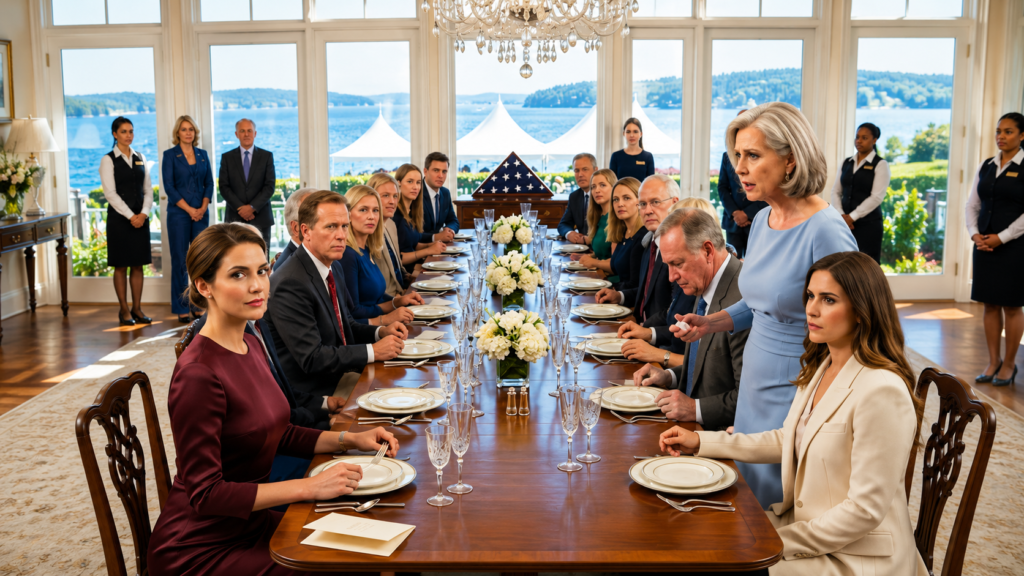
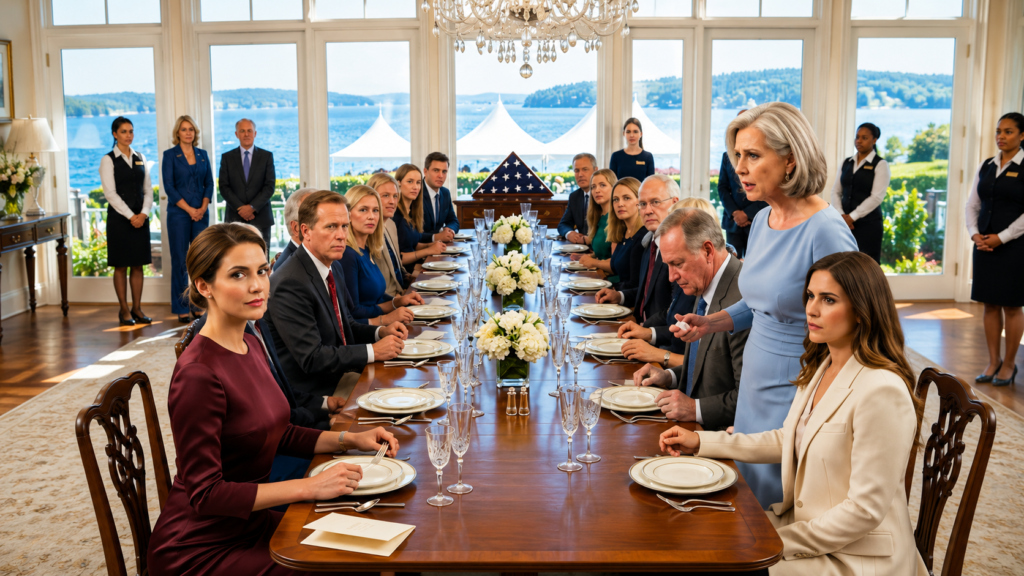
The family gathering was held at the Aldercrest Estate outside Portland, overlooking a wide stretch of the Columbia River.
The property was enormous.
Stone walls.
Tall windows.
Perfect gardens.
Black cars lined the driveway.
Servers moved between white tents carrying trays of champagne.
Everything looked effortless.
Everything had clearly cost a fortune.
I stepped out of my car wearing a simple midnight-blue dress.
No dramatic entrance.
No announcement.
I walked inside.
Relatives I barely remembered moved through the ballroom.
Some glanced at me without recognition.
An uncle whispered something to his wife.
A cousin stared for several seconds.
Someone asked another guest,
“Who is she?”
Then my mother turned.
She was holding a champagne glass.
Her eyes passed over me casually.
A polite smile appeared.
The kind reserved for strangers at formal events.
“Hello,” she said.
I smiled.
“Hello, Mom.”
The champagne glass stopped halfway to her lips.
Her face changed.
First confusion.
Then disbelief.
Then something close to fear.
“Camille?”
“Yes.”
She stared at me.
My father appeared beside her.
He looked at me.
Then at my mother.
Then back at me.
For fourteen years, they had remembered me as an eighteen-year-old girl with a cheap suitcase and seventy-five dollars.
That girl was gone.
My sister Sabrina arrived a moment later.
She looked almost exactly as I remembered.
Perfect hair.
Perfect dress.
Perfect smile.
But this time, she wasn’t looking at me like a younger sister.
She was looking at me like competition.
Dinner began shortly afterward.
Everyone behaved as though nothing strange had happened.
Mom asked about my company.
Dad asked about revenue.
Sabrina asked how many employees I had.
Nobody asked where I had lived.
Nobody asked how I survived.
Nobody asked what those fourteen years had cost me.
They wanted the success story.
Not the truth behind it.
So I gave them polite answers.
I smiled.
I nodded.
I let them believe I was comfortable.
Then Mom stood.
She lifted her champagne glass.
The room slowly quieted.
“I’d like to say something about Camille.”
Every face turned toward me.
Mom smiled warmly.
“We’ve always been incredibly proud of our daughter.”
I almost laughed.
She continued.
“Camille has become an extraordinary woman, and we are so happy to have her home again.”
Home.
That word hit harder than I expected.
I slowly placed my fork beside my plate.
The tiny sound echoed across the table.
Mom looked at me.
I looked back at her.
Fourteen years of silence stood between us.
Then I smiled.
Not angrily.
Not bitterly.
Just calmly.
Because this time, I wasn’t the abandoned girl waiting for a car to come back.
I was the woman who had survived without them.
And I finally had something to say.
“Mom,” I said softly, “before you finish that toast, there’s something everyone here deserves to know.”
The room went completely silent.
My father lowered his glass.
Sabrina stopped smiling.
And my mother suddenly looked less certain than she had when I walked through the door.
Because she had no idea what I had brought with me.
And she was about to learn that I hadn’t returned to the family reunion to ask for a place at their table.
I had returned to show them exactly what they had thrown away.
PART 2 — THE TRUTH AT THE TABLE
Nobody moved.
My mother’s smile remained frozen.
“What exactly are you talking about?” she asked.
I looked around the table.
At the relatives who had spent years hearing one version of my story.
At Sabrina, who was suddenly gripping her wineglass too tightly.
At Dad, whose eyes had dropped to the white tablecloth.
Then I said,
“The day you left me at the station.”
The room seemed to shrink.
Mom’s face lost what little color remained.
“Camille, this isn’t the place.”
“It is exactly the place.”
My voice stayed calm.
“You invited me here to celebrate family.”
I looked directly at her.
“So let’s talk about what happened to the family.”
Nobody interrupted.
I reached into my handbag and pulled out a small envelope.
I had carried it for years.
Inside was the bus ticket from that night.
Faded.
Bent.
Almost illegible.
But I had kept it.
Not because I wanted to live in the past.
Because sometimes you need proof that something really happened when everyone else pretends it didn’t.
I placed it on the table.
“This is from the night you left me.”
Dad stared at it.
Mom whispered,
“You kept that?”
“For fourteen years.”
Sabrina shifted in her chair.
“I didn’t know they left you like that.”
I turned toward her.
“You didn’t know because nobody told you.”
She looked down.
“I was eighteen,” I continued. “I had seventy-five dollars, a suitcase, and no idea where I was going to sleep.”
Mom shook her head.
“We thought you needed independence.”
I almost smiled.
“Independence?”
“You were becoming an adult.”
“You could have taught me independence without abandoning me.”
Her mouth opened.
No answer came.
Dad finally spoke.
“We made a decision we thought was necessary.”
I looked at him.
“Did you?”
He swallowed.
“I believed your mother knew what was best.”
That sentence hurt more than I expected.
Because it confirmed what I had always known.
He had watched.
He had understood.
And he had chosen silence.
I leaned back.
“Then let me tell you what happened after you drove away.”
The room stayed silent.
“I slept above a laundromat.”
Aunt Claire covered her mouth.
“I worked overnight shifts.”
My cousin stared at me.
“I rode buses before sunrise.”
I paused.
“I ate whatever I could afford.”
Mom’s eyes filled with tears.
But I didn’t stop.
“I got sick once and went to work anyway because missing one shift meant I couldn’t pay rent.”
Dad looked down.
“I didn’t have anyone to call.”
My voice softened.
“And every time something went wrong, I learned to solve it myself.”
Sabrina whispered,
“Camille…”
I turned toward her.
“You don’t get to feel guilty for something you didn’t choose.”
She looked surprised.
“What?”
“You were the favorite. That wasn’t your decision.”
Her eyes filled.
“I never asked them to treat you that way.”
“I know.”
For the first time that evening, I believed she might actually understand.
Then Mom spoke.
“We’re proud of what you’ve accomplished.”
I looked at her.
“Are you?”
“Yes.”
“Or are you proud that I became successful enough to make the family look good?”
She flinched.
Nobody answered.
That was answer enough.
I picked up my wineglass.
“I didn’t come here to humiliate anyone.”
Dad finally looked at me.
“Then why did you come?”
I thought about that question.
Because I had asked myself the same thing on the drive here.
“I came because I wanted to know whether there was anything left worth saving.”
Mom’s tears began falling.
“There is.”
I shook my head gently.
“Maybe.”
Then I placed another document on the table.
This time, Dad recognized it.
His expression changed instantly.
“What is that?”
“A business proposal.”
He picked it up.
His hands trembled slightly.
I watched him read the first page.
Then the second.
His face became increasingly confused.
“This company…”
“Is mine.”
He looked at me.
“What does this have to do with us?”
“Everything.”
I pointed toward the property outside.
“You’re planning to sell part of this estate.”
Dad froze.
“How do you know that?”
“Because one of the investors who approached my company asked me to create the branding for the development.”
Sabrina looked at Dad.
“You never told me that.”
“I didn’t know she was involved.”
I continued.
“The project is called Riverstone Commons.”
Dad stared at me.
“Yes.”
“I reviewed the preliminary documents.”
I paused.
“Your family’s property is heavily leveraged.”
Silence.
Mom looked at Dad.
“What is she talking about?”
Dad’s jaw tightened.
“It’s under control.”
I shook my head.
“No, it isn’t.”
I slid another sheet across the table.
“The developer is offering you a fraction of what the property is actually worth.”
Dad picked it up.
His face changed.
“You couldn’t possibly know that.”
“I know because I had an independent valuation done.”
He stared at the numbers.
Then at me.
The room erupted in whispers.
For the first time that evening, nobody was looking at me as the abandoned daughter.
They were looking at me as the person who understood something they didn’t.
Mom leaned forward.
“Why would you do that for us?”
I took a breath.
“Because I wanted to know whether you invited me here because you loved me or because you needed me.”
No one spoke.
Dad slowly put the papers down.
“The developer contacted you?”
“Yes.”
“And you turned them down?”
“Yes.”
“Why?”
I looked at him.
“Because I knew they were trying to take advantage of you.”
Mom began crying again.
I expected to feel satisfaction.
I didn’t.
Only sadness.
Because this was the strangest part of coming home.
I had spent fourteen years imagining the moment they would finally need me.
I thought it would feel powerful.
Instead, it felt empty.
Dad rubbed his forehead.
“Why didn’t you tell us?”
“Because I wasn’t sure you would listen.”
He looked at me for a long time.
Then he said,
“You’re right.”
Two words.
Simple.
Almost impossible to hear from him.
Sabrina reached across the table.
“Camille, I am sorry.”
I looked at her hand.
Then at her face.
She was crying now.
“I should have asked where you went.”
I nodded.
“You should have.”
“I thought you left because you wanted to.”
“I know.”
She swallowed.
“I was seventeen. I believed everything Mom told me.”
“I know.”
That was the strange thing about family.
Sometimes the people who hurt you were also people who had been taught the same distorted version of the truth.
The dinner slowly dissolved.
People stopped talking about business.
The champagne remained untouched.
One by one, relatives approached me.
Some apologized.
Some asked questions.
Others simply stood there because they didn’t know what to say.
I didn’t forgive everyone.
Not that night.
Forgiveness wasn’t something I could hand out because everyone suddenly felt uncomfortable.
But I listened.
And for the first time, people listened to me.
Later, I stepped outside onto the terrace.
The Columbia River stretched beneath the moonlight.
Cold wind moved through the trees.
I heard footsteps behind me.
It was Dad.
He stopped several feet away.
“I should have come back for you.”
I said nothing.
“I wanted to.”
I turned.
“Then why didn’t you?”
His eyes filled with tears.
“Because your mother convinced me that if we went back, we’d undermine the lesson.”
I stared at him.
“What lesson?”
He looked ashamed.
“I don’t know anymore.”
I looked toward the river.
“You didn’t teach me independence, Dad.”
He waited.
“I taught myself.”
He nodded.
“I know.”
After a long silence, he said,
“Can I try again?”
I didn’t answer immediately.
Then I said,
“You can try.”
He looked relieved.
“But things won’t go back to how they were.”
“I understand.”
“No pretending.”
“I understand.”
“No rewriting the past.”
He nodded.
“And no calling me only when you need something.”
His eyes lowered.
“I understand.”
For the first time in fourteen years, my father didn’t ask me to make things easier for him.
He simply accepted the boundary.
When I returned inside, Mom was waiting.
She had removed her jewelry.
Her carefully arranged hair had begun to fall apart.
She looked smaller.
Older.
Human.
“I don’t expect you to forgive me tonight,” she said.
I nodded.
“Good.”
She gave a sad smile.
“But I want you to know something.”
I waited.
“I regretted it.”
“The day you left me?”
“Yes.”
“Then why didn’t you call?”
She looked down.
“Pride.”
That answer was painfully honest.
And somehow, honesty was harder to hate than cruelty.
I stepped closer.
“I spent years thinking there was something wrong with me.”
Mom began crying.
“I know.”
“No,” I said gently.
“You don’t.”
She looked at me.
“I spent years wondering what I had done to make my own mother leave me.”
Her face crumpled.
“And there was nothing wrong with me.”
She shook her head.
“No.”
I took a slow breath.
“That is the part I needed to hear.”
We stood there without touching.
Not mother and daughter healed in one magical moment.
Just two people finally looking at the truth.
When I left the estate that night, nobody followed me to the car.
Nobody begged me to stay.
Nobody asked for another chance.
For the first time, they understood that my life was no longer something they could control.
I sat behind the wheel and looked back at the house.
Fourteen years ago, I had left a station believing my family had taken everything from me.
Now I understood something different.
They had taken my childhood.
They had taken years I could never recover.
But they had not taken my future.
I had built that myself.
And as I drove away beneath the Portland streetlights, my phone buzzed.
A message from Dad.
Thank you for coming.
Then another.
I know I don’t deserve it, but I’d like to earn the right to be your father again.
I stared at the screen for a long time.
Then I typed one sentence.
Start by telling the truth, even when it hurts.
I pressed send.
And for the first time since that train station, I felt something I hadn’t allowed myself to feel in years.
Not revenge.
Not victory.
Peace.
PART 3 — WHAT THEY COULDN’T TAKE
The next morning, I woke up expecting regret.
Instead, I felt strangely calm.
For fourteen years, I had imagined returning to my family home.
Sometimes in those fantasies, I arrived with nothing.
Sometimes I arrived wealthy.
Sometimes they begged me to forgive them.
Sometimes I walked past them without saying a word.
Reality was quieter.
There had been no screaming.
No dramatic revenge.
No perfect apology that erased the past.
Just the truth.
And somehow, the truth was enough to let me breathe.
Three days after the reunion, Dad called.
Not asking for money.
Not asking for business advice.
Not asking me to rescue the family.
He simply asked,
“Would you have coffee with me?”
I almost said no.
Then I remembered what he had written.
I want to earn the right to be your father again.
So I agreed.
We met at a small café near the river.
Dad arrived early.
He looked nervous.
It was strange seeing him that way.
When I was eighteen, I had spent years trying to make him proud.
Now he was sitting across from me, trying to earn something from me.
Trust.
“I don’t know where to start,” he admitted.
“Start with the truth.”
He nodded.
Then he told me everything.
The years of favoritism.
The arguments Mom and I had that he pretended not to hear.
The decision to leave me.
The guilt afterward.
The reason they never called.
He admitted that they had convinced themselves I was strong enough to survive.
But underneath that excuse was something uglier.
They had simply found it easier to invest their time, money, and attention in Sabrina.
Because Sabrina made them feel successful.
I listened.
I didn’t interrupt.
When he finished, I said,
“I appreciate you telling me.”
His eyes filled.
“Does that mean you forgive me?”
I shook my head.
“Not yet.”
He nodded slowly.
“That’s fair.”
And that answer mattered.
Because he didn’t argue.
He didn’t tell me I was holding a grudge.
He didn’t ask me to make him feel better.
He accepted the consequence.
That was the beginning.
Not forgiveness.
Accountability.
Over the next several months, Dad kept his word.
He called when he said he would.
He remembered my birthday.
He asked about my company without trying to take credit for it.
He never mentioned money.
Never asked me for favors.
And when Mom wanted to invite me to another family event, he told her,
“Let Camille decide.”
That sentence meant more to me than any apology.
Sabrina changed too.
She left the family business and started working for a nonprofit.
One afternoon, she called me.
“I need to tell you something.”
“What?”
“I’ve been jealous of you.”
I smiled faintly.
“I know.”
“No. I mean really jealous.”
She laughed nervously.
“You built everything they told me I was supposed to have.”
I didn’t know what to say.
She continued.
“They gave me everything, and somehow I still felt like I had to perform for them.”
I looked out my office window.
“Maybe we were both trapped in different ways.”
She became quiet.
“Can we be sisters?”
I thought about it.
“Maybe.”
“That’s not a yes.”
“It isn’t a no.”
She laughed.
“Fair enough.”
It took time.
But eventually, we found a new relationship.
Not the one we should have had as children.
That was impossible.
We couldn’t go backward.
Instead, we built something different.
Something honest.
A few months later, my company received a major opportunity.
A national retail chain wanted us to handle its entire rebranding campaign.
It was the biggest contract Rowan & Co. had ever received.
The day we signed it, I walked into my office and found a package on my desk.
Inside was an old photograph.
Me at eighteen.
Standing outside the train station.
My graduation dress.
My suitcase beside me.
I had never seen the photograph before.
There was a note on the back.
I took this from the car before we left. I kept it because I knew someday I’d have to face what I had done.
It was from Dad.
I sat alone in my office for a long time.
Then I placed the photograph inside a drawer.
Not hidden.
Not displayed.
Just kept.
Because I no longer needed to pretend that the girl in that picture didn’t exist.
She was part of me.
She was the reason I became strong.
But she was not the whole story.
A year after the family reunion, I returned to that train station.
I hadn’t planned to.
I was in Portland for a client meeting, and suddenly I found myself standing outside the same entrance.
The station had changed.
The benches were newer.
The coffee shop was different.
The walls had been repainted.
But the smell was almost exactly the same.
Diesel.
Rain.
Coffee.
Memory.
I stood there for a few minutes.
Then I laughed.
Not because it was funny.
Because the eighteen-year-old version of me had believed that moment was the end of everything.
She had been wrong.
It had been the beginning.
I took out my phone.
There were messages waiting for me.
One from Dad.
One from Sabrina.
One from my team.
And one from Mom.
For a moment, I stared at her name.
Then I opened the message.
I’m proud of you. Not because of your company. Not because of what you’ve accomplished. I’m proud that you became yourself despite us.
I read it twice.
Then I put the phone away.
I didn’t need to answer immediately.
Maybe I never would.
Forgiveness didn’t have to happen on someone else’s schedule.
I walked inside the station.
Bought a coffee.
Then sat on the same kind of bench where I had once cried into my graduation diploma.
Only this time, I wasn’t waiting for anyone.
I was leaving on my own terms.
Before I stood, I opened my bag and took out a small envelope.
Inside was the old bus ticket.
I looked at it one final time.
Then I folded it carefully.
I didn’t throw it away.
I didn’t need to destroy the past to move beyond it.
I simply put it back in my bag.
Some memories are not chains.
Some are landmarks.
They remind you how far you’ve traveled.
When I stepped outside, rain had begun falling.
I walked toward my car.
My phone rang.
It was Dad.
I answered.
“Hello?”
“Where are you?”
I smiled.
“Portland.”
There was a pause.
“Are you okay?”
I looked back at the station.
Then at the city around me.
“Yes.”
And I meant it.
Because I finally understood something I had spent fourteen years learning.
My parents had left me with seventy-five dollars and a suitcase.
They thought they were leaving behind a difficult daughter.
They thought I would fail.
They thought I would eventually come back asking for help.
Instead, I built a life they could never have given me.
I built it from early mornings and cheap meals.
From rejection.
From exhaustion.
From loneliness.
From every night I wondered whether I had made the wrong choice.
I built it without their approval.
Without their money.
Without their protection.
And most importantly, without becoming cruel because they had been cruel to me.
That was my real victory.
Not the company.
Not the magazine covers.
Not the money.
Not walking into that reunion and watching my mother’s face change when she finally recognized me.
The victory was becoming a woman who no longer needed the people who abandoned her to admit that she was worth loving.
I got into my car.
The rain tapped softly against the windshield.
Before starting the engine, I looked at the passenger seat.
For a brief moment, I imagined my eighteen-year-old self sitting there with her suitcase.
Scared.
Angry.
Alone.
I wanted to tell her something.
So I whispered it aloud.
“You didn’t deserve what happened to you.”
I took a breath.
“But you survived it.”
Then I started the engine.
And drove away.
Not from my family.
Not from my past.
From the version of myself who had spent years believing she had been abandoned because she wasn’t enough.
She had always been enough.
She just needed to stop waiting for someone else to prove it.
And as the station disappeared in the rearview mirror, I smiled.
Because for the first time in fourteen years, I wasn’t the daughter they had left behind.
I was simply Camille.
And my life had never really been waiting for them to come back.
It had been waiting for me to come home to myself.
THE END.