COLD OPEN
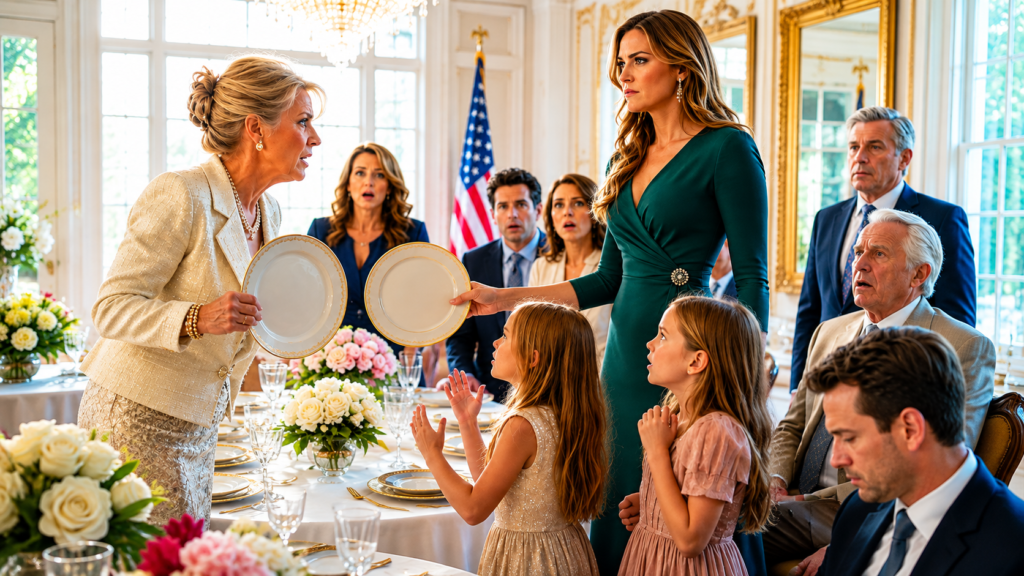
“These plates are for family.”
My mother-in-law, Estelle, lifted my daughters’ porcelain plates from the dining table and held them against her chest.
My eleven-year-old daughter, Piper, froze with her fork halfway to her mouth.
Eight-year-old Maeve dropped hers onto the floor.
Estelle pointed toward the kitchen.
“Only women who give this family sons deserve a place at my table. The girls can eat from paper plates.”
The room went silent.
My brother-in-law, Grant, suddenly became fascinated with his dinner. His wife, Kendra, started to speak, but he quietly caught her hand beneath the table.
Then I looked at my husband.
Nolan sat three chairs away.
He wouldn’t look at his mother.
He wouldn’t look at me.
Most painfully, he wouldn’t look at our daughters.
Piper stared at him, waiting for her father to defend her.
Maeve’s eyes filled with tears.
“Mom,” she whispered, “did we do something wrong?”
I knelt beside her.
“No, sweetheart. You did nothing wrong.”
Estelle watched us with the satisfied expression of someone who believed she had just reminded everyone who was in charge.
But she had made one enormous mistake.
She had forgotten whose house we were standing in.
Eight months earlier, I had quietly met with an attorney.
I hadn’t told Nolan.
I hadn’t told Estelle.
I had simply prepared for the day I might finally need to protect my daughters—and my home—from the family that believed they had a right to control both.
That evening, I reached for my phone.
I sent my attorney one word.
Proceed.
Estelle had no idea that the woman she had just humiliated in front of the entire family had already prepared the paperwork that could put her out of my house.
And she was about to discover just how expensive her mistake would be.
PART 1: THE HOUSE SHE NEVER OWNED
Eight months earlier, our life in Charleston, South Carolina still looked peaceful from the outside.
Our house stood on a quiet street near the water, surrounded by old oak trees and small gardens. It wasn’t the biggest home in the neighborhood, but it had been mine long before I met Nolan.
I had purchased it with my own savings.
The deed was in my name.
The mortgage was paid.
Every renovation, repair, and property tax bill had come from me.
Nolan knew that.
Estelle knew it too.
At least, I thought she did.
When Nolan and I married, he moved into my house.
For the first few years, everything was fine.
He was a loving father.
He helped Piper with school projects, took Maeve to dance practice, and rarely missed one of their weekend activities.
But whenever Estelle came to visit, the atmosphere changed.
She believed sons carried a family’s legacy.
Daughters, in her opinion, eventually became part of someone else’s family.
At first, she disguised those beliefs as jokes.
“Maybe you’ll give Nolan a boy someday,” she would say.
Then she’d glance at Piper and Maeve.
“Your father needs someone to carry on the family name.”
I ignored her.
So did Nolan.
Or at least, he pretended to.
Then the comments became harder to dismiss.
At Thanksgiving, Estelle looked around the table and sighed.
“So many girls.”
Piper was nine at the time.
She looked confused.
“Is that bad, Grandma?”
Estelle smiled.
“Of course not, darling.”
But her tone said something completely different.
Another Christmas, she gave Nolan a tiny blue baby outfit.
“I kept this for my grandson.”
Maeve looked at the gift.
“What did you get us?”
Estelle handed her a small envelope without looking up.
“You girls already have plenty.”
I watched Maeve’s smile disappear.
That was the first time I realized the damage wasn’t only happening to me.
My daughters were beginning to believe their grandmother valued them less because they were girls.
I started paying closer attention to Nolan.
Whenever Estelle made one of those comments, he laughed nervously or changed the subject.
He never confronted her.
His silence became its own kind of answer.
The situation became worse after Estelle started treating my house like hers.
One Saturday morning, she arrived carrying several boxes.
“What are those?” I asked.
“Things for the guest room.”
She walked past me.
I followed her upstairs.
“You should have asked first.”
She turned around.
“Nolan said I could make myself comfortable.”
“Comfortable is one thing. Redecorating my house is another.”
She smiled.
“You’re being territorial.”
I stared at her.
“My name is on the deed.”
Her smile disappeared for a moment.
Then she shrugged.
“It’s a family home.”
“No,” I said. “It’s my home.”
She didn’t answer.
But she didn’t put the boxes away either.
A few weeks later, I discovered that she had been given a key.
I confronted Nolan.
“Why does your mother have a key to my house?”
He looked irritated.
“Because she visits often.”
“That isn’t an answer.”
“She’s my mother.”
“And I’m your wife.”
He sighed.
“It’s just a key.”
I looked at him for several seconds.
“No. It’s a boundary.”
He walked away.
I stood alone in the hallway, listening to the front door close.
That was the moment I understood something important.
Estelle wasn’t trying to visit.
She was slowly establishing control.
First the guest room.
Then the key.
Then the kitchen.
She began moving things without asking, criticizing the girls’ bedrooms, and telling me which furniture should be replaced.
Then she started talking about the future.
One afternoon, while looking through the backyard, she said casually, “A grandson could really use this space someday.”
I turned toward her.
“A grandson?”
She smiled.
“You know what I mean.”
“I don’t think I do.”
She lowered her voice.
“This family needs a boy.”
I felt something cold settle in my chest.
Not anger.
Clarity.
That evening, after Estelle left, I opened my laptop.
I searched for a family attorney in Charleston.
The next morning, I met Celia Warren at her office.
I brought the deed.
The mortgage records.
The messages.
The photographs of changes Estelle had made without permission.
Celia reviewed everything carefully.
Then she looked at me.
“Your mother-in-law has no ownership interest in this property.”
“I know.”
“But you need to be careful about how you handle this.”
“What should I do?”
“Document everything. Don’t threaten her. Don’t announce what you’re planning.”
“And if she crosses the line?”
Celia closed the folder.
“Then we act.”
I nodded.
I didn’t know when that moment would come.
I only knew it would.
Eight months later, Estelle stood in my dining room holding my daughters’ plates.
She told two little girls they weren’t worthy of sitting at her table.
And without realizing it, she had finally crossed the line I had been waiting for.
This time, I wasn’t going to argue.
I was going to act.
PART 2: THE LINE SHE FINALLY CROSSED
For several seconds after I sent the message to Celia, I simply stood in the kitchen.
The family dinner continued behind me.
Someone laughed awkwardly.
A chair scraped across the floor.
Estelle was already telling Grant something as though nothing had happened.
But I could hear the quiet sniffle coming from Maeve.
I turned toward my daughters.
“Finish your dinner.”
Piper looked at me.
“What about Grandma?”
I kept my voice gentle.
“Let me handle Grandma.”
That was all I said.
I didn’t confront Estelle that night.
I didn’t raise my voice.
I didn’t threaten her.
Instead, I waited.
Because Celia had taught me something months earlier:
When someone believes they have control, the most dangerous thing you can do is let them continue believing it.
Dessert was served twenty minutes later.
Estelle returned to the dining room wearing the same satisfied expression.
She placed a slice of cake on her own plate.
Then she looked toward the kitchen.
“Are the girls coming back?”
“No,” I said.
Her eyebrows lifted.
“Why not?”
“They’re eating in the kitchen.”
She smiled.
“Good. Maybe they’ll learn.”
Nolan finally looked up.
“Mom.”
The room went silent.
Estelle turned toward him.
“What?”
“You went too far.”
For the first time that evening, I saw something unexpected in her expression.
Surprise.
Not guilt.
Surprise that her son had finally spoken.
She slowly put down her fork.
“I was teaching them manners.”
“They’re children.”
“They’re family.”
Nolan looked toward the kitchen.
“They’re your granddaughters.”
Estelle’s face hardened.
“And they are girls.”
Nolan didn’t answer.
I watched him carefully.
This was the first time he had challenged his mother.
But it was too late to erase what had already happened.
The damage had been done.
The next morning, Estelle called me.
I didn’t answer.
She called again.
Then again.
Finally, she sent a message.
We need to discuss what happened last night.
I replied with one sentence.
There’s nothing left to discuss.
Her response came immediately.
You are being dramatic.
I didn’t answer.
Another message arrived.
This is a family matter.
I looked at the screen.
Then I forwarded the entire conversation to Celia.
Her response came ten minutes later.
Keep every message. Do not delete anything.
I didn’t.
Three days later, Estelle arrived at the house without warning.
She used her key.
I was sitting at the kitchen table helping Piper with a school assignment.
Maeve was coloring beside us.
The front door opened.
Estelle walked in.
Piper looked up.
“Grandma?”
Estelle ignored her.
She looked directly at me.
“We need to talk.”
“You shouldn’t have entered without permission.”
She held up the key.
“Nolan gave me this.”
“I know.”
“So I can come here.”
“No,” I said calmly. “You can use that key because my husband gave it to you. That doesn’t mean you have permission to enter whenever you want.”
Her expression hardened.
“This is ridiculous.”
“Then give me the key.”
She laughed.
“Absolutely not.”
Piper stopped writing.
Maeve stopped coloring.
Both girls were watching us.
Estelle noticed.
She lowered her voice.
“You’re turning them against me.”
“No.”
“You are.”
“I’ve never said a negative word about you to them.”
“You don’t have to. They see the way you behave.”
Her face reddened.
“You’ve always wanted to separate Nolan from his family.”
I stood.
“No. I’ve been trying to protect my children from being taught that they’re less valuable because they’re girls.”
Estelle’s eyes narrowed.
“Watch yourself.”
“I am.”
She stepped closer.
“You have no idea what you’re doing.”
I almost smiled.
Actually, for the first time, I knew exactly what I was doing.
“I think you should leave.”
She stared at me.
Then she pointed toward the hallway.
“This isn’t over.”
“No,” I said.
“It isn’t.”
She walked out.
The door slammed behind her.
Piper waited several seconds.
Then she asked, “Is Grandma mad at us?”
I sat beside her.
“No.”
“Then why does she keep saying things about boys?”
I looked at my daughter.
“Because some people grow up believing boys and girls have different value.”
“Do you believe that?”
“Never.”
Maeve climbed onto my lap.
“Will Grandma make us leave our house?”
I held her tightly.
“No.”
I knew that answer was more complicated than I let her believe.
But I also knew something else.
This house was legally mine.
And I had already started the process of proving it.
The following week, Celia sent me an email.
The subject line contained only two words:
READY TO FILE
I opened the attachment.
The paperwork included formal notice regarding Estelle’s unauthorized access and her continued interference with my property.
There was also documentation establishing my sole ownership.
I read everything twice.
Then I called Celia.
“Are you certain?”
“Yes.”
“What happens after we file?”
“She’ll receive formal notice.”
“And if she refuses to leave?”
“Then we proceed through the proper legal channels.”
I looked through the kitchen window.
Piper and Maeve were playing in the backyard.
For the first time in months, I felt my shoulders relax.
“File it.”
Celia paused.
“Are you sure?”
“Yes.”
I ended the call.
That evening, Nolan came home late.
He placed his keys on the counter.
“Mom called me.”
I didn’t look up from the paperwork in front of me.
“I assumed she would.”
“She says you’re trying to throw her out.”
“I am.”
He stared at me.
“You’re serious?”
“Completely.”
“She has nowhere else to go.”
“She owns a house twenty minutes from here.”
“She says it’s not the same.”
“It isn’t my responsibility to provide her another home.”
Nolan rubbed his forehead.
“You’re making this bigger than it needs to be.”
I finally looked at him.
“She took our daughters’ plates.”
“I know.”
“She told them they weren’t real family.”
“I know.”
“And you still think I’m the one making this bigger?”
He didn’t answer.
I stood.
“I needed you to defend them that night.”
His face fell.
“I was shocked.”
“So were they.”
He looked away.
“I should have said something.”
“Yes.”
“I was wrong.”
I wanted to believe that was enough.
But apologies don’t erase patterns.
I walked past him toward the hallway.
Behind me, he said quietly,
“What happens now?”
I stopped.
“The paperwork has been filed.”
He turned pale.
“You already did it?”
“Yes.”
He stood there in silence.
For the first time, I saw him understand that this wasn’t an argument between his wife and his mother.
It was the consequence of years of allowing his mother to cross boundaries.
And this time, I had drawn one she couldn’t simply step over.
The official notice arrived at Estelle’s house two days later.
That evening, my phone rang.
Her name appeared on the screen.
I let it ring.
It stopped.
Then started again.
I ignored it.
A voicemail appeared.
I listened.
Her voice was shaking with anger.
“You have no idea what you’ve done.”
I deleted nothing.
I saved the voicemail.
Then I forwarded it to Celia.
Her reply came almost immediately.
Good. Keep documenting.
I placed the phone on the counter.
Outside, the Charleston sky was turning orange over the trees.
Inside, Piper and Maeve were laughing together upstairs.
For the first time since the dinner, I smiled.
The legal battle had only just begun.
But Estelle had finally realized something she should have understood from the beginning:
She wasn’t fighting for control of her family’s house.
She was fighting for control of mine.
PART 3: THE DAY ESTELLE LOST EVERYTHING
The hearing was scheduled for a rainy Tuesday morning in Charleston.
Estelle arrived at the courthouse with Grant and Kendra.
She wore a cream-colored suit and carried herself like she was walking into a family meeting rather than a legal proceeding.
I arrived with Celia.
Nolan came alone.
He looked exhausted.
Estelle saw him and immediately walked toward him.
“You’re really going through with this?”
Nolan didn’t answer.
She turned toward me.
“This is what you’ve wanted all along, isn’t it?”
I shook my head.
“No. I wanted you to respect my home and my children.”
“You’ve destroyed this family.”
“No,” I said quietly. “Your choices did.”
Celia touched my arm.
“Don’t engage.”
I nodded.
We entered the courtroom.
Estelle’s attorney argued that she had been treated like a member of the household for years.
He described her visits, the key Nolan had given her, the furniture she had purchased, and the family gatherings she had hosted.
For a moment, I wondered whether the judge might actually believe him.
Then Celia stood.
She presented the deed.
The property records.
The mortgage documents.
The messages.
Photographs of Estelle entering the house without permission.
And finally, the recordings and written messages documenting her repeated comments about my daughters.
The judge studied everything in silence.
Then he looked at Estelle.
“Mrs. Vale, do you claim ownership of this property?”
Estelle hesitated.
“No.”
“Do you have a lease?”
“No.”
“Then on what basis did you believe you had unrestricted access?”
Estelle looked toward Nolan.
“He gave me a key.”
The judge nodded.
“A key does not establish ownership.”
Estelle’s face tightened.
Celia continued.
She presented the message Estelle had sent me after the dinner.
This is a family matter.
Then another.
You have no idea what you’re doing.
The judge looked over the documents again.
Finally, he delivered his decision.
Estelle had no ownership rights.
She was ordered to surrender her key immediately and was prohibited from entering the property without my permission.
The room became completely silent.
Estelle stared at me.
“You did this to me.”
I met her eyes.
“No.”
I paused.
“You did this when you decided my daughters didn’t belong at your table.”
Her face crumpled for just a second.
Then the anger returned.
“This family will never forgive you.”
I looked at Nolan.
He was staring at the floor.
“I can live with that.”
Outside the courthouse, rain fell steadily over the pavement.
Estelle caught up with me beneath the awning.
“You think you’ve won?”
I turned around.
“This wasn’t a competition.”
“You took my family away.”
“No.”
I looked at her carefully.
“You pushed them away yourself.”
She opened her mouth.
Nothing came out.
For once, she had no argument.
The hardest conversation happened that evening.
Nolan and I sat at the kitchen table after the girls went to bed.
He looked at me for a long time.
“I owe you an apology.”
I said nothing.
“I should have stopped her years ago.”
“Yes.”
“I kept telling myself she would change.”
“She didn’t.”
“I was afraid of losing my mother.”
I looked at him.
“And you were willing to let your daughters believe they were less important.”
His eyes filled with regret.
“I know.”
That answer mattered.
Not because it fixed everything.
But because, for the first time, he wasn’t defending himself.
He was accepting responsibility.
“I don’t know what happens to us now,” he said.
“Neither do I.”
He nodded.
“I understand.”
For the next several weeks, we lived carefully around each other.
There were no dramatic fights.
No shouting.
Just the uncomfortable work of deciding whether a marriage could survive years of silence.
Nolan began counseling.
He stopped giving his mother access to our lives.
Most importantly, he started showing our daughters through his actions that he understood what he had failed to do.
One Saturday morning, he took Piper and Maeve to the park.
Before they left, he knelt in front of them.
“I owe both of you an apology,” he said.
Piper looked confused.
“For what?”
“For not speaking up when someone made you feel like you didn’t belong.”
Maeve wrapped her arms around his neck.
“You’re here now.”
Nolan closed his eyes.
“Yes,” he whispered.
“I am.”
Estelle never returned to the house.
A few months later, she sold her property and moved to another part of South Carolina.
Grant eventually stopped speaking to her.
Kendra remained distant.
The family gatherings became smaller.
Quieter.
And much less controlled by Estelle.
As for me, I kept the plates she had taken from my daughters.
Not because they were expensive.
They weren’t.
I kept them because they reminded me of the moment everything changed.
One Sunday morning, I placed them on the table.
Piper noticed.
“Mom, why are you using those?”
I smiled.
“Because they’re ours.”
Maeve climbed into her chair.
“Are we having breakfast here?”
“Yes.”
She looked toward the empty chair where Estelle used to sit.
“Is Grandma coming?”
“No.”
Maeve nodded.
Then she picked up her fork.
Piper looked at me.
“Can I have the blue plate?”
I handed it to her.
“Of course.”
She smiled.
The kitchen filled with ordinary sounds again.
Forks against porcelain.
Laughter.
Morning sunlight through the windows.
Nothing dramatic.
Nothing frightening.
Just my daughters eating breakfast in their own home.
I looked around the room and realized something.
Estelle had spent years believing family was defined by blood, sons, names, and inheritance.
She was wrong.
Family wasn’t about who deserved a particular plate.
It was about who made you feel welcome at the table.
Who protected you when you were too young to protect yourself.
And who stood beside you when someone tried to convince you that you didn’t belong.
That morning, my daughters belonged.
They always had.
And this time, everyone knew it.
THE END.