COLD OPEN
My father threw my grandmother’s savings passbook into her grave and said it was worthless. The next morning, I carried that same book into a bank—and the teller went pale before calling the police.
“That thing isn’t worth anything. Let the old woman take it with her.”
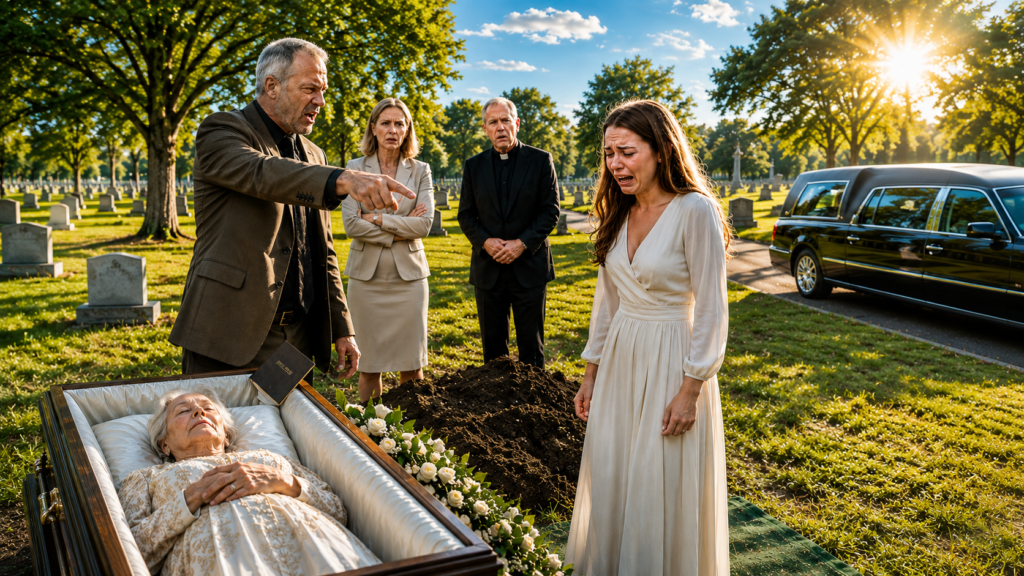
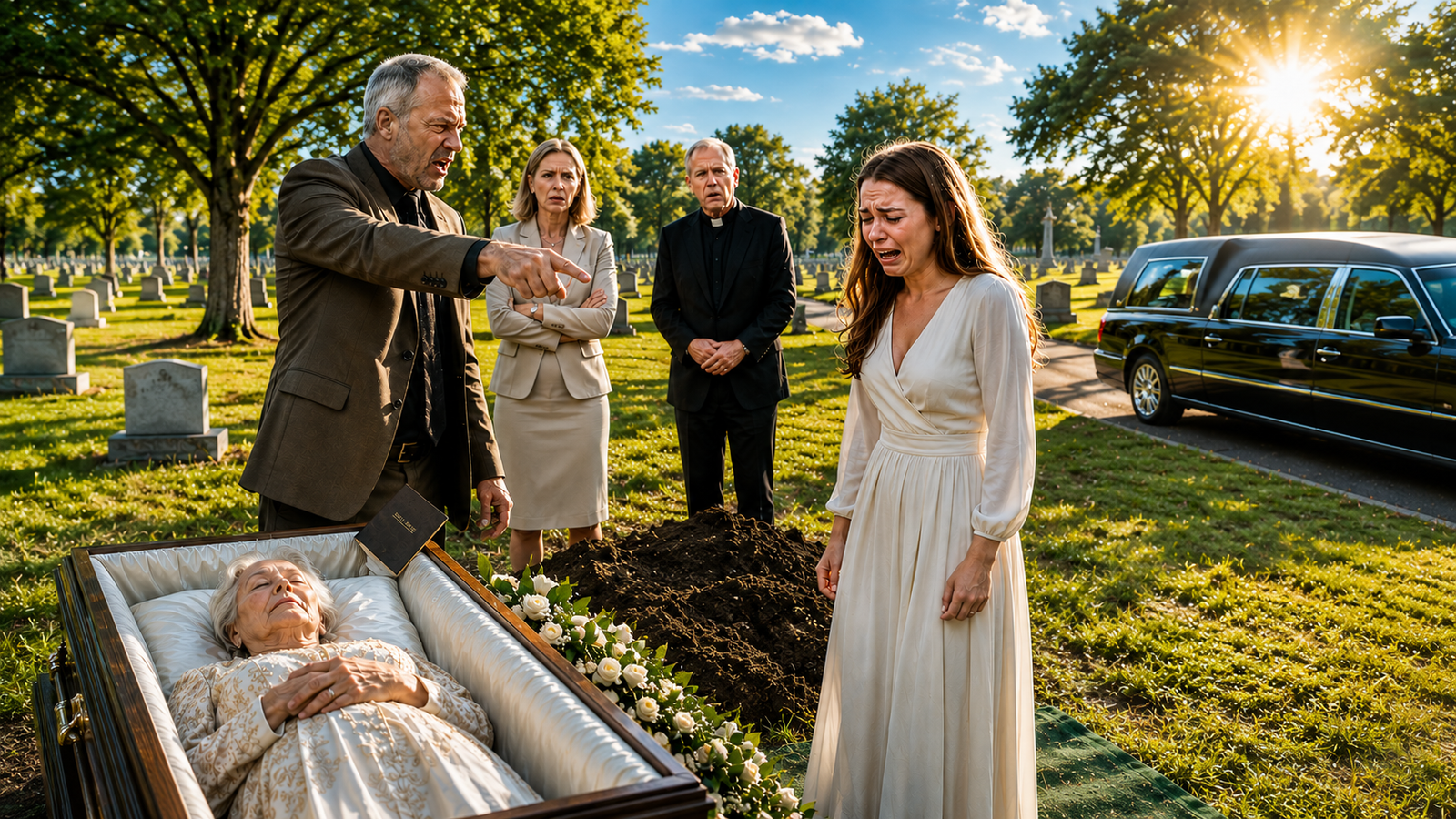
My father, Victor Callahan, tossed the faded green passbook onto Grandma Beatrice’s open coffin. It landed against her folded hands among damp soil and dying roses.
Nobody moved.
Not my aunts. Not my cousins. Not even the minister who had just finished the final prayer at Briarwood Cemetery.
Two nights earlier, Grandma Beatrice had squeezed my fingers and whispered, “Marissa… whatever happens, don’t let Victor find that book.”
Victor was my father.
And apparently, the person she feared most.
PART 1
I was twenty-nine, standing beside her grave in a borrowed black dress while my worn shoes sank into the wet ground. Dad straightened his dark coat and gave me a cold smile.
I knew that expression.
He wore it whenever he dismissed my tears as “attention seeking,” whenever he demanded money from me, and whenever Grandma stepped between us because she knew what his anger could become.
“There’s your inheritance, Marissa,” he said, pointing toward the coffin. “A little old passbook. No property. No house. No fortune.”
My stepmother, Diane, chuckled behind her sunglasses.
My half-brother, Jordan, leaned toward me.
“Maybe there’s enough for dinner in there.”
Several relatives laughed.
I didn’t.
Grandma always kept that passbook wrapped in a floral handkerchief inside an old metal tea tin beneath her bed. Every month, she carried it to the bank in her knitted sweater and worn leather purse.
When I was a child, I sometimes saw it beside the little glass bird on her kitchen table.
“That book will matter someday,” she once told me. “But when that day comes, you must be careful who you trust.”
I never understood what she meant.
Until now.
When the funeral workers lowered her coffin, Dad never shed a tear. He simply watched the dirt fall, his expression strangely focused—as if he wanted to make absolutely certain something remained buried.
Soon, everyone began leaving.
I stayed behind.
Footsteps faded over the gravel.
Car doors slammed.
Engines started one after another.
When the final vehicle disappeared through the cemetery entrance, I dropped to my knees.
I dug into the wet soil with my bare hands until my fingers touched something smooth.
The passbook.
I pulled it out, smeared mud from the cover, and opened the first page.
Beatrice Callahan.
Beneath her name, Grandma had written a single sentence in shaky blue ink:
“If Victor tells you this book is worthless, ask yourself why he was so determined to get rid of it.”
My stomach tightened.
I ran.
That night, I locked myself inside my tiny apartment above a bakery on Willow Avenue. I pushed a chair against the door, pulled the curtains shut, and opened the passbook beneath the yellow light of my kitchen lamp.
At first, everything looked ordinary.
Forty dollars.
One hundred dollars.
Two hundred and eighty.
Six hundred.
Occasionally, a thousand.
They were the kinds of small savings Grandma had built over decades from baking pies, repairing clothes, and doing laundry for neighbors.
Then the numbers changed.
Suddenly, there were large withdrawals.
Bank transfers.
Amounts far beyond what Grandma should have been moving.
And beside several transactions were the same initials.
V.C.
Victor Callahan.
My father.
I stared at the entries until the letters blurred.
A folded piece of paper was tucked between two pages.
I opened it.
Grandma’s handwriting covered the page.
“Marissa, if you are reading this, I am sorry I kept this from you. Your father did not simply take money from me. He also tried to take something that was meant to belong to you from the beginning.”
My hands went cold.
At the bottom, Grandma had added:
“Do not ask the family. Do not trust Diane. Go directly to the bank. Tell them to check the account carrying the red seal.”
I turned every page.
Near the back, I finally saw it.
A faint red circle beside a handwritten banking code.
I copied the code onto my phone.
Then I sat there in silence.
I didn’t sleep.
At seven-thirty the next morning, still wearing the black dress from the funeral, I left my apartment with the passbook hidden inside a grocery bag and wrapped in a kitchen towel.
I took a bus to the oldest branch of the bank in the city, located on Harbor Street.
Inside, everything looked painfully normal.
Customers waited in line.
Children complained beside their parents.
People argued over transfers and debit cards.
A printer hummed behind the counters.
Everyone seemed to be living an ordinary morning.
Mine was anything but ordinary.
A young teller with dark hair smiled at me.
“Good morning. How can I help you?”
I carefully unwrapped the book.
“This belonged to my grandmother. She died yesterday. She told me to bring it here.”
The teller entered the account number.
She stopped.
Then she typed it again.
Her eyebrows pulled together.
She looked at the screen.
Then at the passbook.
Then at me.
The color slowly disappeared from her face.
“Are you a direct relative of the account holder?”
“I’m her granddaughter.”
“Your full name?”
“Marissa Callahan.”
She asked for my identification.
I slid my driver’s license across the counter.
Her fingers trembled as she compared it with the information on her monitor.
Then she suddenly picked up the phone.
“Mr. Parker, I need you at window six immediately.”
She paused.
“And please have security come over.”
I stared at her.
“What did you find?”
She didn’t answer.
Instead, she made another call.
This time, I heard only one word clearly.
“Police.”
My pulse began pounding.
Less than a minute later, a man in a charcoal-gray suit hurried toward the counter. His name badge was crooked against his shirt.
He glanced at the teller.
Then at me.
Then at the muddy green passbook.
His expression changed.
He flipped the counter sign to WINDOW CLOSED, reached over, and carefully took the passbook from the teller’s shaking hands.
He opened it.
His face went completely still.
Then he looked at me.
“Ms. Callahan,” he said quietly, “where did you get this book?”
“My grandmother gave it to me.”
The manager swallowed.
“She couldn’t have.”
“Why not?”
He glanced toward the security guard.
Then back at me.
“Because according to our records, this account was never supposed to be accessible to anyone in your family.”
The room seemed to go silent.
And suddenly, I understood.
My grandmother had never been trying to hide a worthless savings account.
She had been hiding a secret.
PART 2
For several seconds, I couldn’t move.
“What do you mean, it was never supposed to be accessible to my family?”
Mr. Parker closed the passbook.
“I need you to come with me to a private office.”
“Why?”
“Because what I’m about to show you shouldn’t be discussed at this counter.”
Two security officers positioned themselves near the entrance.
That frightened me more than anything he had said.
I followed him through a narrow hallway into a small office with frosted windows. He locked the door behind us.
The teller remained outside.
Mr. Parker placed the passbook on his desk.
“My name is Gregory Parker. I’ve been managing this branch for eleven years. Your grandmother opened this account thirty-one years ago.”
I stared at him.
“Thirty-one years?”
He nodded.
“But the balance in this passbook doesn’t make sense.”
He opened a secure banking application on his computer.
“Because the printed balance you’re seeing isn’t the actual balance.”
My heart began racing.
“What is the actual balance?”
Gregory hesitated.
Then he turned the monitor toward me.
I stared at the number.
I couldn’t understand it.
“That’s impossible.”
“It isn’t.”
“That much money?”
“Yes.”
My grandmother, who had spent her entire life wearing secondhand coats and saving coins in jars, had somehow accumulated a fortune.
But Gregory wasn’t finished.
“There is something else.”
He clicked another file.
A scanned document appeared.
My name was written across the top.
MARISSA CALLAHAN — BENEFICIARY
I stopped breathing.
“What is that?”
“A beneficiary designation.”
“Why would my grandmother put my name there?”
“Because she intended you to receive the account.”
I shook my head.
“But why hide it?”
Gregory looked at me carefully.
“Because someone tried to change it.”
My stomach dropped.
“Victor?”
He didn’t answer immediately.
Instead, he pulled another document from a locked drawer.
“This was submitted eighteen months ago.”
I recognized the signature immediately.
My father’s.
“He tried to remove me?”
“Not exactly.”
Gregory turned the paper around.
Victor hadn’t simply removed my name.
He had attempted to transfer the entire account into a company registered under his name.
I stared at the document.
“But Grandma was still alive.”
“She was.”
“And she refused?”
Gregory’s expression darkened.
“Your grandmother came here personally.”
“When?”
“Five months ago.”
I remembered that day.
Grandma had called me from her kitchen.
She sounded frightened.
I had asked what was wrong.
She told me she was tired.
I believed her.
Gregory lowered his voice.
“She told us Victor had been pressuring her for months. He knew about the account. He knew there was money inside it. But he didn’t know everything.”
“What didn’t he know?”
Gregory opened another file.
“This.”
On the screen was a photograph of an old legal document.
At the bottom was Grandma’s signature.
And beneath it was another name.
Mine.
I leaned closer.
It was a trust agreement.
Grandma had established it shortly after I was born.
The account wasn’t merely a savings account.
It was part of a trust created for me.
My father had never been the owner.
He had only been listed as a temporary administrator while I was a minor.
“He couldn’t take it,” I whispered.
Gregory shook his head.
“Not legally.”
“Then how did he withdraw money?”
“That is exactly what we’re investigating.”
He pulled up the transaction history.
There were dozens of withdrawals.
Some were small.
Others were enormous.
Every one had been authorized through a combination of signatures and identification documents.
And the dates made my blood run cold.
Several withdrawals happened while Grandma was hospitalized.
One occurred three days after she suffered a stroke.
Another happened while I was sitting beside her hospital bed.
I remembered Victor arriving that afternoon.
He had kissed Grandma’s forehead.
Then he asked me to leave the room.
I had thought he wanted privacy with his mother.
Now I knew better.
“He stole it,” I whispered.
Gregory didn’t correct me.
“We believe someone used forged authorization documents.”
“Can you prove it?”
“We already have reason to suspect fraud.”
He opened another folder.
Inside were copies of identity documents, transaction slips, and security logs.
Then I saw something that made my hands turn cold.
A signature.
My father’s signature.
Beside it was a date from four months earlier.
But there was one problem.
Grandma had been unconscious in the hospital that entire week.
“She couldn’t have signed this.”
Gregory nodded.
“We know.”
“Then why hasn’t anyone arrested him?”
“Because we needed the original evidence.”
He looked directly at me.
“And now you’ve brought us the missing piece.”
I stared at the green passbook.
“What piece?”
“The original transaction record.”
He pointed to the final pages.
“Your grandmother knew someone had been altering the account. She kept the original book because she understood that the electronic records could be disputed.”
My throat tightened.
“She knew this would happen.”
“She was preparing for it.”
Gregory reached beneath his desk and removed a sealed envelope.
“There is one more thing your grandmother left with the bank.”
My name was written across the front.
FOR MARISSA — ONLY IF VICTOR TRIES TO TAKE THE ACCOUNT.
I stared at the envelope.
“Why didn’t you give me this yesterday?”
“Because we didn’t know you existed as the beneficiary.”
“But you just said my name was on the trust.”
“The trust was sealed.”
He slid the envelope toward me.
I hesitated before opening it.
Inside was a single handwritten letter.
My grandmother’s words stared back at me.
Marissa,
If you’re reading this, then your father finally made his move.
I’m sorry.
There is something I never told you about your birth.
I stopped.
The room seemed to tilt.
I read the next line.
The money was never the most important thing.
The trust was created because of what happened the night you were born.
My fingers tightened around the paper.
Gregory watched my expression.
“What does it say?”
I looked up.
“My grandmother says the trust wasn’t created because of money.”
“Then why?”
I swallowed.
“I don’t know.”
A sudden knock struck the office door.
Gregory stood.
One of the security officers opened it.
A police detective stepped inside.
He was holding a photograph.
“Mr. Parker, we’ve got a problem.”
Gregory frowned.
“What happened?”
The detective looked at me.
“Your father is outside.”
My blood ran cold.
“He followed me?”
The detective shook his head.
“He didn’t come here for you.”
He placed the photograph on the desk.
It showed my father standing beside a black SUV outside the bank.
In his hand was a brown leather briefcase.
The detective’s voice dropped.
“He came here because someone told him the passbook had been found.”
I looked at Gregory.
Then at Grandma’s letter.
And suddenly, I realized the most frightening part.
My father didn’t know what was inside the passbook.
But someone else did.
PART 3 — THE TRUTH
My hands went cold.
“Someone told him?”
The detective nodded.
“We’re still trying to determine who.”
Gregory immediately locked the office door again.
“Marissa, you need to stay here.”
I looked at Grandma’s letter.
“There has to be more.”
I unfolded the final page.
At the bottom, beneath her signature, Grandma had written one last sentence:
“If Victor comes for the money, ask him why he was there the night you were born.”
I stared at the words.
The detective noticed my expression.
“What happened?”
“I don’t know.”
But deep inside, something shifted.
My father had always refused to talk about the night I was born. Whenever I asked, he changed the subject.
Grandma had always been different.
Whenever I mentioned my birth, she became quiet.
Now I understood why.
The detective received a message on his radio.
He looked toward Gregory.
“Victor is demanding to speak with his daughter.”
I stepped toward the door.
“No.”
Both men looked at me.
“I want to talk to him.”
Gregory immediately shook his head.
“That isn’t wise.”
“He came here because he thinks he can intimidate me. If I hide, he’ll keep coming.”
The detective studied me for several seconds.
Finally, he nodded.
“But you stay behind the security line.”
A few minutes later, I entered the bank lobby.
Victor stood near the entrance, his expensive coat perfectly buttoned, his briefcase hanging from one hand.
When he saw me, his expression changed.
“Marissa.”
I had never heard my name sound so threatening.
“You shouldn’t have come here,” he said.
“I could say the same to you.”
His eyes moved toward the passbook.
“Give it to me.”
“No.”
His jaw tightened.
“You don’t understand what you’re holding.”
“Then explain it.”
He stepped closer.
“That account belonged to your grandmother.”
“And now it belongs to me.”
He laughed.
“You actually believe that?”
“I believe the documents.”
For the first time, fear flickered across his face.
“You’ve been talking to the bank.”
“Yes.”
His voice lowered.
“Your grandmother was confused near the end.”
“Then why did she leave written instructions?”
He said nothing.
I took the letter from my pocket.
“She told me to ask you about the night I was born.”
Victor’s face changed instantly.
The confidence disappeared.
“You don’t need to know about that.”
“I think I do.”
He looked toward the exit.
The detective stepped forward.
“Mr. Callahan, you need to remain where you are.”
Victor ignored him.
“You have no idea what your grandmother did.”
“What did she do?”
He looked at me.
“She saved you.”
The words hit harder than I expected.
“From what?”
Victor’s eyes filled with something I had never seen before.
Regret.
“She knew I couldn’t be trusted with the money.”
I stared at him.
“That’s not what I asked.”
He lowered his head.
“The night you were born, your mother died.”
I already knew that.
But he continued.
“She had a life-insurance policy. Your grandmother used every dollar of it to establish the trust.”
I looked at Gregory.
He nodded.
Victor continued.
“She knew I would eventually waste it. So she put everything into the trust and named you as the beneficiary.”
“Then why did you keep taking money?”
He didn’t answer.
The detective stepped closer.
“Mr. Callahan, those withdrawals are under investigation.”
Victor’s shoulders dropped.
“I was going to pay it back.”
I almost laughed.
“How?”
He looked at me.
“With another investment.”
Gregory shook his head.
“You had already lost most of it.”
Silence.
Then Victor finally admitted the truth.
He had been taking money from the account for years.
He had used it to cover debts, business losses, and loans he couldn’t repay.
When Grandma discovered what he had done, she threatened to expose him.
So Victor tried to change the beneficiary records.
When that failed, he forged documents.
And when Grandma became ill, he believed he finally had a chance to take control of everything.
But she had already protected the original records.
And she had left the passbook where he could never find it.
With me.
The detective placed handcuffs around Victor’s wrists.
He didn’t resist.
As they led him away, he stopped beside me.
“I never meant to hurt you.”
I looked at him for a long moment.
“You didn’t just steal money, Dad.”
His eyes met mine.
“You stole years from Grandma.”
He looked away.
That was the last time I spoke to him.
Two months later, the bank completed its investigation.
Most of the stolen money was recovered through legal action and frozen assets. The remaining amount was placed back under the trust Grandma had created.
I never moved into a mansion.
I never became obsessed with the money.
Instead, I used part of it to restore Grandma’s little house.
The kitchen still smelled faintly of cinnamon.
Her sewing machine remained beside the window.
And on the table, I placed the old green passbook inside a glass case.
Not because it represented wealth.
Because it represented the one thing Grandma had never stopped protecting.
Me.
One spring afternoon, I sat in her garden and reread her final letter.
At the very bottom, beneath everything else, I discovered a sentence I had somehow missed.
“Money can disappear, houses can burn, and people can betray you. But the truth has a way of finding its way home.”
I closed my eyes.
For the first time since her funeral, I felt peaceful.
Grandma had known the truth would eventually surface.
She had simply trusted me to be brave enough to uncover it.
And she had been right.
THE END.