COLD OPEN
The message from my father arrived at 8:17 on Thanksgiving morning.
Thanksgiving is full. Maybe next year.
Five words.
That was all it took to remind me exactly where I stood in my own family.
I stared at the screen while rain tapped against the windows of my apartment in Tacoma, Washington.
My family was celebrating without me.
Again.
So I opened the folder containing the deed to my $5 million ranch in Wyoming, picked up my phone, and called my assistant.
“Find two hundred people who have nowhere to spend Thanksgiving.”
She hesitated.
“Two hundred?”
I looked at my father’s message one more time.
“Yes.”
Then I smiled.
“Because if my family says their table is full, I’ll build one big enough for everyone else.”
PART 1: THANKSGIVING WAS FULL
My name is Audrey Callahan.
I was thirty-three years old, the youngest of three siblings, and for most of my life I had felt like an unwanted extra at my own family’s table.
My father, Graham Callahan, owned a regional construction company.
My mother, Diane, treated every holiday gathering like a carefully staged magazine photograph.
My older sister, Celeste, was the favorite.
She had stayed close to home, married the man my parents approved of, bought a beautiful house, and somehow always knew exactly what to say whenever my father needed someone to agree with him.
My older brother, Evan, was different.
He was quieter.
He noticed things.
But he had survived our family by learning when not to speak.
And then there was me.
At family dinners, I was always placed somewhere near the edge.
Even as an adult, Celeste’s friends would occupy the dining room while Evan and I ended up near the kitchen.
Nobody officially said I didn’t belong.
They didn’t have to.
They simply made sure I understood it.
When I earned a full scholarship to Caltech, my father barely looked up from his newspaper.
“That’s impressive,” he had said. “Though you could have gone somewhere closer to home.”
When I started my first technology company from a tiny rented office, my mother called it my “little computer business.”
When that company eventually became successful enough to attract a major acquisition offer, my father didn’t call.
He sent a text.
Proud of you, sweetheart.
That was it.
No celebration.
No dinner.
No hug.
Just four words on a screen.
I told myself it didn’t matter.
I worked harder.
I built another company.
I moved farther away.
I learned to turn every rejection into motivation.
But some wounds don’t disappear.
They simply become quieter.
That Thanksgiving morning, I was sitting alone in my apartment in Tacoma when my phone buzzed.
8:17 a.m.
I looked at the screen.
Dad: Thanksgiving is full. Maybe next year.
I stared at the message.
Then I typed:
No problem. Happy Thanksgiving.
I pressed send.
It was the kind of response people gave when explaining their feelings had become more exhausting than hiding them.
I walked toward the window.
Rain blurred the buildings outside.
Families were gathering everywhere.
Cars were packed with groceries.
People were carrying pies, casseroles, wine, flowers.
And somewhere a few hours south, my family was preparing a Thanksgiving dinner that apparently had no chair for me.
I should have been devastated.
Instead, I remembered the folder sitting on my desk.
Three weeks earlier, I had signed the final paperwork for a property I had kept completely secret.
Red Cedar Ranch.
Two hundred and forty acres in western Wyoming.
A restored stone-and-timber house.
Three barns.
A small lake.
A creek cutting through the property.
And mountains rising beyond the fields.
Purchase price:
Five million dollars.
My parents had no idea.
None of them did.
I had bought the ranch because I wanted somewhere that belonged completely to me.
No family expectations.
No judgment.
No carefully assigned chair at the end of the table.
Just space.
Until that morning, I had planned to use it as a private retreat.
A place to disappear whenever life became too loud.
But as I stared at the deed, a different thought entered my mind.
If my family didn’t have room for me…
Maybe I could make room for people who actually needed it.
I called Evan.
He answered after several rings.
“Hey.”
“Is Thanksgiving really full?”
There was silence.
Then he sighed.
“Dad said Celeste wanted to keep it small.”
“How small?”
“Family and a few close friends.”
I laughed quietly.
“I am family.”
“I know.”
“Does Dad know that?”
Evan didn’t answer.
He didn’t need to.
After a moment, he said,
“You know how they are.”
That sentence had protected my family from accountability for decades.
I ended the call.
Then I opened my laptop.
My assistant, Maya, was already working on another project.
I typed:
I need you to make some calls.
She replied almost immediately.
What kind?
I looked once more at my father’s message.
Then I typed:
Contact the county sheriff’s office, local shelters, churches, food banks, veterans’ groups, and anyone else who might know people spending Thanksgiving alone.
I continued.
Find families who can’t afford a proper meal. Elderly people with nowhere to go. Veterans. Anyone who needs a seat at a table.
Maya replied:
How many people are we talking about?
I looked around my silent apartment.
Then I imagined two hundred empty chairs becoming two hundred full ones.
I typed:
Two hundred.
A few seconds passed.
Then another message appeared.
Are you serious?
I smiled.
Completely.
I added one final instruction.
Get the ranch ready by tomorrow. Tables, chairs, heaters, food, cooks, transportation—everything.
Then I paused.
And typed:
No one gets turned away.
For the first time that Thanksgiving morning, I felt something other than rejection.
I felt anticipation.
My family had closed a door in my face.
They had no idea I was about to open one for two hundred strangers.
PART 2: THE TABLE THEY NEVER EXPECTED
By noon, Red Cedar Ranch was no longer a quiet retreat.
It had become a construction site.
Maya called me every twenty minutes with another update.
“We have three catering companies.”
“Good.”
“One of them can provide enough food for nearly two hundred and fifty people.”
“Book them.”
“We’re going to need more tables.”
“Get more.”
“And transportation.”
“Arrange buses.”
There was a pause.
“How many?”
“As many as necessary.”
Maya laughed softly.
“I’ve worked for you for four years. I’ve never heard you sound this excited.”
I looked through the ranch’s kitchen window.
Snow had begun falling over the distant mountains.
“Neither have I.”
By late afternoon, the first volunteers arrived.
A retired teacher named Harold came with his wife.
A group of firefighters offered to help unload supplies.
Two college students volunteered to serve meals.
A local church sent twenty people.
A veterans’ organization offered to provide transportation for elderly guests.
Nobody asked why I was doing this.
They simply asked where they could help.
That alone felt strange.
My entire life, I had been surrounded by people who asked what something would do for them.
Here, strangers were asking what they could do for someone else.
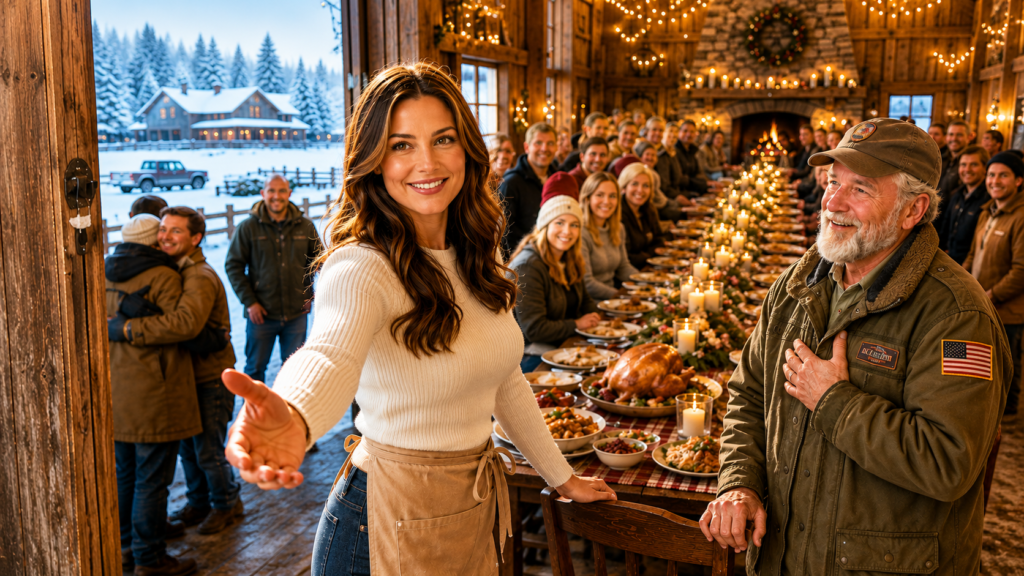
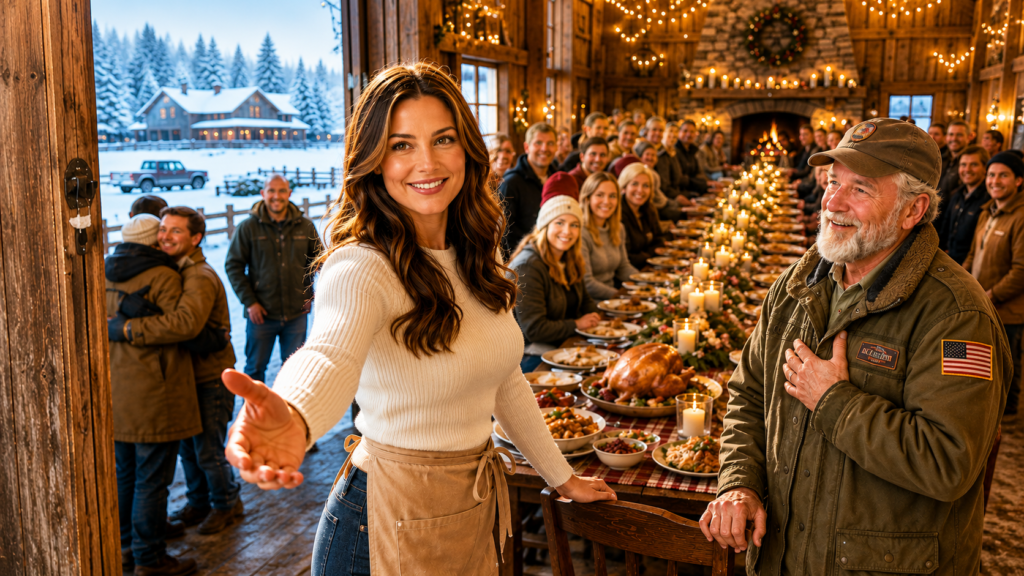
As tables were carried into the main barn, I walked between them, checking every detail.
Long wooden tables.
White tablecloths.
Warm lights.
Heaters positioned near the doors.
A children’s corner with toys and coloring books.
A separate table for people with dietary restrictions.
And at the center of the room, I placed a handwritten sign:
WELCOME. THERE IS ALWAYS ROOM HERE.
I stepped back.
For some reason, that sentence made my throat tighten.
The first guests arrived just after five.
A widowed woman named Margaret came alone.
She stood outside the barn holding a small purse with both hands.
“Are you sure I’m supposed to be here?” she asked.
I smiled.
“Yes.”
“I don’t know anyone.”
“You will.”
She looked at the tables.
“There are so many people.”
I nodded.
“That’s the point.”
Her eyes filled with tears.
She hugged me before I could react.
“Thank you.”
I hugged her back.
“You’re welcome.”
Then she walked inside.
Ten minutes later, an exhausted father arrived with his two children.
Then three veterans.
Then an elderly couple.
Then a group of young adults who had recently aged out of foster care.
Then a family whose apartment building had suffered a fire the previous month.
The number kept growing.
Two hundred became two hundred and seventeen.
Then two hundred and thirty-one.
Maya looked at me.
“We’re over capacity.”
I glanced at the empty tables we had saved near the back.
“Then use those.”
“That’s another forty seats.”
“Good.”
She smiled.
“Got it.”
At seven thirty, the barn was full.
Laughter echoed beneath the wooden rafters.
Children ran between tables.
Someone started playing an old country song near the fireplace.
A retired Marine told stories to a group of teenagers.
Margaret was sitting beside another widow, laughing as if they had known each other for years.
I stood near the entrance and watched.
This was supposed to be my family’s holiday.
Instead, I had never felt more surrounded by family.
Then my phone buzzed.
Dad.
I stared at his name.
For years, seeing that name had made me nervous.
That night, it didn’t.
I answered.
“Hello?”
His voice was sharp.
“Where are you?”
“At my ranch.”
“What ranch?”
I smiled.
“You didn’t know?”
There was a pause.
“What are you talking about?”
“Red Cedar Ranch.”
Silence.
Then:
“You bought property in Wyoming?”
“Yes.”
“How much?”
I didn’t answer.
He already knew.
“That’s impossible,” he said.
“Why?”
“You never mentioned it.”
“You never asked.”
Another silence.
Then his tone changed.
“Your mother says you’re hosting some kind of event.”
“I am.”
“How many people?”
I looked across the room.
More guests were entering.
“About two hundred and thirty.”
My father actually laughed.
“You’re having strangers at your house on Thanksgiving?”
“Apparently.”
“You’re making a spectacle.”
“No.”
I looked around at the smiling faces.
“I’m having dinner.”
He became angry.
“While your family is having Thanksgiving without you?”
I let the silence sit between us.
“You told me Thanksgiving was full.”
“That was not what I meant.”
“It was exactly what you said.”
He sighed.
“Come home.”
I almost laughed.
“Home?”
“Our house.”
I looked at the barn.
At the people who had been turned away by nobody.
At the sign above the entrance.
THERE IS ALWAYS ROOM HERE.
“No,” I said.
Then I ended the call.
An hour later, another vehicle arrived.
This time, it wasn’t a bus.
It was a black SUV.
Maya hurried toward me.
“Your parents are here.”
I stared at her.
“All of them?”
“Your parents, Celeste, and Evan.”
I felt something inside me settle.
Not fear.
Not anger.
Just certainty.
“Let them in.”
Maya raised an eyebrow.
“Are you sure?”
“Yes.”
The doors opened.
My father entered first.
He stopped almost immediately.
Behind him came my mother.
Then Celeste.
Evan was last.
My father’s eyes moved across the crowded barn.
He saw the food.
The tables.
The volunteers.
The children laughing.
The elderly guests.
The veterans.
The hundreds of people sitting together.
He looked at me.
“What is this?”
I answered calmly.
“Thanksgiving.”
Celeste crossed her arms.
“You did all this because we didn’t invite you?”
“No.”
I looked around the room.
“I did this because you taught me something.”
My mother frowned.
“What?”
I smiled sadly.
“You taught me exactly what it feels like when someone tells you there’s no room for you.”
I gestured toward the tables.
“So I made sure nobody here would hear those words.”
Nobody spoke.
Then Margaret walked toward us.
She looked at my parents.
Then at me.
“Are these your family?”
I nodded.
Margaret smiled.
“Then they should have been sitting with us.”
My father looked stunned.
I almost laughed.
But before I could answer, Evan stepped forward.
“I agree.”
Celeste turned sharply.
“What?”
Evan looked at our father.
“She should have been invited.”
My father’s face hardened.
“This isn’t the time.”
“No,” Evan replied. “It is.”
For the first time in my life, my brother wasn’t silent.
He looked at me.
“I should have said something years ago.”
I didn’t know what to say.
So I simply nodded.
My mother began crying.
Celeste looked away.
And my father stood in the middle of the room, surrounded by hundreds of strangers who had received the seat he had refused to give his own daughter.
Then something happened that none of us expected.
A little girl walked up to me.
She couldn’t have been older than seven.
She tugged gently on my sleeve.
“Excuse me?”
I crouched beside her.
“Yes?”
“Can I sit with you?”
I smiled.
“Of course.”
She took my hand.
And as I led her toward the nearest table, I glanced back at my family.
For once, I didn’t wonder whether they were proud of me.
I didn’t need them to be.
Because the room was already full of people who were grateful I had opened the door.
And that was worth more than any invitation I had ever wanted.
PART 3: THE TABLE THAT CHANGED EVERYTHING
For several minutes, nobody in my family spoke.
The little girl was still holding my hand as we walked toward an empty chair.
Her name was Ruby.
Her mother had told me they had spent the previous Thanksgiving eating crackers in a motel room after losing their apartment.
Tonight, Ruby had pumpkin pie.
She had a warm coat.
And she had a seat at the table.
She smiled at me.
“This is the best Thanksgiving ever.”
I swallowed hard.
“I’m glad.”
Across the room, my father heard her.
For the first time that evening, he looked uncomfortable.
Not angry.
Not superior.
Just uncomfortable.
Because the people sitting inside my barn had been rejected by life in ways far greater than anything my family had ever done to me.
And yet they were still capable of welcoming strangers.
My mother eventually approached me.
She stood beside the table, looking at the handwritten sign above the entrance.
THERE IS ALWAYS ROOM HERE.
“I didn’t know you had done all this,” she whispered.
“I didn’t tell you.”
“Why?”
I looked at her.
“Because I was tired of trying to impress you.”
Her eyes filled with tears.
“We were proud of you.”
I shook my head.
“No, Mom. You were proud when other people could see what I’d accomplished.”
She lowered her gaze.
“That isn’t fair.”
“Maybe not.”
I took a breath.
“But it was how it felt.”
She looked across the barn.
At Margaret laughing with another woman.
At the veterans sharing stories.
At the children decorating cookies.
Then she whispered,
“I’m sorry.”
Those two words were something I had waited years to hear.
And strangely, when they finally came, they didn’t have the power I thought they would.
I nodded.
“Thank you.”
She seemed surprised.
“You don’t forgive me?”
“I didn’t say that.”
I smiled gently.
“I’m just not going to pretend everything is fixed because you said you’re sorry.”
She nodded slowly.
For once, she didn’t argue.
Celeste was next.
She approached me near the fireplace.
“You always had to make everything bigger than it needed to be.”
I looked at her.
“You mean Thanksgiving?”
She shrugged.
“You know what I mean.”
I glanced toward the crowded tables.
“Do you?”
She sighed.
“Dad always said you were difficult.”
“I know.”
“He said you didn’t need anyone.”
I laughed softly.
“That’s funny.”
“Why?”
“Because every time I needed my family, you made sure I understood I wasn’t really part of it.”
Celeste looked away.
For a moment, the confident expression disappeared.
Then she whispered,
“I was jealous.”
I hadn’t expected that.
“Of what?”
“Everything.”
She swallowed.
“You left. You built something. You became successful without Dad.”
I stared at her.
“You could have just been happy for me.”
“I didn’t know how.”
I nodded.
“Maybe that’s something you need to learn.”
She didn’t answer.
But she stayed.
For the rest of the evening, Celeste helped volunteers serve dessert.
It wasn’t an apology.
Not yet.
But it was a beginning.
My father was the last one.
He stood near the entrance with his coat still on.
He looked at the crowd.
Then at me.
“You really spent five million dollars on this place?”
I smiled.
“Something like that.”
“You could have bought another house.”
“I already have a house.”
He shook his head.
“You’ve changed.”
I thought about the folding chairs.
The ignored phone calls.
The scholarship he barely acknowledged.
The company he called a little project.
The Thanksgiving message.
“Yes,” I said.
“I have.”
He looked toward the tables.
“Was this all to prove something to us?”
“No.”
I paused.
“It was to prove something to myself.”
“What?”
“That I don’t have to keep begging people to make room for me.”
My father’s face hardened.
Then softened.
“You’re still my daughter.”
“I know.”
“I never wanted you to feel unwanted.”
I looked at him.
“But you made me feel that way.”
He had no response.
Finally, he removed his coat.
“Is there still a seat?”
I looked toward the dining room.
There were dozens of empty chairs.
“There are always seats here.”
He nodded.
And for the first time in years, my father sat at my table.
Not because I had finally earned his approval.
Not because he had invited me.
But because I had stopped waiting for an invitation.
We ate until nearly midnight.
Nobody cared that the turkey had gone cold.
Nobody cared that the children had fallen asleep against their parents.
Nobody cared that the snow outside had covered the driveway.
People told stories.
They laughed.
They exchanged phone numbers.
Some promised to return next year.
By the time the last guests left, the ranch was quiet again.
I stood outside beneath the porch light.
Evan came beside me.
“You okay?”
I nodded.
“More than okay.”
He smiled.
“I meant what I said earlier.”
“I know.”
“I should’ve defended you.”
“You were scared.”
“So were you.”
I looked toward the mountains.
“I was.”
He smiled.
“But you weren’t anymore.”
“No.”
I looked back at the warm lights glowing through the windows.
“I don’t think I am.”
The next morning, I woke to a strange sound.
Laughter.
I walked downstairs.
My father was in the kitchen making coffee.
My mother was helping clean dishes.
Celeste was packing leftovers.
Evan was outside shoveling snow.
For a second, it looked like an ordinary family morning.
But something was different.
Nobody was pretending.
Nobody was competing.
Nobody was deciding who deserved a chair.
My father handed me a cup of coffee.
“Your coffee.”
I took it.
“Thanks.”
He hesitated.
“Your ranch is beautiful.”
I smiled.
“It is.”
He looked toward the windows.
“Maybe next Thanksgiving…”
I raised an eyebrow.
“Maybe?”
He smiled.
“I’m asking early this time.”
I laughed.
“Good.”
A year later, Red Cedar Ranch hosted Thanksgiving again.
This time, there were nearly four hundred guests.
Some were people who had come the year before.
Some were new.
There were veterans, single parents, elderly neighbors, foster families, college students, and people who simply didn’t have anyone to spend the holiday with.
And at the center of it all was the same wooden sign.
THERE IS ALWAYS ROOM HERE.
I kept it there permanently.
Because that Thanksgiving changed more than my relationship with my family.
It changed me.
For years, I had believed success meant building something impressive enough that my parents would finally look at me differently.
I was wrong.
Success wasn’t the ranch.
It wasn’t the companies.
It wasn’t the money.
It was standing in a room filled with people who had once been told they didn’t belong and being able to tell them:
“You’re welcome here.”
My father eventually understood that.
My mother did too.
Celeste and I rebuilt our relationship slowly.
Evan became the brother I had always needed.
But even if none of them had changed, I would have been okay.
Because I had learned something more important.
You cannot force people to make room for you.
Sometimes, you have to build your own table.
And when you finally do, don’t make it smaller to fit the people who once excluded you.
Make it bigger.
Make it warm.
Make it impossible for anyone to wonder whether they belong.
Because the greatest revenge isn’t making the people who rejected you regret it.
It’s creating a life so full that you no longer need their approval.
And that Thanksgiving, I finally stopped asking whether there was room for me.
I realized something much better.
I was the one setting the table.
THE END.