COLD OPEN
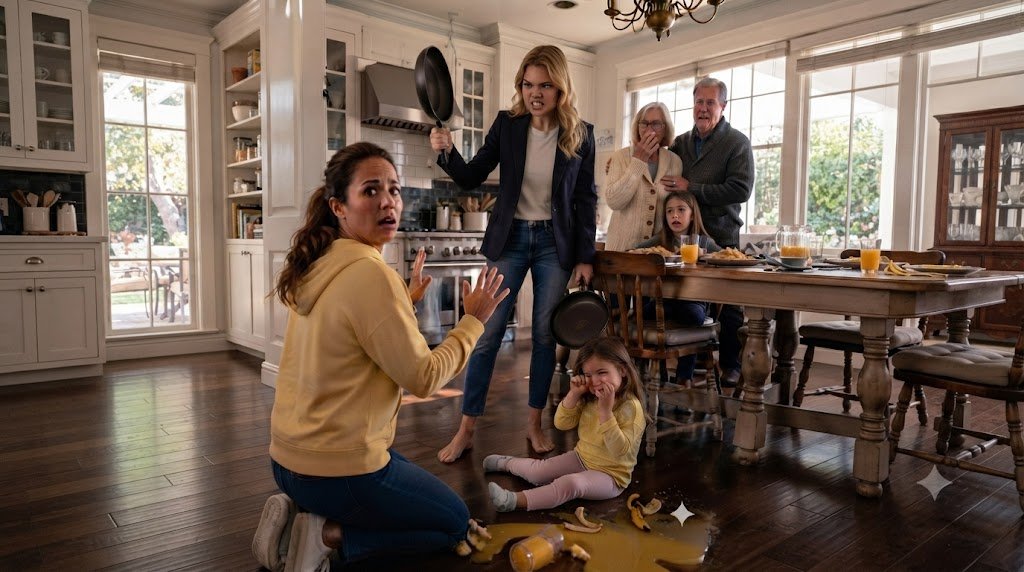
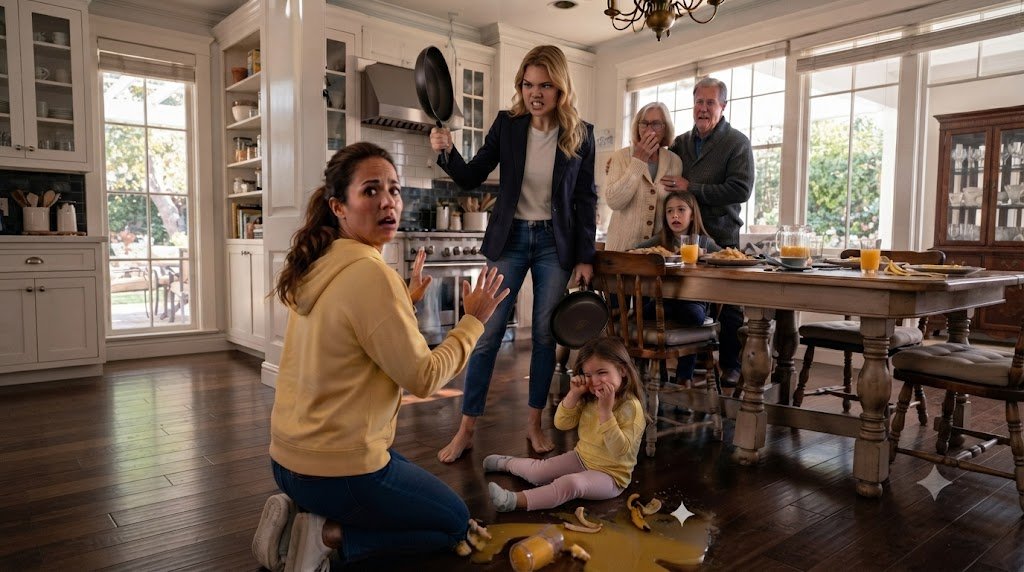
At Breakfast, My Four-Year-Old Daughter Accidentally Took Her Cousin’s Seat And Reached For A Plate Of Eggs. My Sister Snatched The Cast-Iron Skillet From The Stove And Sent It Crashing Into Her Face, Leaving Her Motionless On The Kitchen Floor.
When I Heard The Explosion, I Ran Downstairs, shouting, “What kind of person—” before my mother cut me off.
“Enough! Take her somewhere else. You’re ruining the morning for everyone!”
I carried my daughter to the hospital, but what I discovered there would make that breakfast impossible to forget.
PART 1
The clearest thing I remember from that morning was the sharp smell of butter scorching on the edge of my mother’s old stove.
I had gone upstairs to rinse maple syrup from Sophie’s pale-blue sweatshirt. I thought I would be gone for five minutes.
I was upstairs for less than eight.
At exactly 8:23 a.m., a violent metallic crash shook the floor beneath my feet.
Then came silence.
Not ordinary silence.
The kind that makes your stomach drop before your mind understands why.
I ran downstairs and found Sophie lying beside Audrey’s chair. One tiny sock had slipped halfway off her foot, and her fingers were curled against the wooden floor.
A heavy black skillet lay inches from her head.
Bits of scrambled egg clung to its rim.
Audrey stood frozen beside the table, staring at a puddle of orange juice spreading across the floor. My sister, Marina, was beside the stove, her arms crossed tightly over her chest.
I dropped to my knees.
“Sophie!”
I called her name again and again until I saw the faintest movement beneath her ribs.
She was breathing.
When I lifted her, her body sagged against me. Her head rolled backward, and I immediately supported her neck.
Marina gestured toward Audrey’s place setting.
“She took Audrey’s seat.”
I stared at her.
“She’s four years old.”
“She has to learn.”
“She’s a child!”
“She still needs to understand boundaries.”
I took one step toward Marina.
My mother moved between us.
“Take Sophie outside,” she said sharply. “Everyone is already upset. Don’t make this worse.”
My father silently picked up Sophie’s little purple cup and placed it beside the sink.
He never once looked at her.
That was the moment something inside me went cold.
I stopped arguing.
I carried my daughter out of the house.
In the driveway, my hands were trembling so badly that I buckled Sophie into her car seat, checked the latch, then checked it again.
The car smelled faintly of crayons and the banana slices she had dropped beneath the passenger seat the previous afternoon.
I put the emergency operator on speaker and followed every instruction while backing out of my parents’ driveway.
My mother appeared on the porch.
She was holding my jacket.
She wasn’t holding Sophie’s shoes.
At 8:46 a.m., a nurse took one look at my daughter and immediately called for the pediatric trauma team.
I followed the stretcher until the hospital doors closed between us.
Then I stood beneath harsh fluorescent lights, staring at the dried syrup smeared across my sleeve.
A receptionist named Maya brought me a cup of water. While entering the information, she accidentally marked Sophie’s age as six.
“Four,” I said.
Maya looked up.
I swallowed.
“My daughter is four.”
She corrected the form.
Then she reached the section asking how the injury had occurred.
My hand stopped moving.
The pen hovered above the paper until a tiny black spot formed beneath its tip.
Finally, I wrote:
“My sister threw a hot skillet at my four-year-old daughter during breakfast.”
Maya stopped typing.
“Did you personally see her throw it?”
“No.”
I looked toward the closed treatment doors.
“But everyone else in that kitchen did.”
My phone had been vibrating nonstop.
Mom.
Marina.
Dad.
Mom again.
I silenced every incoming call but left the notifications visible.
At 9:34 a.m., a doctor finally came to me.
Sophie was stable.
She had been sedated and was receiving treatment for a serious facial injury and concussion. Because of her age and the circumstances surrounding the injury, a hospital social worker needed to speak with me before any relatives were permitted to see her.
I pressed my palms against my knees, forcing myself to breathe.
A few minutes later, a social worker named Patricia entered with a hospital security officer.
She sat across from me.
“Has anyone in your family contacted you about what happened?”
Before I could answer, Dad’s name appeared on my screen.
This time, I answered.
“Daniel,” he said quietly, “your mother thinks everyone needs some time before you start blaming people.”
“I’m not blaming anyone. I told the hospital exactly what happened.”
“You weren’t in the kitchen.”
I stared at the floor.
“Was the skillet thrown?”
Silence.
I waited.
He didn’t answer.
Finally, he said, “Marina has Audrey to worry about.”
I ended the call.
Patricia extended her hand.
“May I see your phone?”
I handed it over.
As she reviewed the messages, another notification appeared.
It wasn’t from Marina.
It was from my mother.
The preview contained only one sentence:
“I told Marina to deal with Sophie before you came downstairs.”
PART 2 — THE MESSAGE
Patricia read the message twice.
Then she looked at me.
“Did your mother mean that literally?”
“I don’t know.”
My voice sounded strange, even to me.
“She said she told Marina to deal with Sophie.”
The security officer beside Patricia asked, “Can you unlock the phone for us?”
I did.
Patricia scrolled through the conversation.
There were no long explanations from my mother. No apology. No question about whether Sophie was alive.
Just a series of short messages.
Mom: You need to control her.
Mom: She cannot keep interfering with Audrey.
Mom: I warned you this would happen.
Then, sent less than three minutes after I had carried Sophie out of the house:
Mom: I told Marina to deal with Sophie before you came downstairs.
Patricia placed the phone on the table.
“Has your daughter ever been treated differently by your family?”
I hesitated.
That question opened a door I had spent years keeping closed.
“Yes.”
“How?”
I rubbed my forehead.
“Marina’s daughter, Audrey, is nine. My parents treat her like she can do no wrong.”
“And Sophie?”
“They’ve always said she was difficult.”
Patricia leaned forward.
“What does difficult mean?”
I thought about the birthday parties where Sophie was told to sit somewhere else.
The Christmas morning when Audrey received three wrapped presents before anyone remembered Sophie was standing nearby.
The family photographs where my mother would pull Audrey onto her lap and tell Sophie to move because there wasn’t enough room.
“She’s four,” I said quietly. “Sometimes she talks too loudly. Sometimes she gets excited. She’s a normal child.”
Patricia nodded.
“Has Marina ever physically hurt her before?”
I looked at the closed hospital doors.
“No.”
Then I corrected myself.
“Not like this.”
The security officer wrote something down.
“What happened at breakfast before you went upstairs?”
I replayed the morning in my head.
It had seemed so ordinary.
My mother had been cooking eggs.
Dad was reading something on his tablet.
Marina and Audrey were already seated at the table.
Sophie had been sleepy, still wearing her sweatshirt, and I had helped her climb into the chair beside Audrey.
Then my mother told me to get a towel because syrup had spilled on Sophie.
Nothing seemed dangerous.
Nothing warned me that leaving the room would change everything.
“I was gone less than ten minutes.”
Patricia nodded slowly.
“Did anyone mention being angry with Sophie before you went upstairs?”
I remembered Marina’s expression.
“Yes.”
“What did she say?”
“She told Sophie to move.”
“Why?”
“Because she said the chair belonged to Audrey.”
Patricia exchanged a glance with the security officer.
“And what did Sophie do?”
“She moved.”
“Then?”
“She came back.”
“Why?”
I almost smiled despite everything.
“She saw Audrey’s plate of strawberries and wanted one.”
Patricia’s expression softened.
“That sounds like a four-year-old.”
“It does.”
My phone vibrated again.
This time it was Marina.
Patricia looked at the screen.
“You don’t have to answer.”
“I want to know what she’s saying.”
I accepted the call.
For several seconds, neither of us spoke.
Then Marina whispered, “How is Sophie?”
I stared at the hospital doors.
“You tell me.”
“What does that mean?”
“You were standing there.”
“I didn’t mean for this to happen.”
My grip tightened around the phone.
“So you admit you threw it?”
“I panicked.”
“You threw a skillet at a child.”
“She came toward me!”
“She’s four!”
“I know!”
Marina’s voice cracked.
For the first time, she sounded frightened.
“I thought she was going to hurt Audrey.”
“With what?”
“She grabbed the fork.”
I closed my eyes.
“A plastic fork?”
Silence.
Then Marina said, “It happened so fast.”
I looked at Patricia.
She was writing everything down.
“What happened after Sophie fell?”
Marina began crying.
“Mom told me to go upstairs.”
“Why?”
“She said Dad would handle it.”
“And Dad?”
“He told me to keep quiet.”
My entire body went still.
“Who else was there?”
“Everyone.”
“Did Mom tell you to throw the skillet?”
“No.”
Marina paused.
“She told me to make sure Sophie understood that Audrey’s things were off-limits.”
I heard Patricia quietly ask the security officer to contact hospital administration.
I lowered my voice.
“Marina, listen to me carefully. Did Mom know you were holding the skillet?”
“I don’t know.”
“Did she see what happened?”
Another pause.
“Yes.”
That single word changed the room.
I ended the call.
Patricia immediately asked, “Can you preserve that recording?”
“I think so.”
The security officer took the phone again and helped document the call.
Then Patricia said something that made my stomach tighten.
“There may be more to this than a family argument.”
“What do you mean?”
She pointed toward the hospital doors.
“Your daughter is four years old. She suffered a serious injury inside a home where multiple adults were present. Yet every person you’ve mentioned seems more concerned about protecting someone than asking how she is.”
I didn’t answer.
Because I knew exactly what she meant.
My family wasn’t confused about what happened.
They were deciding what version of it they could survive.
At 10:18 a.m., a nurse came rushing toward us.
“Sophie is awake.”
I stood so quickly that the chair scraped against the floor.
“Can I see her?”
The nurse nodded.
“But only one person.”
I followed her through the doors.
Sophie lay beneath a thin white blanket, her face partially bandaged.
Her eyes opened when she heard my voice.
“Daddy?”
I took her hand.
“I’m here, sweetheart.”
She squeezed my finger.
For a moment, neither of us spoke.
Then she whispered something that made my heart stop.
“Daddy…”
“Yes?”
“Grandma told Aunt Marina I was a bad girl.”
I looked at the nurse.
Then back at my daughter.
Sophie swallowed.
“She said I shouldn’t sit at Audrey’s table.”
I leaned closer.
“What happened after that?”
Sophie’s eyes filled with tears.
“Aunt Marina picked up the hot pan.”
My blood went cold.
“And then?”
She squeezed my hand harder.
“Grandma said…”
Her voice became barely audible.
“‘Make her remember.’”
I froze.
Outside the room, footsteps suddenly stopped.
Someone had been standing on the other side of the door.
Then the handle began to turn.
PART 3 — THE TRUTH COMES OUT
The door opened.
My father stood there.
Behind him were my mother and Marina.
For several seconds, nobody moved.
Then my mother looked at Sophie.
Her expression changed the instant she saw the bandages.
“Oh, sweetheart…”
She took one step into the room.
I stood up.
“Stop.”
My mother froze.
“She needs to see me.”
“She needs people who won’t hurt her.”
My father lowered his eyes.
“Daniel, this has gone too far.”
“No. It went too far when a four-year-old was hit with a skillet.”
Marina began crying.
“I said I was sorry.”
“You’re not the only person who needs to apologize.”
My mother stiffened.
“I never told anyone to hurt her.”
I looked directly at her.
“Sophie says you did.”
“She was confused.”
“She was awake enough to remember your words.”
My mother shook her head.
“She’s four.”
“Yes,” I said. “Exactly. Which means she shouldn’t have been put in a position where she had to remember something like this.”
Patricia entered behind them with the security officer.
“Everyone needs to leave the room except the child’s father.”
My mother immediately protested.
“You can’t keep us from our granddaughter.”
Patricia remained calm.
“Not while the investigation is ongoing.”
My father finally spoke.
“There is an investigation?”
“Yes.”
The color drained from his face.
My mother stared at me.
“You called the police?”
“I called 911.”
“You’re destroying this family.”
I almost laughed.
“No, Mom. I’m finally refusing to protect it.”
The room went silent.
Patricia asked Marina to remain available for questioning.
Marina looked at me.
“I never wanted to hurt Sophie.”
I believed her.
But that didn’t erase what she had done.
“You should have protected her.”
Marina covered her face.
My mother turned toward her.
“Don’t say another word.”
Patricia immediately noticed.
“Why shouldn’t she?”
My mother didn’t answer.
The security officer stepped closer.
“Mrs. Hart, we’d like you to come with us.”
My mother looked at my father.
He didn’t move.
For the first time in my life, I saw fear in her eyes.
Not fear for Sophie.
Fear for herself.
That was when I understood.
The message on her phone wasn’t the only evidence.
She had sent several messages that morning.
The hospital later recovered them.
At 8:05 a.m., she had written to Marina:
“She needs to learn that Audrey comes first.”
At 8:11 a.m.:
“Don’t let her take Audrey’s seat again.”
And at 8:21 a.m., just before the skillet struck:
“Handle it before Daniel comes back.”
Those messages changed everything.
Marina admitted that my mother had repeatedly complained about Sophie being “spoiled” and “disrespectful.”
She admitted she had been angry before breakfast.
My father eventually confessed that he had seen the skillet hit Sophie and had chosen not to intervene because he was afraid of what would happen if he challenged my mother.
That confession hurt almost as much as the injury itself.
Because silence had been a choice.
For years, I had believed my family was complicated.
Now I understood the truth.
They weren’t complicated.
They had simply become comfortable sacrificing one child to protect another.
Sophie remained in the hospital for several days.
Her doctors monitored her concussion and treated the injuries to her face. She was frightened by loud noises for weeks afterward.
But she healed.
Slowly.
One morning, several weeks later, she stood in our kitchen wearing a new yellow sweatshirt.
She climbed into a chair and looked at me.
“Daddy?”
“Yes?”
“Is this my chair?”
I felt something tighten in my chest.
I crouched beside her.
“You can sit anywhere you want.”
She smiled.
“Even at the big table?”
“Especially at the big table.”
She laughed.
Then she reached for a strawberry.
For the first time in weeks, breakfast felt like breakfast again.
My mother was no longer part of our mornings.
Marina entered a plea and was required to complete court-ordered counseling and parenting programs. The investigation also resulted in my mother facing charges related to her involvement and attempts to influence the story afterward.
My father eventually called.
He wanted forgiveness.
I told him forgiveness wasn’t the same thing as trust.
Trust had to be rebuilt.
And rebuilding would take time.
Months later, Sophie still sometimes asked why Grandma was angry with her.
I never told her that she wasn’t loved.
I told her something more important.
None of it had been her fault.
Not the chair.
Not the strawberries.
Not the spilled juice.
Not the skillet.
Nothing.
She had simply been a four-year-old who wanted to sit with her family at breakfast.
And that was the part I would never forget.
The morning my daughter was hurt, my family tried to convince me that keeping the peace mattered more than telling the truth.
But when I walked into that hospital carrying my unconscious child, something inside me changed forever.
I stopped protecting people who had never protected her.
And I learned that sometimes the hardest family decision isn’t choosing whom to forgive.
It’s deciding whom you will never allow to hurt your child again.
THE END.