COLD OPEN
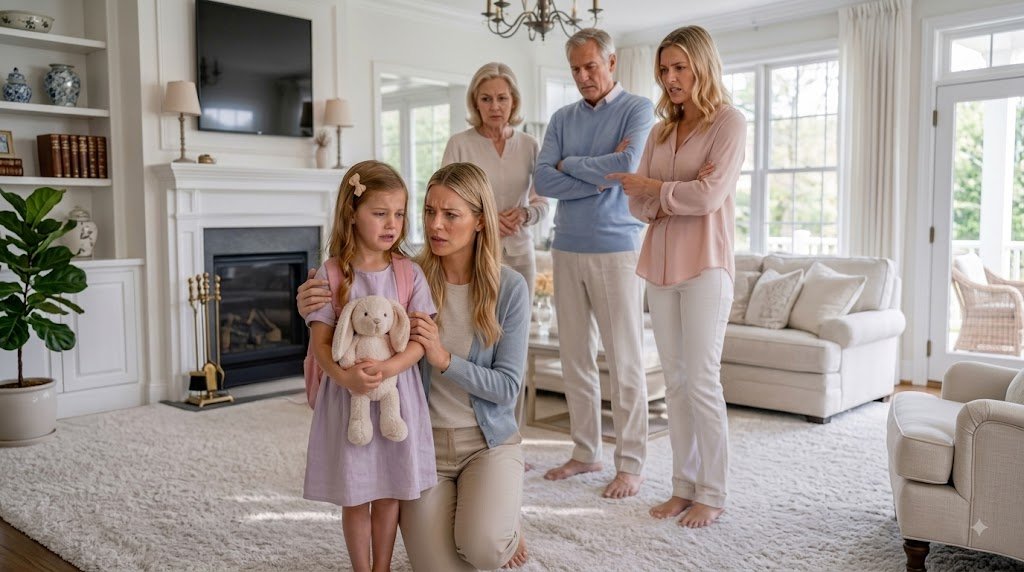
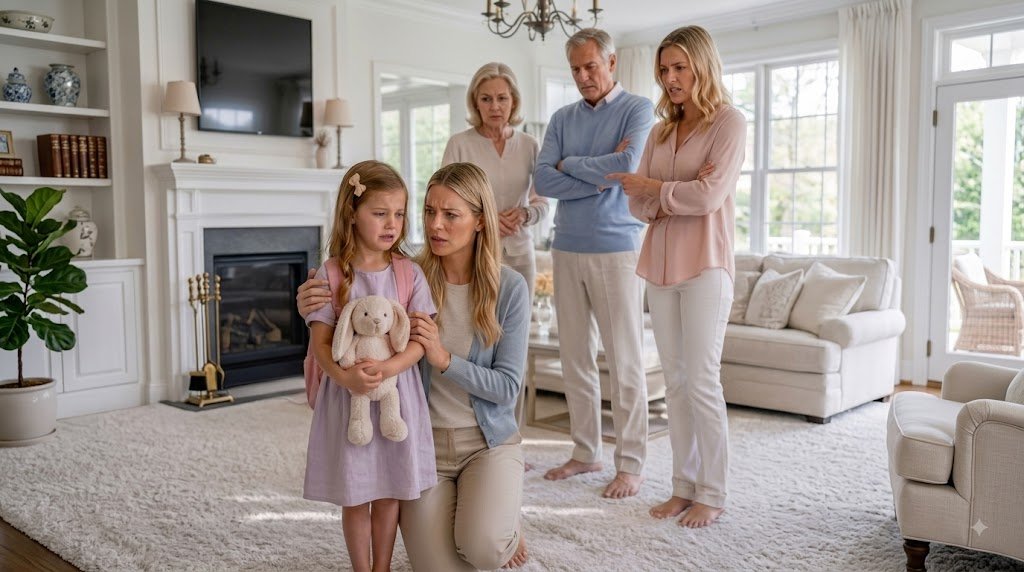
Three days after I was admitted to the hospital, I came back to my parents’ house and found my six-year-old daughter standing beneath the hallway light with a backpack already fastened to her shoulders.
She didn’t run to me.
She didn’t throw her arms around my waist or call “Mom” the way she normally did whenever we’d been apart.
She simply stared at the floor.
Her tiny hands were gripping the backpack straps so tightly that her knuckles had turned pale.
The bag was stuffed so full that the zipper barely closed. The floppy ears of her favorite stuffed rabbit poked through the opening.
I looked at my daughter.
Then at the backpack.
And one terrifying thought entered my mind:
Why did my little girl believe she was about to be sent away?
PART 1: THE GIRL WHO THOUGHT SHE HAD TO LEAVE
My name is Nora Whitmore.
Three days earlier, I had been rushed to a hospital in Savannah, Georgia, after complications with my pregnancy.
I was still weak when the doctors finally told me that both my unborn baby and I were out of immediate danger.
I should have felt nothing but relief.
Instead, the second I saw my daughter, Elsie, standing in that hallway, something cold settled in my stomach.
My husband, Daniel, stood beside me at the entrance.
He had driven slowly from the hospital because I was still recovering and nearly seven months pregnant.
I opened my arms.
“Sweetheart, come here. Mommy missed you.”
Elsie lifted her eyes.
But she didn’t move.
Behind her, my mother appeared with an enormous smile.
“There you are!” she exclaimed. “Elsie has been such a wonderful little girl.”
My younger sister, Mara, stepped into the hallway behind her.
Her daughter, Sophie, stood at her side.
Sophie and Elsie were the same age.
But there was something smug in Sophie’s expression, the look of a child who knew the adults around her would always protect her.
Mara glanced at Elsie.
Then at me.
For the briefest moment, I saw a tiny smile pull at the corner of her mouth.
It vanished almost immediately.
But I knew my sister.
I had spent my entire childhood learning to recognize that expression.
It was the look Mara wore whenever she believed she had won.
Daniel reached for Elsie’s backpack.
“Come on, sweetheart. Ready to go home?”
Elsie nodded.
But she wouldn’t let him take the bag.
We left almost immediately.
I didn’t stay for my mother’s coffee.
I didn’t listen to her stories about how wonderfully the girls had behaved.
I simply told everyone I was exhausted.
That part was true.
But it wasn’t why I wanted to leave.
I couldn’t stop looking at Elsie’s face.
During the drive home, Elsie sat silently in the back seat with her stuffed rabbit pressed tightly against her chest.
Normally, she could talk for an entire car ride.
She would tell us about breakfast, invent ridiculous stories, describe every game she’d played with Sophie, and explain some new idea she’d decided was absolutely brilliant.
That day, there was nothing.
Not a single question.
Not one song.
I turned around as much as my seat belt allowed.
“Did you have a good time with Grandma?”
She shrugged.
“Did something happen?”
Elsie continued staring through the window.
I waited.
Finally, she whispered,
“Mommy… am I taking up too much room?”
Daniel’s hands tightened around the steering wheel.
“What do you mean?” I asked carefully.
She looked down at the rabbit.
“I can be smaller.”
My heart sank.
“I don’t need all my toys.”
Her voice trembled.
“I can sleep somewhere else.”
“Who told you that?”
She twisted one of the rabbit’s ears around her finger.
She wouldn’t answer.
I looked at Daniel.
He looked back at me.
Neither of us said anything.
But we both understood that something had happened while I was in the hospital.
When we reached our house, Elsie didn’t take off her backpack.
She remained beside the front door as though she were waiting for someone to decide whether she was allowed to stay.
I forced a smile.
“We’re home, sweetheart.”
She looked at me.
“You can take your things to your bedroom.”
She hesitated.
Then she slowly walked inside.
A few minutes later, I noticed her stuffed rabbit lying on the sofa.
“Elsie, honey, could you put your rabbit in the toy box before dinner?”
The reaction was immediate.
She rushed to the sofa, grabbed the rabbit, and shoved it into the toy box.
Then she burst into tears.
“I’m sorry!”
I froze.
Elsie covered her face.
“I didn’t know it was taking too much space!”
Daniel immediately knelt beside her.
“Hey, hey. Nobody is angry.”
“I’ll be good!”
Her sobs became louder.
“Please don’t send me away!”
My entire body went cold.
Daniel looked at me.
I could see the shock on his face.
He gently took Elsie’s hands.
“No one is sending you anywhere.”
She shook her head.
“Aunt Mara said I have to make room for the real children.”
I felt something inside me crack.
Elsie continued through her tears.
“She said when the baby comes, Mommy won’t need me anymore.”
Daniel’s jaw tightened.
Then Elsie whispered the words that would stay with me forever.
“She said you would send me back to the orphanage.”
For several seconds, I couldn’t breathe.
I dropped to my knees and pulled my daughter into my arms.
She was trembling violently.
All the fear she had carried for three days finally came pouring out.
“Listen to me,” I whispered.
I gently lifted her face.
“You are my daughter.”
She stared at me through tears.
“You are our family. You are not going anywhere.”
“But Aunt Mara said—”
“Aunt Mara was wrong.”
I wiped the tears from her cheeks.
“You are not temporary.”
She sniffed.
“You are not being replaced.”
I held her tighter.
“This is your home. You belong here. And nothing about your new baby brother or sister will ever change that.”
She cried against my shoulder until her breathing finally slowed.
Daniel carried her upstairs and tucked her into bed.
I remained downstairs.
I stood beside the toy box and stared at the stuffed rabbit she had been afraid to leave on the sofa.
My parents.
My sister.
The people who were supposed to love my daughter had spent three days convincing a six-year-old child that she was disposable.
They had made her believe that becoming a big sister meant losing her family.
And they apparently expected me to complain for a few minutes, accept some excuse, forgive them, and continue pretending everything was normal.
I listened to Elsie’s faint crying from upstairs.
Then I made a decision.
They had told my daughter to make room.
Fine.
I was going to show them exactly what making room really meant.
And this time, it wasn’t going to be my daughter who had to leave.
PART 2: THE TRUTH THEY NEVER EXPECTED ME TO FIND
The next morning, I woke before sunrise.
I hadn’t slept more than two hours.
Every time I closed my eyes, I heard Elsie’s voice.
Please don’t send me away.
I walked into her bedroom quietly.
She was curled beneath her blanket, still clutching the stuffed rabbit against her chest.
For a moment, I simply watched her sleep.
Then I noticed something on the floor.
Her backpack.
It was still packed.
I opened it carefully.
Inside were three shirts, two pairs of socks, her toothbrush, a small coloring book, and a photograph of Daniel and me.
She had packed the things she believed she would need if we abandoned her.
I sat on the edge of the bed and covered my mouth.
Six years old.
She was six years old.
And my family had convinced her to prepare for losing her home.
I took a photograph of the backpack.
Then I closed it.
I wasn’t going to forget this.
At breakfast, Elsie barely touched her pancakes.
Daniel sat across from her.
“Want some strawberries?”
She shook her head.
“What about your favorite cereal?”
Another shake.
I reached across the table.
“Elsie.”
She looked at me.
“You don’t have to be afraid anymore.”
She whispered,
“Can Grandma come back?”
I felt Daniel’s eyes move toward me.
“No.”
Elsie looked confused.
“Why?”
“Because I need to talk to Grandma before she comes here again.”
Daniel nodded.
“You won’t be alone with them again.”
Elsie seemed to relax slightly.
Then the doorbell rang.
I knew exactly who it was.
My mother never knocked twice.
I opened the door.
My mother, Judith, stood there holding a casserole dish.
Beside her was Mara.
Sophie waited behind them.
Judith smiled.
“We brought breakfast.”
I didn’t move aside.
“You need to leave.”
Her smile disappeared.
“Nora, don’t be dramatic.”
“You told my six-year-old daughter she was going back to an orphanage.”
Judith’s face tightened.
“Oh, sweetheart, she misunderstood.”
“No.”
My voice was calm.
“She repeated your words.”
Mara crossed her arms.
“She was being difficult.”
Daniel stepped beside me.
“She was terrified.”
Mara rolled her eyes.
“She needs to learn that the baby is going to need attention.”
“She is six,” I said.
“She’ll survive.”
I stared at my sister.
There it was.
The same cold expression she’d worn all my life.
The expression of someone who believed other people’s pain was an inconvenience.
“Get off my property.”
Judith looked shocked.
“You’re throwing your own mother out?”
“Yes.”
“We were only trying to help.”
“No,” I said. “You were teaching my daughter that she doesn’t belong.”
Mara laughed bitterly.
“You’re seriously choosing her over your own family?”
I looked directly at her.
“She is my family.”
Silence.
Then I closed the door.
That afternoon, I called my parents.
Not to argue.
To ask one question.
“Why did you tell Elsie she was adopted?”
My mother went silent.
I hadn’t known whether it was true.
Now I knew.
“You never told her?”
Judith finally answered.
“We thought she should know eventually.”
“Eventually?”
“She has a right to know where she came from.”
I gripped the phone.
“Who told her she would be sent back?”
No answer.
“Mom.”
“It was an expression.”
“You scared my child.”
“We didn’t mean it literally.”
I closed my eyes.
Then I remembered something Elsie had said.
Make room for the real children.
“Mom,” I said quietly, “what exactly did you tell her about the baby?”
Another pause.
Then she said,
“We told her things would be different.”
“Different how?”
“We told her that once you had a biological child, you would finally have your own family.”
The words hit harder than I expected.
My own mother.
The woman who had held Elsie as a newborn.
The woman who had promised to love her.
She had apparently spent three days teaching my daughter that she was somehow less real.
I ended the call.
Then I called my attorney.
Her name was Caroline Hayes.
She had helped me with an adoption matter years earlier.
When I explained what had happened, she didn’t interrupt.
At the end, she asked,
“Do you have evidence?”
“Yes.”
“Messages?”
“Yes.”
“Did your daughter repeat what they said?”
“Yes.”
“Any witnesses?”
“Daniel heard her.”
Caroline was silent for a moment.
“Then start documenting everything.”
“What should I do?”
“Write down the exact words your daughter used. Don’t coach her. Don’t repeatedly question her. Just record what she spontaneously tells you.”
I opened a notebook.
The first page was blank.
I wrote the date.
Then I wrote:
Elsie said Aunt Mara told her she would be sent back to the orphanage after the baby arrived.
My hand shook.
But I kept writing.
Three days later, something happened that changed everything.
I was putting away laundry when I found a folded sheet of paper beneath Elsie’s mattress.
At first, I thought it was a drawing.
Then I opened it.
It was a list.
At the top, in uneven six-year-old handwriting, were the words:
THINGS I CAN GIVE AWAY
Underneath:
My pink blanket.
My rabbit.
My books.
My bedroom.
My toys.
At the bottom she had written:
Then maybe Mommy can keep me.
I sat down on the floor.
I couldn’t breathe.
Daniel found me there.
He read the page.
His face changed.
“This ends now.”
I nodded.
“Yes.”
That night, Daniel called his mother.
I stood nearby but said nothing.
“I need you to listen carefully,” he said.
Judith immediately began crying.
But Daniel didn’t soften.
“You will never speak to Elsie alone again.”
A long silence followed.
Then Judith said,
“You’re letting Nora turn you against us.”
“No.”
His voice was steady.
“You did that yourself.”
He ended the call.
For the first time since we came home from the hospital, I saw relief in his eyes.
A week later, Caroline called me.
“I found something.”
“What?”
“Your parents contacted a private family counselor.”
I frowned.
“Why?”
“They’ve been claiming that Elsie is emotionally unstable because of the pregnancy.”
My stomach dropped.
“They’re trying to make it look like she needs to be removed from the home.”
Caroline continued.
“And there’s more.”
“What?”
“Your mother has been telling people that because Elsie was adopted, she has no legal connection to your family.”
I stared at the wall.
That was completely false.
But then Caroline said something that made my blood run cold.
“They aren’t just trying to hurt her.”
“They’re trying to create a record.”
I understood immediately.
They weren’t simply being cruel.
They were building a story.
A story where Elsie was the problem.
A story where I was an unstable mother.
A story where sending my daughter away could somehow be portrayed as necessary.
I looked toward the hallway.
Elsie’s bedroom door was open.
Her stuffed rabbit sat safely on her pillow.
For the first time, I understood what my family had been doing.
They weren’t preparing my daughter for a new baby.
They were preparing the ground to take her away.
And they had no idea that I had already started gathering everything I needed to stop them.
PART 3: THE DAY THEY LOST THEIR POWER
Two weeks later, my parents made their biggest mistake.
They called child services.
They claimed Elsie was neglected.
They claimed I was too ill to care for her.
And they claimed my pregnancy had made me emotionally unstable.
When Caroline called to tell me, I wasn’t surprised.
I was ready.
“I have everything,” I said.
“Good,” she replied. “Then don’t panic.”
I didn’t.
Because Caroline had been documenting every message, every accusation, and every attempt my parents had made to isolate Elsie.
Daniel had also saved the text messages from Mara.
One message stood out:
Once the baby arrives, she won’t be your priority anymore. She needs to understand that now.
Another said:
If she can’t accept being replaced, maybe she shouldn’t stay with you.
Those messages changed everything.
A social worker came to our house on a rainy Thursday afternoon.
Her name was Maribel Grant.
She was calm and professional.
She spoke to Daniel first.
Then to me.
Finally, she asked if she could speak with Elsie privately.
I agreed.
I had nothing to hide.
Elsie sat at the kitchen table with her rabbit beside her.
Maribel gently asked,
“Do you feel safe at home?”
Elsie nodded.
“Does anyone hurt you?”
“No.”
“Does your mom take care of you?”
“Yes.”
“Do you want to live somewhere else?”
Elsie looked at her.
Then she shook her head.
“I want to stay with Mommy and Daddy.”
Maribel smiled gently.
“Why?”
Elsie hugged her rabbit.
“Because this is my home.”
Then she looked down.
“But Grandma said I might have to leave.”
Maribel’s expression changed.
“What did Grandma tell you?”
Elsie answered slowly.
“She said I’m not a real child because I’m adopted.”
I felt Daniel’s hand tighten around mine.
“And what else?”
“She said when Mommy’s baby comes, there won’t be room for me.”
Maribel wrote something down.
Then Elsie said something none of us expected.
“She told me to pack my backpack.”
Maribel looked up.
“Who did?”
“Aunt Mara.”
That was the moment everything became clear.
My parents had told investigators that Elsie was unstable.
But their own words had created the evidence proving why she was frightened.
Three days later, Caroline sent me a message.
They withdrew the complaint.
I stared at the screen.
“Why?”
“They know the investigation isn’t going their way.”
Then another message arrived.
But your mother wants to meet.
I almost refused.
Then I thought about Elsie.
“Set it up.”
We met at a quiet restaurant outside Hilton Head.
Judith arrived alone.
She looked older than I remembered.
She sat across from me.
“I made mistakes.”
I said nothing.
“She was never supposed to be this frightened.”
“But you frightened her.”
Judith’s eyes filled with tears.
“We thought you were making a mistake by adopting her.”
My hands tightened around the edge of the table.
“You’ve had six years to tell me that.”
“We thought once you had a biological child, you’d finally understand.”
“Understand what?”
“What it means to have a real family.”
I stared at her.
Then I said the words I had wanted to say for years.
“Elsie is my real family.”
Judith began crying.
“I know that now.”
“No.”
I shook my head.
“You know it because you lost access to her.”
She looked down.
I continued.
“You didn’t lose your granddaughter because of me. You lost her because you taught a six-year-old child that she could be discarded.”
Judith whispered,
“Can you ever forgive me?”
“I may forgive you someday.”
I stood.
“But forgiveness doesn’t mean access.”
Then I walked away.
Mara was different.
She never apologized.
Instead, she sent one final message.
You ruined this family.
I replied:
No. I protected my daughter.
Then I blocked her number.
I blocked my parents too.
For the first time in my adult life, I didn’t feel guilty for creating distance.
I felt free.
Seven months later, my baby was born.
A healthy little boy.
We named him Caleb.
Elsie was the first person allowed to hold him.
She stood beside my hospital bed, nervous and excited.
“Can I really hold him?”
I smiled.
“Of course.”
She carefully took Caleb into her arms.
“He’s tiny.”
“He is.”
She looked at me.
“Does he have to share my room?”
I laughed softly.
“No.”
She smiled.
“Good.”
Then she looked down at her brother.
“I’ll teach him everything.”
I kissed her forehead.
“You’re going to be an amazing big sister.”
Her eyes suddenly filled with tears.
“Mom?”
“Yes?”
“I’m not going anywhere, right?”
I pulled her close.
“Never.”
A year later, Elsie still kept her old backpack.
Not because she was afraid anymore.
She kept it because she had turned it into something else.
She decorated it with colorful stickers.
Her rabbit hung from the zipper.
And inside were her favorite books, crayons, and a small photograph of our family.
One afternoon, I found her packing it.
I smiled.
“Going somewhere?”
She nodded.
“To Grandma’s?”
I froze for half a second.
Then I realized she was smiling.
“No,” she said.
“I’m going to the park with Dad.”
I laughed.
“Then why the backpack?”
She shrugged.
“Just in case.”
I knew exactly what she meant.
But I also knew she was no longer packing to escape.
She was packing because she could.
Because the choice belonged to her.
Not my mother.
Not Mara.
Not anyone else.
Years later, when I think about those three days in the hospital, I don’t remember the fear of my pregnancy.
I remember the little girl waiting in the hallway with a backpack on her shoulders.
I remember how she believed she needed to become smaller to remain loved.
And I remember the promise I made that night.
They had wanted her to make room.
So I made room.
I removed the people who taught her that love could be conditional.
I removed the fear.
I removed the lies.
And I gave my daughter something no one could ever take from her again.
A home where she never had to earn her place.
A family where she was never a second choice.
And the certainty that she belonged.
Because blood can create a family.
But love, protection, and choice are what make it home.
THE END.