COLD OPEN
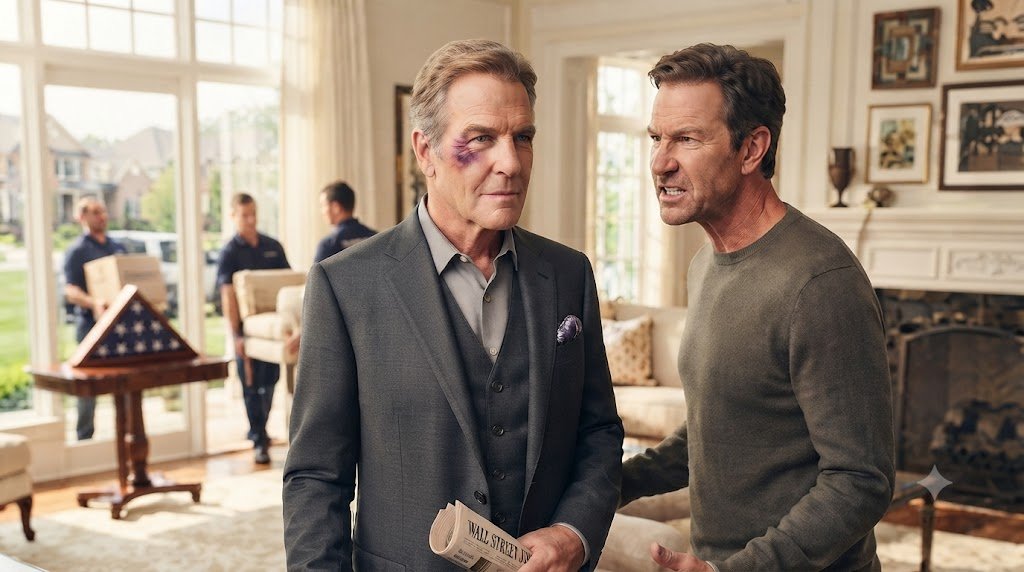
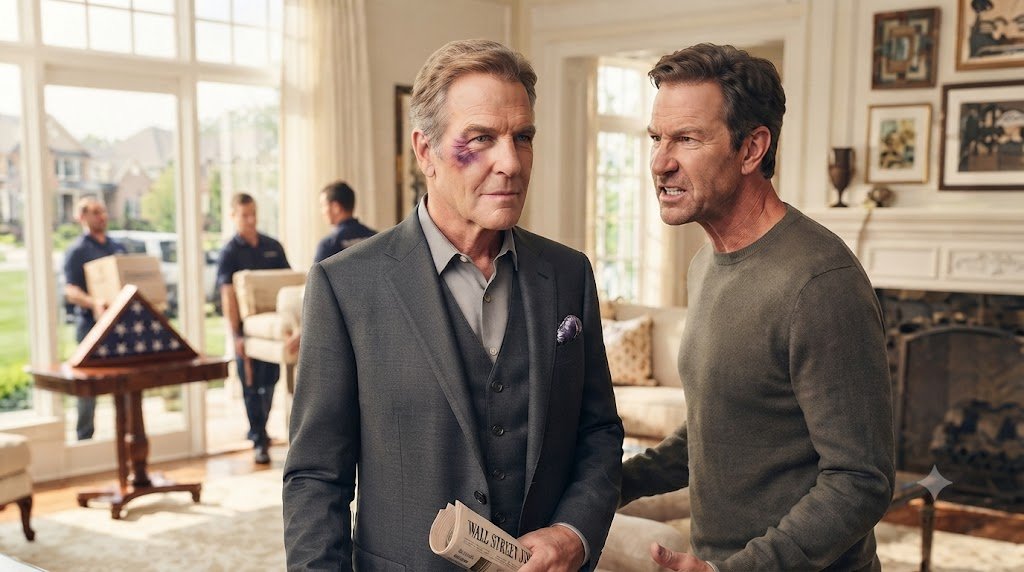
My son hit me thirty times in front of his wife because he believed an old man had nothing left to fight with.
He was wrong.
The next morning, while he sat in his office planning renovations for the house he believed he would inherit, I signed one document.
By sunset, the property was no longer his to dream about.
And when he discovered who had bought it, his confidence disappeared.
PART 1
My name is Walter Grayson. I am seventy years old.
For forty-three years, I built hotels, shopping centers, and residential developments across Arizona and Nevada. I learned early that buildings reveal more about people than their clothes ever do.
My son, Caleb, had forgotten that.
I bought his house seven years earlier.
Not because he earned it.
Because I wanted to give him a chance to build a life without struggling through the mistakes I had made at his age.
The house stood on a quiet ridge outside Scottsdale, surrounded by desert gardens and enormous windows that caught the orange light of every sunset.
Caleb called it his home.
His wife, Marissa, called it “the family estate.”
Neither knew the truth.
The property belonged to one of my companies.
Caleb had never owned it.
He had never even read the paperwork.
Over the years, his attitude changed.
At first, he called every Sunday.
Then every few weeks.
Eventually, he only contacted me when he wanted money, advice, or access to one of my connections.
Marissa was worse.
She hated my old pickup truck.
She complained when I arrived without warning.
Once, at a dinner party, I heard her tell a friend, “Walter is wealthy, but he still behaves like a contractor.”
I smiled when she said it.
She didn’t know that contractor had paid for the house she was standing in.
Then came Caleb’s thirty-second birthday.
I arrived carrying a small wooden box containing his grandfather’s watch.
I thought it might remind him that family was worth more than appearances.
Instead, the evening ended with his hand against my face.
The first slap shocked me.
The fifth made me angry.
By the fifteenth, I stopped trying to understand how my own son had become capable of hurting me.
By the thirtieth, I knew exactly what I had to do.
Marissa watched from the sofa.
She didn’t stop him.
She simply whispered, “Maybe now he’ll finally learn.”
Caleb stood over me, breathing heavily.
“You think because you paid for everything, you can control me forever?”
I wiped the blood from my mouth.
“No,” I said quietly.
He laughed.
That was his mistake.
I wasn’t trying to control him.
I was about to stop supporting him.
The following morning, Caleb woke up convinced the previous night’s argument was finished.
He walked into his home office, poured himself coffee, and began planning a renovation.
He had already chosen a new swimming pool, a larger garage, and an addition for the master bedroom.
At 9:12 a.m., his phone rang.
It was his realtor.
“Caleb,” the man said carefully, “we need to talk about the property.”
Caleb frowned.
“What about it?”
“There has been a transfer of ownership.”
He laughed.
“That’s impossible.”
“I’m afraid it isn’t.”
Caleb stared at the papers on his desk.
“Who bought the house?”
There was a pause.
Then the realtor answered.
“Red Mesa Holdings.”
Caleb’s face tightened.
“Who owns Red Mesa?”
Another silence.
Then:
“Walter Grayson.”
For several seconds, Caleb couldn’t speak.
The house suddenly felt different.
The walls.
The furniture.
The expensive paintings.
Even the office where he had been planning his future.
None of it belonged to him.
At that exact moment, I was sitting across town with my attorney, signing the final documents.
I didn’t feel victorious.
I felt relieved.
Because sometimes the hardest thing a parent can do isn’t giving a child another chance.
It’s finally accepting that the child has already wasted every chance you’ve given him.
PART 2
Caleb didn’t call me.
That surprised me.
For the first hour after learning the truth, he apparently called the realtor seventeen times.
Then he called the attorney who had handled the original purchase.
Then he called the bank.
Everyone gave him the same answer.
The property belonged to Red Mesa Holdings.
And Red Mesa Holdings belonged to me.
At 11:40 that morning, Caleb finally drove to my office.
He entered without an appointment.
His expensive shirt was wrinkled, his hair was disheveled, and the confidence he normally wore like armor had disappeared.
“You sold my house.”
I continued reading the document in front of me.
“No. I sold my property.”
His jaw tightened.
“You know exactly what you did.”
“Yes.”
“You promised me that house.”
I looked up.
“I promised you a place to live. I never promised you ownership.”
Caleb slammed both hands onto my desk.
“After everything I’ve done for you?”
I almost laughed.
“Everything you’ve done for me?”
He stopped.
For a moment, neither of us spoke.
Then I opened the drawer beside me and removed a folder.
I placed it between us.
Inside were bank statements, maintenance bills, property taxes, insurance payments, and renovation invoices.
Seven years of expenses.
Every dollar I had paid.
Caleb flipped through the pages.
“You kept records?”
“I kept records because you never did.”
He threw the folder back onto the desk.
“So what? You’re going to throw your own son out?”
“No.”
I leaned back.
“I’m giving you thirty days.”
His eyes widened.
“Thirty days?”
“You’re thirty-two years old, Caleb.”
He stared at me.
“You have a career. You have a wife. You have savings. You have every opportunity I had when I was your age.”
His voice became quieter.
“You’re really doing this because I hit you?”
I looked directly into his eyes.
“No.”
That answer seemed to surprise him.
“I’m doing this because the hitting finally showed me what I had refused to see for years.”
His face changed.
I continued.
“You didn’t become cruel last night. Last night simply removed my excuse for pretending you weren’t.”
Caleb looked away.
For the first time, he seemed ashamed.
But the moment didn’t last.
His phone rang.
Marissa.
He answered.
“What?”
I couldn’t hear her words, but I watched his expression change.
He paced toward the window.
“What do you mean you packed?”
A pause.
“You’re leaving?”
Another pause.
Then his voice dropped.
“You knew about the house?”
Silence.
Caleb slowly lowered the phone.
“What did she say?” I asked.
He looked at me.
“She knew.”
I understood immediately.
Marissa had known that Caleb didn’t own the property.
Not everything.
But enough.
And apparently, she had already decided that a husband without a mansion wasn’t the man she wanted.
Caleb sat down heavily.
“She said she’s going to her sister’s.”
I said nothing.
He stared at the floor.
Then he whispered, “Dad…”
It was the first time he had called me that in months.
“I don’t know what to do.”
For years, I had waited to hear those words.
Now that they finally came, they didn’t make me happy.
They made me tired.
“You start by taking responsibility.”
He looked up.
“For what?”
“For your life.”
I stood and walked toward the window.
Outside, the city moved beneath the afternoon sun.
“I spent years making sure you never had to experience consequences,” I said. “I thought that was love.”
Caleb remained silent.
“I was wrong.”
He swallowed.
“Are you going to keep the house?”
“No.”
He looked surprised.
“Then why sell it?”
“Because I don’t want the house anymore.”
I turned toward him.
“I wanted you to have a home. I never wanted a mansion to become the measure of your worth.”
He stared at me for a long time.
Then he asked the question I had been expecting.
“Where am I supposed to go?”
I handed him a final envelope.
Inside was the address of a small apartment across town.
“I rented it for thirty days.”
His eyes lifted.
“You’re still helping me?”
“I’m giving you a door.”
I paused.
“What you do after walking through it is up to you.”
Caleb held the envelope tightly.
He stood.
At the doorway, he stopped.
“Dad?”
“Yes?”
“I am sorry.”
I looked at him.
“I believe you.”
His shoulders relaxed slightly.
“But being sorry isn’t the same as changing.”
He nodded.
Then he walked away.
I watched him disappear down the hallway.
For the first time in years, I wasn’t thinking about the house.
I was wondering whether my son was finally ready to become a man without living inside his father’s shadow.
I didn’t know the answer yet.
But three days later, I received a message from him.
It contained only one sentence.
“Dad, I found something in the house that you need to see.”
PART 3 — THE LAST THING HE FOUND
I read Caleb’s message twice.
Then I called him.
He didn’t answer.
A minute later, another message arrived.
“Come alone.”
Something about those two words bothered me.
I drove back to the house that afternoon.
The mansion looked strangely different without Caleb standing behind the windows. The garden was still perfectly trimmed, the stone walls still caught the golden sunlight, but the place no longer felt like a home.
It felt like evidence.
Caleb was waiting inside.
He looked exhausted.
No designer jacket.
No expensive watch.
No arrogant expression.
Just my son.
He held an old metal box in his hands.
“I found this behind the panel in the study,” he said.
I immediately recognized it.
It had belonged to my father.
I hadn’t seen it in more than twenty years.
Caleb opened the box.
Inside were several photographs, a handwritten ledger, and an old letter.
I picked up the letter.
The handwriting was unmistakable.
My father’s.
I read it slowly.
He had written the letter shortly before he died.
It wasn’t about money.
It wasn’t about property.
It was about me.
He wrote that he hoped I would never confuse providing for my children with loving them.
He wrote that wealth could protect a family from hardship, but it could never protect them from their own choices.
And at the bottom was one sentence that stopped me.
“A father should leave his children a foundation, not a cage.”
I lowered the letter.
Caleb was watching me.
“You knew this was here?”
“No.”
He looked down.
“I found it yesterday.”
“Why didn’t you tell me immediately?”
“Because I needed to read it first.”
He took a breath.
“Dad, I finally understand.”
I said nothing.
“I thought the house made me important.”
His voice trembled.
“I thought your money meant I was successful.”
He looked around the room.
“But I wasn’t successful. I was just comfortable.”
I walked to the window.
“Comfort isn’t the problem, Caleb.”
“I know.”
“Dependence is.”
He nodded.
For several moments, we stood in silence.
Then Caleb asked, “What happens now?”
I turned toward him.
“Now you build something.”
“With what?”
“Your own hands.”
He smiled faintly.
“That sounds familiar.”
“It should.”
He laughed for the first time in weeks.
A month later, the house was sold.
Caleb moved into a modest apartment.
He found additional work, paid his own bills, and began rebuilding his life without asking me to rescue him.
Marissa never returned.
At first, Caleb blamed her.
Eventually, he stopped.
He understood that she hadn’t created the problem.
She had simply revealed another one.
As for me, I kept the old letter.
I framed it and placed it in my study.
Not because it was beautiful.
Because it reminded me of the lesson I had spent too many years avoiding.
Parents sometimes believe love means removing every obstacle from their children’s path.
But if you remove every consequence, every struggle, and every responsibility, you may also remove the very things that teach them who they are.
Six months after leaving the mansion, Caleb came to visit me.
He arrived in an old used truck.
He was carrying groceries.
“I thought we’d have dinner,” he said.
I smiled.
“You bought the groceries?”
“With my own money.”
“That must have hurt.”
He laughed.
“More than you know.”
We cooked together that evening.
No mansion.
No expensive wine.
No people pretending to admire us.
Just a father and his son sitting at a small kitchen table.
Before he left, Caleb stopped at the door.
“Dad?”
“Yes?”
“Thank you for selling the house.”
I looked at him.
“Why?”
“Because if you hadn’t…”
He hesitated.
“I might have spent my entire life thinking I deserved everything you built.”
I nodded.
“And now?”
He smiled.
“Now I want to build something of my own.”
After he left, I stood by the window for a long time.
The house he had once believed was his was gone.
The money was gone too.
But somehow, I had gained something far more valuable.
My son had finally stopped asking what his father could give him.
And started asking what he could become.
That was the inheritance I had wanted for him all along.
THE END.