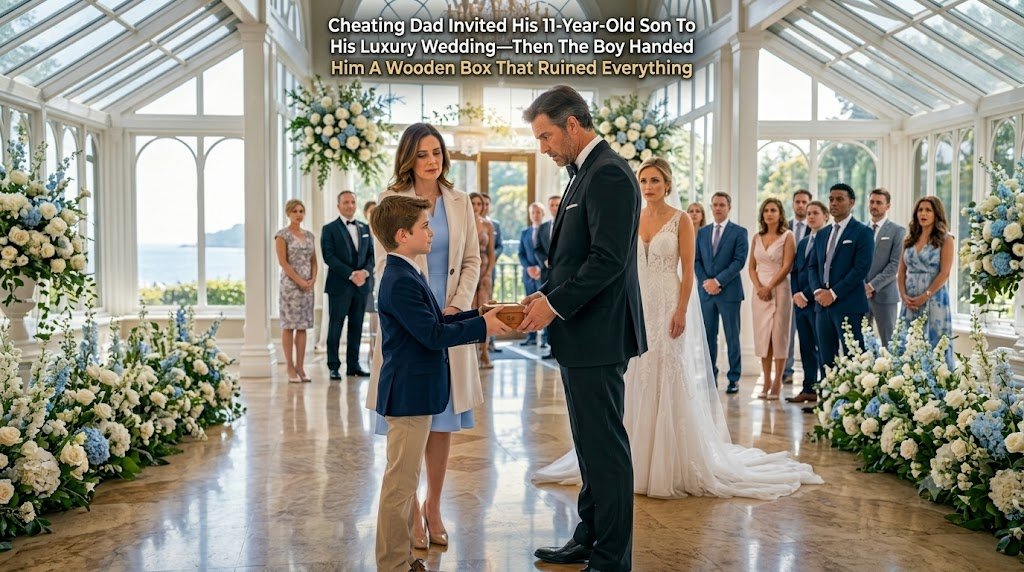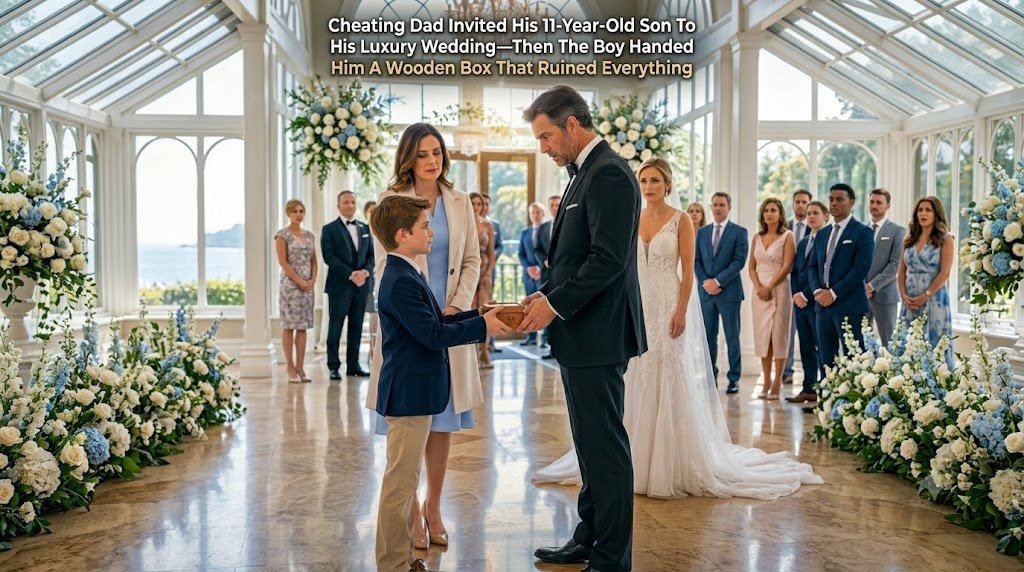
The wedding invitation arrived on a quiet Tuesday afternoon, tucked between a grocery advertisement and an electricity bill inside the mailbox of my small home in Cary, North Carolina. The envelope was thick ivory paper with dark-green lettering pressed into the surface. For several seconds, I assumed it had been delivered to the wrong address because nothing in my current life arrived with hand-lined envelopes or wax seals. Then I saw the name. Nathaniel Cross. My former husband was getting married. I remained on the porch while the late-September wind moved through the maple trees along the street. I did not cry, although my fingers tightened around the envelope until the edge pressed against my palm. My name is Allison Reed. I was thirty-eight years old, worked as an elementary-school librarian, and had spent the previous eighteen months rebuilding a life Nathaniel had abandoned with two suitcases and a carefully prepared explanation about needing freedom. He never called his departure betrayal. He called it honesty. He never admitted that another woman already existed. He described her as a colleague who understood the pressures of his consulting work. Whenever I questioned late dinners, locked screens, or hotel charges, Nathaniel turned my concern into evidence that I was insecure. “You are exhausted, Allison. You see danger whenever life becomes unfamiliar.” “There is nothing happening with Camille.” “You are making our marriage impossible because you refuse to trust me.” His skill was not merely lying. His skill was making another person apologize for noticing the lie. The invitation confirmed he would marry Camille Bennett at the Hawthorne Conservatory in Raleigh, followed by a formal reception at a private country club. The ceremony would begin at four on Saturday afternoon. Beneath my name appeared another. Oliver Cross. Our eleven-year-old son had been invited too. That detail hurt more than Nathaniel’s remarriage. He wanted us visible. He wanted the former wife and nearly forgotten son sitting politely among white flowers while he introduced a new version of his life to colleagues, clients, and relatives. Our presence would allow him to appear generous, mature, and completely forgiven. I carried the invitation into the kitchen and placed it beneath a bowl of apples. Then I made dinner, checked Oliver’s homework, washed dishes, and tried to behave like a mother whose heart had not been disturbed by a piece of expensive paper. Oliver discovered it while looking for tape. He stood beside the counter with the invitation held in both hands. “Dad is getting married?” His voice contained no anger, which frightened me more than shouting would have. “Yes.” He studied Camille’s name. Oliver remembered her. Nathaniel had introduced Camille during our marriage as a senior project coordinator at Cross Advisory. After the separation, she appeared in photographs beside him at charity events and corporate dinners. Seven months after the divorce became final, they announced their engagement. “Did he tell you?” Oliver asked. “The invitation told me.” He looked down again. “My name is here.” “It is.” “Do we have to go?” “No. We can decline.” Oliver stayed silent for so long that I heard the refrigerator motor restart. Then he said, “I want to attend.” I pulled out a chair and sat across from him. “Why?” He rubbed one thumb over the raised lettering. “Because Dad invited me.” The answer carried everything he could not say aloud. Perhaps Nathaniel wanted him there. Perhaps the invitation meant his father had remembered him. Perhaps standing in the same room would make Nathaniel acknowledge the birthdays, school events, and weekends he had forgotten. Children continue hoping long after adults learn that hope can become another form of injury. “The day may be difficult,” I warned him. “Your father will be busy, and he may not give you much attention.” “I know.” “People may ask uncomfortable questions.” “I know.” “You are allowed to change your mind.” Oliver nodded. “I still want to go.” During the following week, he rarely mentioned the wedding. He completed school assignments, polished his dress shoes, and asked whether his navy blazer still fit. He also began gathering items inside a small wooden box that had once held a pocketknife Nathaniel gave him during a camping trip. Every time I entered Oliver’s bedroom, he closed the lid. I did not force him to explain. Children sometimes require privacy before they discover the language for disappointment. One evening, I saw a yellow notebook open across his desk. Dates had been written in neat columns, with several short sentences beside each one. Oliver closed it when he noticed me. “I am okay, Mom.” Sometimes “I am okay” means a child has no safe way to say everything else. I kissed his forehead and left the room.
Saturday arrived with the heavy, golden heat typical of early autumn in North Carolina.
By three o’clock, Oliver stood in the center of his bedroom wearing the navy blazer I had pressed the night before. His tie was straight, his shoes reflected the afternoon light, and his hair was brushed flat against his crown. He looked entirely too young for a society wedding, yet too solemn for a boy attending a celebration.
In his hands, he held the small wooden box.
“Are you ready?” I asked, leaning against the doorframe.
“Yes, Mom.”
“Remember, if you want to leave at any time, we will leave. You don’t have to stay for the reception.”
“I know.”
We drove forty minutes west toward Raleigh in silence. The Hawthorne Conservatory sat on a sprawling estate surrounded by manicured boxwood hedges and towering glass panels that caught the late-afternoon sun. Valet attendants in crisp white shirts parked luxury vehicles along the paved drive, while guests in formal attire strolled toward the grand entrance beneath towering oak trees.
As we walked up the stone steps, a wedding coordinator holding a clipboard checked our names against a gold-embossed list.
“Allison Cross… I mean Reed. And Oliver Cross.” Her smile was practiced, polite, and completely empty. “Family seating is in the second row on the groom’s side.”
“Thank you,” I said.
The interior of the conservatory smelled of white roses, eucalyptus, and expensive perfume. Sunlight poured through the massive glass ceiling, casting warm beams across rows of mahogany folding chairs. The guests were already seated, murmuring quietly among themselves while a string quartet played a delicate arrangement of a classical waltz.
We made our way down the aisle. Every head seemed to turn, not toward Oliver, but toward me.
Word of Nathaniel’s divorce and rapid remarriage had traveled through his social circles, and the presence of the discarded first wife carried a certain morbid curiosity. I kept my chin up, my hand resting gently on Oliver’s shoulder, guiding him toward the second row.
Then I saw Nathaniel.
He stood near the altar in a custom charcoal tuxedo, looking every bit the successful, confident executive. His hair was trimmed to perfection, and as the string quartet transitioned into a more romantic melody, he turned his head to watch the processional doors swing open.
Camille entered on her father’s arm.
She wore a strapless silk gown embroidered with thousands of tiny crystals that caught the sunlight like spilled water. She smiled radiance and poise, playing the part of a woman who had won an uncontested prize.
Oliver did not look at the bride.
His eyes remained fixed entirely on his father.
Throughout the twenty-minute ceremony, Nathaniel never once glanced toward the second row. He recited his vows with a steady, resonant voice, placed a platinum band on Camille’s finger, and kissed her amid polite applause and falling rose petals.
He was entirely enveloped in his new beginning.
Following the ceremony, guests drifted out toward the manicured lawn for the cocktail hour before moving into the glass pavilion for the reception.
“Do you want to get some punch, Oliver?” I asked softly as we walked out onto the stone terrace.
“No, Mom. I need to find Dad.”
“He’s greeting guests by the fountain. It might take a while before—”
“I have to give him this now,” Oliver interrupted, lifting the small wooden box.
Before I could stop him, he slipped away through the crowd of laughing guests in pastel dresses and dark suits. I watched him weave past towering floral arrangements and waiters holding silver trays, feeling a tight, protective knot twist in my chest.
Nathaniel stood beside the grand marble fountain, holding a glass of champagne while laughing with a group of senior partners from Cross Advisory. Camille stood beside him, resting her hand lightly against his arm.
Then Oliver stepped into their circle.
He didn’t speak immediately. He simply waited until Nathaniel noticed him.
The laughter around the fountain stuttered. Several guests turned to look at the boy standing silently in the expensive wedding party.
Nathan’s smile stiffened.
“Oliver,” Nathaniel said, his voice dropping into the patronizing tone he reserved for minor inconveniences. “I’m glad you made it. Did you enjoy the ceremony?”
“Yes, Dad,” Oliver said.
He did not smile. He lifted the small wooden box with both hands and extended it toward his father.
“What is that?” Camille asked, her voice light, carrying the forced cheerfulness of a stepmother trying to appear approachable for the cameras.
Nathan ignored her question, his eyes fixed on the box. A sudden shadow crossed his face as he recognized the wood.
“Please open it before you get married,” Oliver said, repeating the words he had practiced for days. “Mom said I had to give it to you today.”
Nathan set his champagne glass down on a passing waiter’s tray. His fingers reached out and gripped the brass latch of the box.
He lifted the lid.
Inside lay a collection of folded papers, an old yellow notebook, and a small stack of printed text messages.
Nathan picked up the top paper.
It was a calendar printout dated from eighteen months ago—the exact weekend Nathaniel had claimed he was attending an emergency corporate retreat in Atlanta while the hotel receipts in my possession showed otherwise.
Beneath it was a printed copy of a bank statement from a secret account, showing funds transferred during the final months of our marriage.
Nathan’s face drained of color. The practiced charm vanished, leaving behind the stark, terrified expression of a man who suddenly realized the secret room he thought he had locked had been opened in front of an audience.
“Where… where did you get this?” Nathaniel whispered, his voice shaking.
Oliver looked up at his father, his eyes entirely dry.
“You left your second phone in the garage cabinet two years ago,” Oliver said evenly. “I found it when I was looking for my baseball glove. I kept it in my desk because I wanted to know why you stopped coming home on weekends.”
Around the fountain, the murmurs died away.
Camille stepped closer, peering over Nathaniel’s shoulder. “Nathaniel? What is he talking about? What are those papers?”
Nathan did not answer her. He stood frozen, holding the proof of his deception while hundred-thousand-dollar wedding flowers bloomed all around him.
The silence around the fountain grew so absolute that the gentle splashing of the water against the marble basin sounded like falling stones.
Camille’s hand slipped off Nathaniel’s arm. She stared at the yellow notebook resting inside the wooden box, then up at her new husband’s pale, sweat-slicked face.
“Nathaniel?” she repeated, her voice losing its polished sweetness, turning sharp and demandingly cold. “What are those papers? What is he talking about?”
Nathan did not look at her. He could not look away from our son.
The documents in his hands weren’t just messy divorce details or old arguments; they were a precise, indisputable timeline of the double life he had meticulously constructed. Every late-night board meeting, every phantom business trip, every fabricated crisis that had kept him away from our home—Oliver had recorded it all, filing the digital breadcrumbs away in a child’s safe place while I remained entirely in the dark.
“You… you kept this?” Nathaniel choked out, his voice a low, strangled rasp meant only for the boy standing before him.
“You said you were working,” Oliver replied, his voice terrifyingly steady for an eleven-year-old. “I just wanted to know what kind of work took all your time.”
Several guests standing nearby began to murmur. A woman in a pale-yellow dress took a slow step backward. A senior partner from Cross Advisory cleared his throat, suddenly finding his wristwatch fascinating.
Camille snatched the top paper from Nathaniel’s trembling hand. Her eyes scanned the printed text messages—messages sent between Nathaniel and herself during our marriage, boasting about how easily I was fooled, how simple it was to slip away while I packed school lunches and helped with homework.
The color drained from Camille’s cheeks. The grand, expensive wedding suddenly felt less like a celebration and more like a public tribunal.
“You absolute fool,” Camille hissed at Nathaniel, her voice trembling with sudden, humiliated fury. “You left this in a garage? You didn’t even clean up your own mess before marrying me?”
“Camille, wait—let me explain—this is out of context—” Nathaniel stammered, finally finding his voice, though it cracked pathetically in the afternoon air.
“Explain what? That you’re an incompetent liar who can’t even manage his own past?” She yanked the platinum band off her left finger and threw it hard against the marble fountain. It hit the stone with a sharp clink before sinking into the water.
Without another word, Camille turned her back on him, hiking up the heavy silk of her designer gown as she marched furiously past the rows of mahogany chairs, fleeing toward the parking lot while dozens of high-society guests stared in stunned silence.
Nathan stood paralyzed. The wedding cake was still uncut. The champagne remained chilled. The expensive photography crew stood by with their cameras frozen, capturing the exact second an eleven-year-old boy dismantled a multi-million-dollar lie.
He slowly lowered the wooden box. His hands shook so badly the papers inside fluttered against the rim.
“Oliver…” Nathaniel whispered, reaching out a trembling hand. “Son… let’s go inside. Let’s talk about this privately. Not here. Not in front of all these people.”
Oliver did not step toward him.
He didn’t yell, and he didn’t cry. He simply looked at the man who had traded an eighteen-year family for a convenient new image, seeing past the custom tuxedo and the corporate success to the coward beneath.
“Mom is waiting by the car,” Oliver said.
He turned around, his back straight, carrying the small wooden box securely against his chest, and walked away from the altar, away from the white roses, and away from the life we had left behind.
I was standing beside the black sedan parked near the exit when I saw him walking down the gravel path.
The afternoon sun caught his hair, and for a fleeting second, he looked so much like his father that my chest ached. But as he drew closer, I saw the steady determination in his stride—the quiet strength of a boy who had carried a heavy secret through a lonely hallway and finally laid it down in the light.
He opened the car door and slid into the passenger seat, placing the wooden box carefully on his lap.
I climbed in beside him, started the engine, and shifted into reverse.
“Did you give it to him?” I asked softly as we rolled down the estate’s tree-lined driveway.
“Yes, Mom,” Oliver said, staring out the window as the expensive glass conservatory faded into the distance.
“Are you okay?”
He turned his head, looking at me with clear, untroubled eyes.
“I’m okay, Mom,” he said, a small, genuine smile touching his lips. “We can go home now.”
I placed my hand over his, and as we drove away from the Hawthorne Conservatory—leaving behind the shattered wedding, the ruined vows, and the ghosts of a marriage built on sand—I knew he was right.
For the first time in years, we were finally going home.