COLD OPEN
My parents told me they could only afford to take one daughter on their anniversary trip to Italy.
So my sister went.
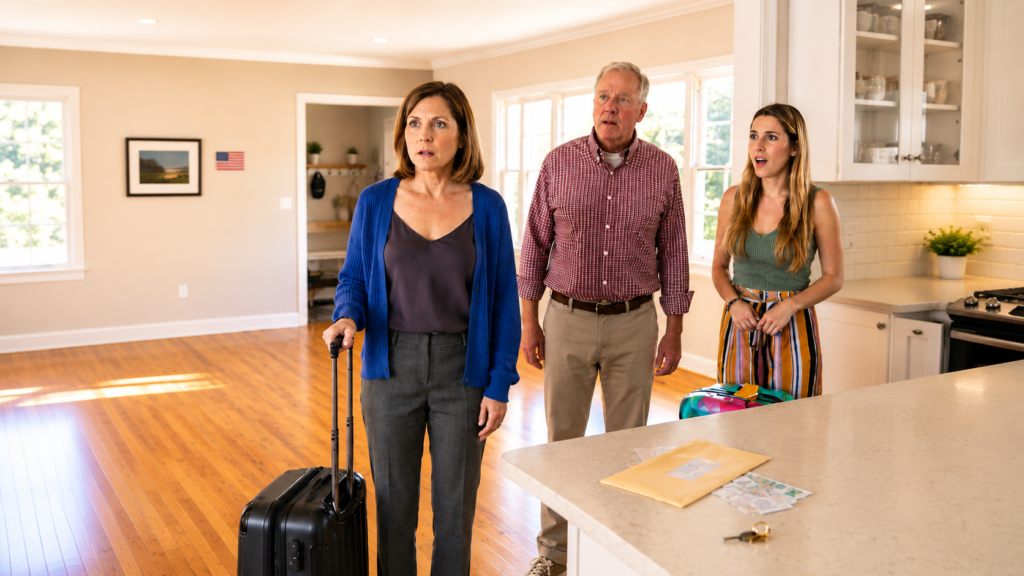
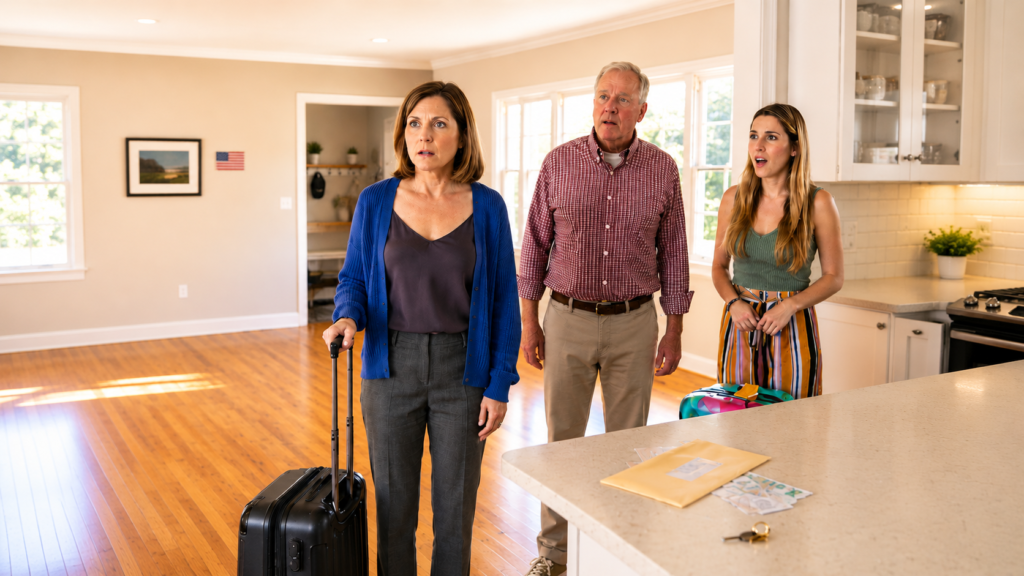
Two weeks later, my parents returned home to find the house almost completely empty.
The television was gone.
The furniture was gone.
The appliances were gone.
Even the expensive coffee machine my mother had cried over at Christmas had disappeared.
On the kitchen counter sat one envelope.
Inside were years of receipts, bank statements, and a total that made my father’s hands start shaking.
At the bottom of the final page, I had written:
You said I was family when you needed my money.
Now I’m finally treating myself like family.
My name is Natalie Brooks.
And this is how I stopped being the daughter everyone depended on.
PART 1 — THE DAUGHTER WHO PAID FOR EVERYTHING
The night my old life finally ended, the kitchen smelled like rosemary, roasted garlic, and chicken.
That was the cruelest part.
It still smelled like home.
My mother, Diane, had always believed a perfect Sunday dinner could hide almost anything.
Financial problems.
Arguments.
Resentment.
All the little cracks in our family that everyone noticed but nobody wanted to discuss.
The chicken was roasting in the oven.
Potatoes simmered on the stove.
Green beans steamed beside the sink.
I had prepared most of the meal.
Of course I had.
I rubbed seasoning beneath the chicken skin because Mom always said I did it better.
I mashed the potatoes because Dad hated lumps.
I arranged the plates while my younger sister, Marissa, sat upstairs laughing on the phone with a friend.
That was how our family worked.
Marissa enjoyed life.
I maintained it.
My name is Natalie Brooks.
I was twenty-eight years old, although my parents still called me “Nattie” whenever they needed something.
A ride.
A payment.
A grocery run.
A signature.
A favor they never called a favor because, according to them, family was supposed to help family.
That Sunday, I sat in my usual chair.
The one with the loose leg nobody else wanted.
Dad was scrolling through his phone.
Marissa finally came downstairs, her blonde hair perfectly styled, and immediately took the largest piece of chicken before everyone had even sat down.
“This smells incredible, Mom.”
Mom smiled.
Then, almost casually, she added,
“Natalie did most of it.”
Most of it.
That was how my contributions were always described.
I did most of it.
I helped.
I handled it.
I took care of things.
I had been doing it for years.
When Dad lost his job, I helped with the bills.
When Mom needed money to finish a home refinancing, I transferred what she needed.
When Marissa wanted a newer car but couldn’t qualify on her own, I co-signed.
When she missed payments, I covered them.
When the refrigerator broke, I bought a new one.
When the washing machine died, I replaced it.
Every emergency somehow became my responsibility.
By twenty-eight, I was still living in the same house, paying for groceries and household expenses while my own plans kept getting postponed.
Then Mom placed her wineglass on the table.
“Oh, before I forget,” she said. “The Italy tickets are booked.”
My heart lifted.
For months, they had talked about Italy.
Their twenty-eighth anniversary.
Two weeks in Europe.
Rome.
Florence.
Venice.
Maybe the Amalfi Coast.
I had secretly imagined going with them more times than I wanted to admit.
A family photograph in front of the Colosseum.
Dinner beneath warm lights.
Walking through old streets together.
For once, I thought, maybe I would feel like I belonged.
“That’s wonderful,” I said. “When do we leave?”
The table became strangely quiet.
Not completely silent.
Just quiet enough for me to know.
Mom sighed.
“Nattie, sweetheart, there’s something we need to explain.”
I put down my fork.
“What?”
She exchanged a glance with Dad.
“We couldn’t afford four tickets.”
I waited.
“So we’re taking Marissa.”
For several seconds, I thought I had misunderstood.
“Just Marissa?”
Mom nodded.
“Your father and I are celebrating our anniversary, and Marissa deserves a proper vacation.”
I looked at Dad.
He didn’t even put down his phone.
“But I’m your daughter too.”
“Of course you are,” Mom said.
Her tone suggested I was being unreasonable.
“It simply wasn’t financially possible to take everyone.”
I almost laughed.
Everyone.
I looked around the kitchen.
The refrigerator I had purchased hummed behind Mom.
The dishwasher I had paid for sat beneath the counter.
The dining table had been bought with my credit card.
Even the groceries on the table had been paid for by me two days earlier.
“Mom,” I said quietly, “how much were the tickets?”
She told me.
I stared at her.
I could have bought my own ticket.
Probably two.
But that wasn’t really the point.
I looked at Dad.
“Are you seriously okay with this?”
He finally lifted his eyes.
“You’re almost thirty, Natalie. If you want to travel, you can pay for your own trip.”
The words were calm.
Reasonable.
Almost sensible.
But they cut deeply.
Yes.
I was an adult.
An adult who had handed them thousands when their finances collapsed.
An adult who had protected their credit.
An adult who had kept their household running.
An adult who had sacrificed vacations and savings because there was always another family emergency.
Yet when it came to enjoying something together, suddenly I was responsible for myself.
Across the table, Marissa smiled.
“Don’t be upset, Nattie. I’ll send you lots of pictures.”
Mom laughed softly.
Dad smiled.
And something inside me went completely still.
There was no argument.
No crying.
No scene.
I simply picked up my fork.
Took another bite.
And said,
“I hope you have a wonderful trip.”
They believed me.
That was the part that hurt most.
Nobody noticed that my voice had changed.
Nobody asked whether I was okay.
Nobody looked closely enough to realize something had ended.
After dinner, I cleared the table.
Washed the dishes.
Wiped the counters.
Put away the leftovers.
Then I went upstairs and closed my bedroom door.
I opened my banking app.
I don’t know what made me do it.
Maybe my heart had finally become tired of arguing with itself.
I downloaded ten years of transactions.
Then I started going through them.
Transfers to Mom.
Payments for Dad.
Marissa’s car.
Household groceries.
Utility bills.
Furniture.
Appliances.
Repairs.
Insurance.
Credit card payments.
One expense after another.
I printed everything.
Page after page came out of the printer.
Soon my bedroom floor was covered in paper.
I sat among the receipts and began calculating.
Slowly.
Carefully.
The final number was staggering.
$96,784.63.
I stared at it.
That wasn’t a few favors.
That wasn’t family helping family.
That was nearly a hundred thousand dollars.
Money I could have saved.
Money I could have invested.
Money that could have bought me a home.
Money that could have given me choices.
Instead, I had spent it keeping everyone else comfortable.
I began sorting the documents.
The mortgage payment I had covered.
The refrigerator.
The washer and dryer.
The living room furniture.
Dad’s television.
Mom’s expensive espresso machine.
Marissa’s car expenses.
Every receipt went into a folder.
I wrote one word across the front.
MINE.
Then I looked around my bedroom.
For the first time, I realized something.
I didn’t actually owe them anything.
They owed me.
And I was done pretending otherwise.
Two weeks later, my parents and Marissa left for Italy.
Mom hugged me quickly at the front door.
“Don’t forget to water the plants.”
Dad reminded me to check the mail.
Marissa pulled her suitcase toward the car.
“Have fun being the house sitter,” she joked.
I smiled.
“Have a great trip.”
They drove away laughing.
I watched until the car disappeared.
Then I went inside.
Locked the door.
And made one phone call.
“Hi,” I said when the moving company answered. “I need a crew tomorrow morning.”
By eight the next day, a truck was parked outside.
The movers started with the living room.
The sofa disappeared.
Then the television.
The coffee table.
The dining chairs.
The expensive cabinet Mom loved showing guests.
Next came the kitchen.
The refrigerator.
The microwave.
The washer.
The dryer.
The espresso machine.
Everything I could prove I had purchased went into the truck.
I didn’t touch my parents’ personal belongings.
I didn’t enter Marissa’s bedroom.
I wasn’t destroying their home.
I was reclaiming mine.
By late afternoon, the house sounded completely different.
Every footstep echoed.
The rooms looked strangely enormous.
The kitchen counter was almost bare.
The living room was empty.
For the first time, I could hear the house breathing.
I placed a sealed envelope on the kitchen counter.
Inside were copies of everything.
Receipts.
Bank statements.
Loan records.
Purchase confirmations.
A complete accounting of the money I had spent over the years.
I wrote one sentence on the first page:
You called me family whenever you needed something.
Then I added:
I am finally choosing myself.
I packed my clothes.
My laptop.
My documents.
A few photographs.
The things that actually belonged to me.
Then I locked the door.
I didn’t leave a note explaining where I was going.
They didn’t need to know.
For years, they had treated me like someone who would always be there.
They were about to discover what happened when I wasn’t.
Two weeks later, my parents returned from Italy.
I was sitting on the porch of a small rental cottage several hours away, drinking coffee and watching the morning fog lift from the hills.
My phone began vibrating.
Once.
Twice.
Then continuously.
The first message was from Mom.
Natalie, what did you do to the house?
Then Dad.
Call me immediately.
Then Marissa.
WHERE IS MY CAR?
I looked at the messages.
For a moment, I almost laughed.
They had spent two weeks in Italy believing I was still the dependable daughter waiting at home.
Now they were finally discovering the truth.
I wasn’t waiting anymore.
Then another message appeared from Mom.
You cannot just take everything. We are your parents.
I stared at the screen.
Then I opened the folder beside me.
Every receipt.
Every transfer.
Every payment.
Every forgotten sacrifice.
All documented.
I took a slow sip of coffee.
And for the first time, I felt no guilt at all.
Because the house wasn’t empty.
It was finally honest.
And somewhere inside that empty house, my family was about to learn exactly how expensive it had been to mistake my love for an unlimited supply of money.
PART 2 — THE RECEIPTS THEY NEVER EXPECTED TO SEE
My phone kept vibrating.
Mom called three times.
Then Dad.
Then Marissa.
I let every call go to voicemail.
For years, I had answered immediately.
If Mom needed money, I answered.
If Dad had a problem with the house, I answered.
If Marissa had missed a payment, I answered.
That morning, for the first time, I allowed the silence to belong to me.
Eventually, Mom sent another message.
This is unbelievable. You have no right to take our things.
I looked at the sentence for nearly a minute.
Then I opened the spreadsheet I had prepared.
Every item in the house had a corresponding receipt.
The refrigerator.
The washer.
The dryer.
The television.
The dining set.
The sectional sofa.
Even the espresso machine.
I had not taken anything that belonged to them.
I had simply stopped donating my belongings to a household that treated me like a guest.
I typed a reply.
I didn’t take your things. I collected mine. The receipts are in the envelope on the counter.
Then I put the phone down.
Five minutes later, Dad called.
This time, I answered.
“Natalie.”
His voice was tight.
“What happened?”
“You know what happened.”
“You emptied the house.”
“I removed the property I paid for.”
“That isn’t how a family works.”
I almost smiled.
“Really?”
There was a pause.
“We’re your parents.”
“And I’m your daughter.”
Another silence.
Then Dad said,
“You could have talked to us.”
“I did.”
“No, you didn’t.”
“I talked for ten years.”
My voice remained calm.
“You just never listened.”
He breathed heavily into the phone.
“Your mother is extremely upset.”
I closed my eyes.
“I know.”
“She says you are punishing us.”
“No.”
“Then what do you call this?”
“A boundary.”
Dad didn’t answer.
I continued.
“You told me I was an adult when I asked why I couldn’t go to Italy.”
“That was different.”
“How?”
“You were asking us to pay for a vacation.”
I laughed softly.
“No, Dad. I was asking to be included.”
He had no response.
I could hear Mom crying somewhere in the background.
Then Dad said,
“You’ve always been difficult when you don’t get your way.”
That sentence changed everything.
Not because it hurt.
Because it confirmed that they still didn’t understand.
They thought this was about Italy.
It wasn’t.
Italy had simply been the final crack in something that had been breaking for years.
“You’re right about one thing,” I said.
“What?”
“I should have stopped much earlier.”
Then I ended the call.
That afternoon, I received an email from Mom.
It was seven paragraphs long.
She accused me of being selfish.
Ungrateful.
Vindictive.
She reminded me that they had raised me.
She mentioned every birthday cake, every Christmas present, every school event they had attended.
Then came the sentence that made me stare at the screen.
We never expected repayment for being your parents.
I leaned back in my chair.
Of course they didn’t.
Because I wasn’t repaying them.
I was reclaiming things they had convinced themselves were theirs.
I opened the spreadsheet.
At the bottom, I added another line.
Total unpaid household contributions: $96,784.63.
Then I attached the documentation.
I wrote only:
Neither did I expect to be financially responsible for everyone else for ten years.
I pressed send.
For the next few hours, nothing happened.
Then Marissa called.
I answered.
She didn’t say hello.
“Where is my car?”
“Which car?”
“You know which one!”
“The blue SUV?”
“Yes!”
“I stopped making payments on it.”
“What?”
“You have the title in your name.”
“You co-signed!”
“I did.”
“And now you’re just abandoning me?”
I closed my eyes.
“No, Marissa. I’m allowing you to take responsibility for something that belongs to you.”
“But you promised!”
“When?”
“You said you’d help me.”
“I helped you for four years.”
Her voice cracked.
“You’re my sister.”
I looked toward the window.
“So am I.”
She became quiet.
Then she said something I had never heard from her before.
“I didn’t know you were this angry.”
I almost laughed.
“I wasn’t angry.”
“What?”
“I was exhausted.”
That seemed to confuse her more than anything else.
I continued.
“Anger burns out, Marissa. Exhaustion makes you stop.”
She began crying.
“I thought you wanted to help.”
“I wanted to be loved.”
Silence.
That was the first time she had nothing to say.
Then she whispered,
“Did Mom know you were doing all this?”
“No.”
“Dad?”
“No.”
“So you planned it without telling anyone?”
I looked down at my coffee.
“I planned my life without telling anyone.”
She hung up.
I didn’t call her back.
The following week, I moved into my new place.
It wasn’t large.
A two-bedroom townhouse on the edge of a quiet lake.
The kitchen was small.
The floors were old.
The living room had only one couch.
But every single thing inside belonged to me.
I bought a secondhand dining table.
Four mismatched chairs.
A cheap lamp.
A mattress that wasn’t fancy but was mine.
On the first night, I sat on the floor eating takeout from a cardboard container.
No family arguments.
No emergency calls.
No one asking whether I had transferred money yet.
The silence felt unfamiliar.
Then it felt beautiful.
I slept for almost ten hours.
The next morning, I woke up without an alarm.
For the first time in years, I didn’t feel responsible for someone else’s crisis before I had even brushed my teeth.
But freedom came with consequences.
My parents stopped speaking to me.
Then they started speaking about me.
Aunt Linda called first.
“Natalie, your mother is devastated.”
“I understand.”
“She says you’ve taken everything from them.”
“I took what I paid for.”
“You could have handled this differently.”
I looked around my new kitchen.
“Perhaps.”
“She says you’re trying to hurt the family.”
“No.”
“Then why do this now?”
I thought about the Italy tickets.
“Because I finally realized waiting for them to value me was keeping me from valuing myself.”
Aunt Linda sighed.
“You’re making a terrible mistake.”
Maybe.
But for the first time, it was my mistake to make.
A few days later, I received an unexpected message from Dad.
Can we meet? Just you and me.
I almost ignored it.
Then I agreed.
We met at a small café near the lake.
Dad looked older than I remembered.
Not physically.
Emotionally.
He sat across from me with both hands wrapped around a cup of coffee.
“I owe you an apology,” he said.
I didn’t speak.
He looked down.
“Your mother and I have been going through the receipts.”
I raised an eyebrow.
“How’s that going?”
He gave a tired smile.
“Badly.”
I waited.
“We didn’t realize how much you were paying.”
That sentence bothered me.
“You didn’t realize?”
“No.”
“How could you not?”
He swallowed.
“You never complained.”
I shook my head.
“That doesn’t mean I wasn’t hurting.”
“I know.”
“No, Dad. You don’t.”
He looked at me.
I reached into my bag and placed a copy of the spreadsheet on the table.
“You saw the payments.”
He stared at the number.
“I saw the number.”
“Then look at the individual transactions.”
He did.
The pages turned slowly.
His expression changed as he recognized things.
The mortgage payment.
The emergency plumbing bill.
The furniture.
Marissa’s insurance.
His television.
Mom’s appliance purchases.
Groceries.
Utilities.
He reached the final page and stopped.
“I had no idea.”
“You never asked.”
His eyes became wet.
“I should have.”
“Yes.”
He folded his hands.
“Why didn’t you tell us you were struggling?”
I looked at him.
“Because every time I said I couldn’t afford something, someone else had a bigger problem.”
He looked away.
That landed.
After several seconds, he whispered,
“I failed you.”
I didn’t immediately answer.
Because I had waited years to hear those words.
And strangely, hearing them didn’t feel as satisfying as I had imagined.
“I needed you to be my father,” I said.
He nodded.
“I know.”
“I didn’t need another bill to pay.”
He wiped his eyes.
“I am sorry.”
This time, I believed him.
But believing an apology wasn’t the same as forgetting.
“I’m not ready to pretend everything is okay,” I said.
“I understand.”
“And I’m not giving the furniture back.”
He almost laughed through his tears.
“I figured.”
“Or the appliances.”
“I figured that too.”
“And I’m not paying Marissa’s car.”
He sighed.
“I figured that one was coming.”
For the first time, we both smiled.
It wasn’t forgiveness.
But it was something.
A beginning, perhaps.
Then Dad reached into his jacket.
He placed a small envelope on the table.
“What is this?”
“Your mother found it.”
Inside was an old photograph.
Me at nineteen.
Standing in the driveway.
Holding a box of groceries.
I stared at it.
“I don’t remember this.”
“I do.”
Dad’s voice became quiet.
“You had just finished a double shift.”
I looked at the photograph again.
I was smiling.
Even then.
Trying to look happy.
Trying to make everything easier.
Dad whispered,
“You shouldn’t have had to become an adult that way.”
I folded the photograph carefully.
“No.”
He nodded.
“You deserved better.”
For the first time, I didn’t argue.
I simply said,
“Yes, I did.”
When I left the café, Dad didn’t ask me to come home.
He didn’t ask me to return the furniture.
He didn’t ask me to forgive Mom.
He just said,
“I’ll call next week.”
I nodded.
“Okay.”
That night, I received another message.
This one was from Mom.
I know you probably don’t want to hear from me, but I need to tell you something.
I stared at the screen.
Then another message arrived.
The Italy trip was my idea.
I stopped breathing for a second.
A third message appeared.
Your father wanted you to come.
I read it twice.
Then a fourth.
I told him there wasn’t enough money because I wanted Marissa to have the trip.
I sat completely still.
For weeks, I had believed my parents had simply accepted an unfair decision.
Now I knew something worse.
It had been intentional.
Mom had chosen.
And Dad had allowed her to choose.
Then one final message appeared.
I don’t know how to fix what I did.
I looked at those words for a long time.
Then I typed my answer.
You can’t fix ten years in one conversation. But you can stop pretending it didn’t happen.
I sent it.
For once, Mom didn’t argue.
She didn’t defend herself.
She didn’t mention how much she had sacrificed as a mother.
She simply replied:
You’re right.
I put the phone down.
Outside, the lake reflected the last orange light of sunset.
My house was quiet.
My bank account was finally mine.
My future was finally mine.
But something told me this wasn’t the end.
Because the receipts had exposed the money.
The Italy trip had exposed the favoritism.
And the empty house had exposed the truth.
But there was still one question nobody had answered.
Why had my mother been so determined to keep me out of that trip?
And when I discovered the answer, I realized the money had never been the biggest secret my family had been hiding.
PART 3 — THE SECRET BEHIND ITALY
I didn’t sleep that night.
Mom’s last message kept replaying in my head.
I wanted Marissa to have the trip.
That explanation was painful enough.
But it didn’t explain why.
The next morning, I called Dad.
He answered on the second ring.
“Are you okay?”
“I need the truth.”
He went quiet.
“About Italy.”
Another pause.
Then he said,
“You deserve to know.”
We met that afternoon at the same café.
Dad arrived carrying a thin folder.
He placed it on the table.
“I found this after you moved out.”
I opened it.
Inside were bank statements.
Credit card applications.
Loan documents.
And a letter from a financial adviser.
I read the first page.
Then the second.
My stomach tightened.
“What is this?”
Dad looked ashamed.
“Your mother and I have been in serious debt for years.”
I stared at him.
“How serious?”
He gave me the number.
It was enormous.
Far beyond anything I had imagined.
I looked back at the documents.
“The Italy trip wasn’t really about not having enough money.”
“No.”
“Then why did you tell me that?”
Dad looked down.
“Because Marissa’s trip was already paid for.”
I frowned.
“What?”
“She won a travel package through an event at work.”
I stared at him.
“She won it?”
“Part of it.”
Dad explained that Marissa had received a travel voucher covering airfare and hotels for two people.
Mom and Dad had only needed to pay the remaining expenses.
But there was more.
They had decided to use their remaining savings to extend the trip.
And they had planned to sell some of the household items when they returned.
My eyes moved toward the folder.
“Wait.”
I looked at him.
“You knew you couldn’t afford the house.”
Dad nodded.
“And you still let me pay for everything.”
He closed his eyes.
“Yes.”
That answer hurt more than the Italy decision.
Because suddenly, every memory looked different.
The refrigerator.
The mortgage payment.
The repairs.
The furniture.
The endless emergencies.
Maybe they hadn’t simply been careless.
Maybe they had been relying on me.
Deliberately.
“You knew I would keep paying.”
Dad’s eyes filled with tears.
“Yes.”
I pushed the folder away.
“How long?”
He didn’t answer.
“How long, Dad?”
“About six years.”
I felt the room tilt.
Six years.
Six years of believing I was helping my family survive.
Six years of them knowing I was carrying the weight.
“You should have told me.”
“I know.”
“You should have let me decide whether I wanted to help.”
“I know.”
“You took that choice away from me.”
Dad nodded.
“I did.”
I stood.
“I need to leave.”
He didn’t stop me.
Outside, I walked several blocks before realizing I was crying.
Not because of the money.
I could earn money again.
Not because of the furniture.
I could replace furniture.
I was crying because I had spent years believing my sacrifices had meaning.
Now I wasn’t sure whether they had ever understood what those sacrifices cost me.
That evening, Mom called.
I almost ignored her.
But I answered.
“Hello?”
“I know you met your father.”
“Yes.”
“He told you.”
“Yes.”
She started crying.
“I wanted to protect you.”
I closed my eyes.
“From what?”
“From the truth.”
“No, Mom.”
My voice was quiet.
“You wanted to protect yourself from the consequences.”
She didn’t argue.
That was new.
“You’re right,” she whispered.
I sat on the edge of my bed.
“Why did you always choose Marissa?”
She took a long breath.
“Because she needed me.”
“So did I.”
“I know.”
“No, you don’t.”
“I do now.”
Silence.
Then Mom said,
“When you were little, you were so independent.”
I almost laughed.
“I was a child.”
“I know.”
“You made me independent.”
“I know.”
Her voice broke.
“I thought because you were strong, you didn’t need me.”
I stared at the floor.
“That was your mistake.”
“Yes.”
For several seconds, neither of us spoke.
Then she said,
“Marissa is coming back tomorrow.”
I frowned.
“Why?”
“She wants to talk to you.”
I wasn’t sure I wanted that.
But I agreed.
The next afternoon, Marissa came to my new house.
She stood at the front door holding a small box.
For once, she wasn’t wearing designer clothes.
No makeup.
No perfect hair.
Just my little sister.
She looked exhausted.
“Can I come in?”
I stepped aside.
She placed the box on the kitchen table.
“What is that?”
“Your stuff.”
I opened it.
Inside were photographs.
Letters.
A few childhood drawings.
Things I had forgotten existed.
“I found them in my room.”
I looked up.
“Why are you giving them to me?”
“Because I realized something.”
She sat down.
“I spent my whole life believing you were lucky.”
I said nothing.
“You were always the responsible one. Mom trusted you. Dad trusted you. Everyone came to you.”
I almost smiled.
“That’s not what it felt like.”
“I know that now.”
She looked at her hands.
“I thought they loved me more because I was special.”
Her voice trembled.
“Now I think they were afraid of losing me.”
I watched her carefully.
“And you?”
She looked up.
“I was afraid of losing everything.”
“What do you mean?”
She took a breath.
“I didn’t know how much they owed you.”
I waited.
“When you moved out, Mom and Dad told me you had taken the furniture because you were angry.”
I nodded.
“They never told me you had paid for most of it.”
“They didn’t?”
“No.”
She looked embarrassed.
“I found the receipts.”
My stomach tightened.
“How?”
“Dad left the folder on the kitchen counter.”
She swallowed.
“I read all of it.”
Then she looked at me.
“You paid for my car.”
“Yes.”
“You paid my insurance.”
“Yes.”
“You covered my credit card.”
“Yes.”
“I thought Mom and Dad did.”
I didn’t know what to say.
She began crying.
“I’m sorry.”
I looked at her.
“I didn’t know.”
“I believe you.”
She wiped her eyes.
“I don’t expect you to forgive me.”
“Good.”
She laughed weakly through her tears.
“I deserve that.”
We sat in silence.
Then I said,
“You were never the reason I was hurt.”
She looked at me.
“They made the choices.”
“I know.”
“But I still benefited from them.”
I nodded.
“That doesn’t make you responsible for everything.”
She took a shaky breath.
“Can we start over?”
I thought about it.
“We can’t start over.”
Her face fell.
“But we can start differently.”
She smiled.
“I’ll take that.”
Over the following months, everything changed.
My parents sold the house.
Not because I forced them to.
Because they finally admitted they couldn’t afford it.
They downsized into a smaller place.
Dad found part-time work.
Mom started handling their finances herself.
And Marissa got a full-time job.
She began making her own car payments.
Her own insurance payments.
Her own decisions.
It wasn’t easy.
There were arguments.
There were setbacks.
There were days when Mom called me crying because she wanted me to solve something.
And each time, I reminded her:
“You can handle this.”
At first, she hated hearing it.
Eventually, she learned.
Dad and I rebuilt our relationship slowly.
Coffee every other week.
Short phone calls.
No financial requests.
No guilt.
No pretending.
Mom took longer.
But one afternoon, she showed up at my door with something in her hands.
It was a small framed photograph.
I recognized it immediately.
It was me at twelve years old.
Standing beside a school art project.
My mother had once thrown that photograph into a drawer because she said it made the hallway look cluttered.
Now she handed it to me.
“I kept it,” she said.
I looked at her.
“Why?”
“Because I was wrong.”
I took the frame.
She started crying.
“I should have been proud of you.”
I nodded.
“Yes.”
She didn’t ask for forgiveness.
She simply hugged me.
I hesitated.
Then I hugged her back.
It wasn’t a magical moment.
The past didn’t disappear.
But something shifted.
A year after the Italy trip, I took my own vacation.
Alone.
I flew to Florence.
Then Rome.
Then the Amalfi Coast.
I stood in front of the Colosseum.
I ate pasta at a tiny restaurant on a side street.
I watched the sunset over the water.
And I realized I didn’t feel jealous.
I didn’t think about Marissa.
I didn’t think about my parents.
I didn’t even think about the trip I had been denied.
I simply enjoyed being there.
Because I had finally stopped waiting for my family to give me permission to live.
On my last night in Italy, I sat outside my hotel with a glass of sparkling water.
I opened my phone.
There was a message from Mom.
I hope you’re having the trip you always wanted.
I smiled.
Then another message appeared from Dad.
We’re proud of you.
And finally, Marissa:
Send pictures. But don’t send too many. I’m still jealous.
I laughed.
For the first time, the word family didn’t feel like an obligation.
It felt like a choice.
And that was the greatest lesson I learned.
Family isn’t the person who reminds you how much they have done for you.
It isn’t the person who expects your sacrifice because you’re related.
And it certainly isn’t the person who only calls when they need something.
Family is the people who respect your boundaries.
Who celebrate your happiness.
Who don’t keep score when you succeed.
And sometimes, family has to be rebuilt.
Not because the past didn’t matter.
But because you finally understand that love without respect is not love you have to keep accepting.
When I returned home from Italy, I unpacked my suitcase in my quiet little house.
The refrigerator hummed.
The kitchen was small.
The furniture was mismatched.
Nothing was impressive.
But everything was mine.
I opened the drawer beside my desk and found the old folder.
MINE.
I took it out.
For a moment, I considered throwing it away.
Instead, I closed it and placed it at the bottom of the drawer.
I no longer needed the receipts to prove what had happened.
I knew.
They knew.
That was enough.
I walked to the window.
Outside, the evening sky was turning gold.
My phone buzzed.
A message from Mom.
Dinner Sunday?
I smiled.
Then typed:
Yes. But everyone brings their own dessert.
Three dots appeared.
Then her reply:
Fair enough.
I laughed.
And for the first time in my life, I wasn’t the daughter holding everything together.
I was simply a woman sitting in a home she had built for herself.
A woman who had finally learned that saying no did not make her selfish.
It made her free.
My parents went to Italy without me.
They thought they were giving my sister a vacation.
Instead, they gave me something far more valuable.
The courage to stop paying for a place where I had never been treated like I belonged.
And when I finally left that empty house behind, I discovered something I should have known all along:
I didn’t lose my family when I walked away.
I finally stopped losing myself.
THE END.