COLD OPEN
My parents demanded that I empty my farmhouse so they could throw a 40-person anniversary party.
I warned them my twelve-year-old daughter had just returned from a bone-marrow transplant and couldn’t be around crowds.
My mother simply said, “Then keep her upstairs.”
So I did exactly what she asked.
But when forty guests arrived that Saturday morning, they didn’t find a party waiting for them.
They found a locked gate, a sheriff, and the evidence I’d saved.
Part 1: The Locked Gate
When my mother told me to keep my twelve-year-old daughter upstairs so forty strangers could celebrate directly beneath her bedroom, something inside me went strangely quiet.
“All right,” I told her.
She heard obedience in my voice.
She didn’t realize I had already decided to follow her instructions in a way she would never forget.
By Friday evening, the farmhouse had been completely cleared.
The folding tables my parents had stored in the old barn were gone.
So were their anniversary decorations, champagne cases, rented party supplies, and every piece of clothing they had left in my guest rooms.
I carefully packed their belongings into a storage unit rented under my father’s name.
Then I changed the gate access code.
I replaced the exterior locks.
Finally, I placed a signed NO TRESPASSING notice beside the driveway.
The farmhouse belonged to me.
Not my parents.
Not “the family.”
Me.
Eight years earlier, I had purchased the property from my late grandfather at its full appraised value.
My parents had refused to buy it because they thought the septic system was outdated and the twenty-five acres surrounding the house were more trouble than they were worth.
But after I spent years repairing and renovating the property, they suddenly started calling it “our family farmhouse.”
By nine o’clock Saturday morning, the first vehicles appeared on the long gravel driveway.
Two charter buses came around the bend.
Behind them was my parents’ dark blue SUV.
A catering truck followed.
Then came a florist’s van and a vehicle carrying the musicians.
Forty guests.
All expecting a celebration.
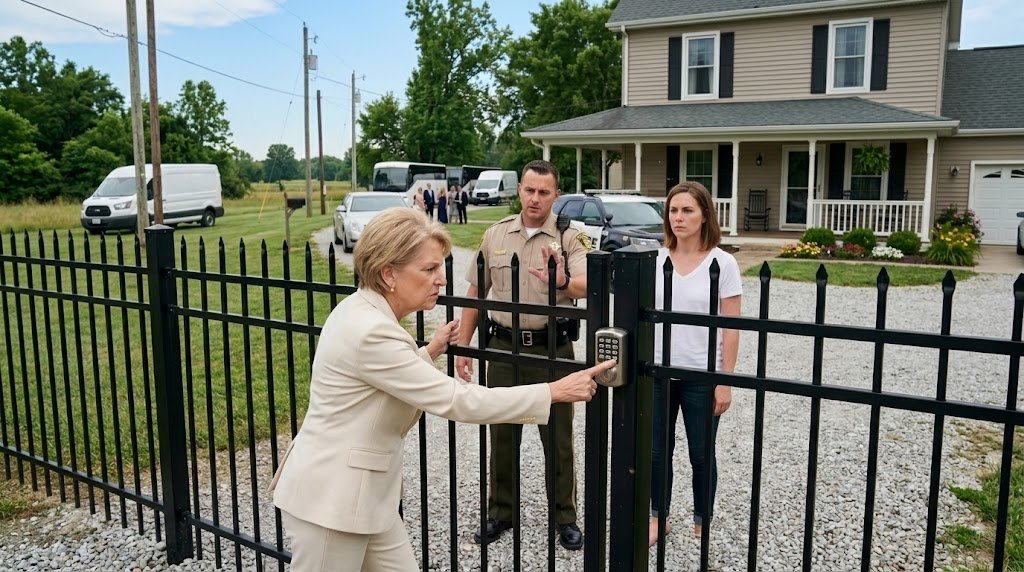
Instead, they found Sheriff Caleb Mercer standing beside the locked front gate.
I watched everything from the living-room window.
Behind me, Lily was sleeping inside the sanitized bedroom we’d prepared for her.
She had returned home from her bone-marrow transplant only thirteen days earlier.
Her doctors had been painfully clear.
A simple infection could become life-threatening.
A crowded party directly beneath her bedroom was the last thing she needed.
My mother stepped out of the SUV wearing a cream-colored dress.
She walked toward the gate with the confidence of someone who had never been told no.
Then she saw Sheriff Mercer.
Her expression changed.
“Why is this gate locked?” she demanded.
Sheriff Mercer held up the trespassing notice.
“Mrs. Dalton, the property owner has withdrawn permission for you and your guests to enter.”
My mother’s jaw tightened.
“I am her mother.”
“That doesn’t give you ownership of the property.”
My father stepped forward.
“Emily agreed to prepare the farmhouse for us.”
I opened the front door and walked onto the porch.
“I did.”
My father pointed toward me.
“Then open the gate.”
“I cleared the house,” I said calmly. “I cleared it of everything that belonged to you.”
Behind my parents, guests were beginning to step off the buses.
Some looked confused.
Others were already whispering.
My mother stared at me through the iron bars.
Then came that familiar smile.
The same cold smile she’d used throughout my childhood whenever she expected humiliation to force me into submission.
“You’re making a fool of yourself,” she said.
“Open the gate.”
“No.”
Her smile disappeared.
She grabbed the bars.
“This is a family property!”
“No. It’s my property.”
“You wouldn’t dare ruin your father’s anniversary.”
“You were warned.”
Sheriff Mercer stepped closer.
“Ma’am, I need you to remain outside the gate.”
Instead, my mother reached through the bars and entered the access code she’d been using for years.
She pressed the final number.
Nothing happened.
She tried again.
Still nothing.
Her face turned red.
Then she suddenly looked toward the farmhouse.
I followed her gaze.
Lily was standing behind the upstairs window.
She was pale.
She wore her medical mask and held one hand against the glass.
My mother’s expression immediately changed.
“See?” she shouted toward the sheriff. “She’s upstairs already! She’s perfectly fine!”
My stomach tightened.
Even Sheriff Mercer looked toward the window.
I pulled my phone from my pocket.
There was one thing my mother didn’t know I had saved.
A voicemail she had left me the previous evening.
I pressed play.
Her own voice came through the speaker.
“If Emily refuses, we’ll use the kitchen entrance. She won’t cause a scene with forty people watching.”
The conversations outside stopped.
My mother went completely still.
Sheriff Mercer slowly turned toward her.
And for the first time that morning, my mother seemed to understand that the party was never going to happen.
Because I hadn’t just locked the gate.
I had been preparing for this moment all week.
Part 2: The Evidence
For several seconds, nobody spoke.
The only sound was the wind moving through the cottonwood trees beside the driveway.
My mother stared at the sheriff.
Then she looked at me.
“Emily, stop this nonsense.”
I held my phone at my side.
“You told me to lock Lily upstairs.”
“I told you to keep her away from the guests.”
“You knew she had just come home from the hospital.”
My mother’s expression hardened.
“She can stay in her room. It’s not as if forty people are going to be in there.”
I felt my hands tighten into fists.
“You don’t understand. Her immune system is severely compromised.”
“I understand perfectly,” she snapped. “And your daughter needs to learn that the world doesn’t stop because she’s sick.”
Sheriff Mercer looked at her sharply.
“Mrs. Dalton, that’s enough.”
My father stepped forward.
“This is a family disagreement. We don’t need law enforcement involved.”
The sheriff glanced at the locked gate.
“You entered private property after permission was revoked.”
My father scoffed.
“This farmhouse has been used by our family for years.”
“Usage isn’t ownership.”
My mother suddenly pointed at me.
“She promised us this weekend.”
“I promised to clear the house.”
“You know exactly what I meant!”
“Yes,” I said. “I did.”
A few of the guests had begun filming with their phones.
My mother noticed.
Her voice dropped.
“Emily, don’t embarrass us.”
I almost laughed.
“You brought forty people here without asking whether my daughter was medically safe.”
My father shook his head.
“You’re becoming paranoid.”
I reached into my pocket and pulled out a folder.
“Then let’s look at the doctor’s instructions.”
I held up the discharge paperwork.
The sheriff read the first page.
“Recent transplant?”
“Yes.”
“Protective isolation recommended?”
“Yes.”
My mother crossed her arms.
“She doesn’t need to be locked away forever.”
“No,” I said. “She needs time to recover.”
Then I pulled out another document.
“This is the message from her specialist. She specifically told us to avoid large gatherings.”
My father looked uncomfortable.
My mother wasn’t finished.
“Doctors always exaggerate.”
That sentence changed everything.
Sheriff Mercer looked at her.
“You knew about the medical restrictions?”
My mother hesitated.
“I knew she was recovering.”
“Did you know about the doctor’s warning?”
She didn’t answer.
I did.
“She knew. I sent it to her Tuesday.”
My father looked at my mother.
“You knew?”
She rolled her eyes.
“Oh, please. We weren’t planning to put the child in danger.”
“Then why did you insist on forty people being inside the house?”
“Because the anniversary was important!”
I looked at the buses.
Forty strangers.
A catering crew.
Musicians.
Florists.
People who had traveled from several different towns.
My daughter had been home less than two weeks.
Suddenly, one of the guests approached the gate.
“Mrs. Dalton,” she said uncertainly, “we were told this was your family’s property.”
My mother didn’t answer.
The woman looked at me.
“Is that not true?”
I shook my head.
“No.”
She looked embarrassed.
“I wish we’d known.”
More guests began murmuring.
My father stepped toward them.
“Everyone, please remain calm. This is simply a misunderstanding.”
I looked at Sheriff Mercer.
“There’s something else.”
He nodded.
“What?”
I opened my phone again.
This time, I played another recording.
My mother’s voice filled the driveway.
“Once everyone arrives, Emily won’t dare refuse us. She’ll look selfish in front of the whole family.”
The guests fell silent.
My father turned toward her.
“Is that your voice?”
My mother stared at the ground.
“That’s out of context.”
I shook my head.
“No. There’s more.”
I played the final recording.
My mother again.
“And if she keeps Lily upstairs, nobody needs to know how sick she really is. We don’t want people asking questions.”
My father’s face changed.
He looked genuinely shocked.
“You said that?”
My mother snapped,
“I was trying to protect the family.”
“No,” I said. “You were trying to protect your image.”
She suddenly started crying.
But I wasn’t moved.
For years, my parents had treated the farmhouse as though owning it was a technicality.
They had used my rooms.
Stored their belongings in my barn.
Hosted gatherings without asking.
And now they had expected me to risk my daughter’s health so they could celebrate their anniversary.
Sheriff Mercer stepped through the gate after I unlocked it from inside.
He approached my parents.
“Mr. and Mrs. Dalton, I’m going to ask you both to leave the property.”
My father looked at me.
“You’re really doing this to your own parents?”
I looked upstairs.
Lily was still standing behind the window.
She raised one hand.
I raised mine back.
Then I looked at my father.
“No.”
I paused.
“You did this to yourselves.”
My mother suddenly shouted,
“You’ll regret turning your back on your family!”
I didn’t answer.
Instead, I watched as the guests slowly began returning to the buses.
The anniversary celebration was over before it had even started.
But just as Sheriff Mercer began closing the gate, one of the catering workers approached me.
“Ma’am?”
I turned.
He held out a small envelope.
“I found this inside one of the boxes your parents delivered yesterday.”
I took it.
There was no return address.
Only my name written across the front.
I opened it.
Inside was a single photograph of Lily in her hospital bed.
On the back, someone had written:
“Your parents aren’t the only ones who know about her condition.”
My blood ran cold.
Because beneath the message was a date.
And it was dated three days before Lily ever came home.
Part 3: The Photograph
I stared at the photograph until the words on the back blurred.
It was Lily.
In her hospital bed.
Her face was pale, her head wrapped in a soft cap, and an IV line ran into her arm.
But there was something worse than the photograph itself.
The timestamp in the corner showed it had been taken inside the hospital.
Three days before Lily came home.
I looked at the catering worker.
“Where did you find this?”
“Inside a box marked ‘anniversary decorations.’”
My stomach tightened.
“Did you see who packed it?”
He shook his head.
“No, ma’am.”
Sheriff Mercer took the photograph carefully.
“Don’t touch anything else.”
I nodded.
Then my phone rang.
The caller ID showed an unknown number.
I answered.
“Hello?”
A man’s voice spoke quietly.
“Emily?”
“Yes.”
“You found the photograph.”
I froze.
“Who is this?”
“My name doesn’t matter yet.”
I stepped away from the sheriff.
“What do you want?”
“I want you to understand something. Your parents weren’t planning to have Lily anywhere near those guests.”
My heart pounded.
“What are you talking about?”
“They knew she was vulnerable. That’s why they wanted her upstairs.”
I looked toward the farmhouse.
“Why?”
The man paused.
“Because they wanted everyone downstairs.”
“For what?”
“To create an alibi.”
The line went silent.
I felt the ground shift beneath me.
“An alibi for what?”
Before he could answer, the call ended.
Sheriff Mercer walked toward me.
“Emily, who was that?”
“I don’t know.”
I handed him the phone.
He immediately called for another deputy.
Within an hour, investigators were inside the farmhouse.
They checked the kitchen entrance.
The guest rooms.
The barn.
The basement.
Then one investigator found something behind a stack of old boxes.
A small security camera.
It wasn’t mine.
It had been installed facing the hallway leading toward Lily’s room.
My blood ran cold.
My parents hadn’t simply wanted to use my farmhouse.
They had been watching my daughter.
The investigator examined the device.
“It has remote access.”
“Can you find out where the footage went?”
“We’re working on it.”
Then Sheriff Mercer returned from the barn carrying another box.
“This was hidden beneath the anniversary decorations.”
Inside were printed medical records.
Lily’s hospital schedule.
Her medications.
Her doctor’s instructions.
And a list of every person who had visited her during treatment.
My parents had been collecting information about my daughter’s illness for weeks.
I couldn’t breathe.
Then I saw something that made my hands tremble.
One name appeared at the bottom of the list.
My mother’s.
Beside it was a handwritten note:
“Keep Emily distracted until Saturday.”
Saturday.
The anniversary party.
The sheriff looked at me.
“Emily, I think your parents were planning something much bigger than a party.”
I nodded slowly.
“I know.”
That afternoon, my parents were questioned separately.
My father finally admitted they had arranged the farmhouse gathering because they wanted to pressure me into signing over partial ownership of the property.
They believed that once forty relatives and friends arrived, refusing them would make me look cruel.
But my mother had gone further.
She had secretly arranged for a private investigator to photograph Lily at the hospital.
She wanted evidence that Lily was sick enough to make me look unstable—but healthy enough to argue that I was exaggerating the danger.
They intended to use that contradiction against me.
The plan collapsed when Sheriff Mercer arrived.
My mother eventually admitted everything.
The trespassing complaint became a criminal investigation.
The hidden camera led to additional charges.
And the medical records became evidence of something far more disturbing.
My parents were ordered to stay away from Lily and the farmhouse.
For the first time in years, the property became quiet again.
No strangers.
No family arguments.
No people treating my home like their personal event venue.
Just me, Lily, and the sound of wind moving through the trees.
Three weeks later, Lily sat beside me on the porch.
Her medical mask was still around her neck.
She looked tired, but she was smiling.
“Dad?”
“Yeah?”
“Are Grandma and Grandpa coming back?”
I looked at her.
“No, sweetheart.”
She was quiet for a moment.
“Good.”
I smiled.
Then she leaned against my shoulder.
“I like our house better when it’s just us.”
I kissed the top of her head.
“So do I.”
That weekend, I took down the old sign my parents had placed near the driveway.
It said:
DALTON FAMILY FARMHOUSE
I replaced it with something much simpler.
PRIVATE PROPERTY.
Because that was what it had always been.
Mine.
And more importantly, it was supposed to be a safe place for my daughter.
I had spent years believing family meant tolerating anything.
The demands.
The manipulation.
The guilt.
The constant assumption that their wishes mattered more than mine.
But watching Lily recover taught me something I should have understood much earlier.
Protecting your child isn’t selfish.
Setting boundaries isn’t betrayal.
And sometimes the bravest thing a parent can do is say no to the people who taught them they were never allowed to.
My parents wanted forty guests to witness me surrender.
Instead, forty guests witnessed me stand my ground.
And the locked gate they thought would humiliate me became the first boundary they could no longer cross.
THE END.