“You’re wrong.”
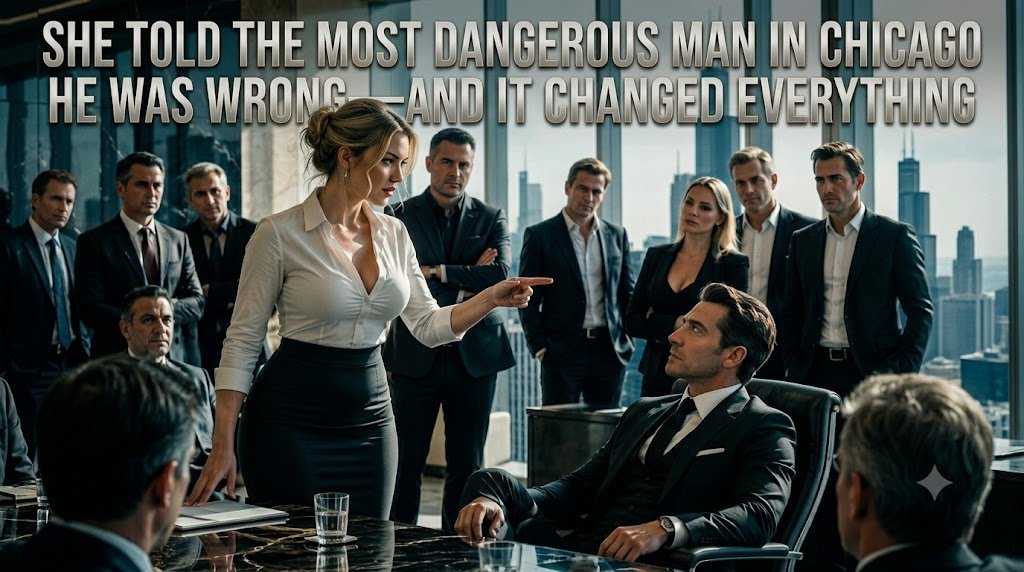
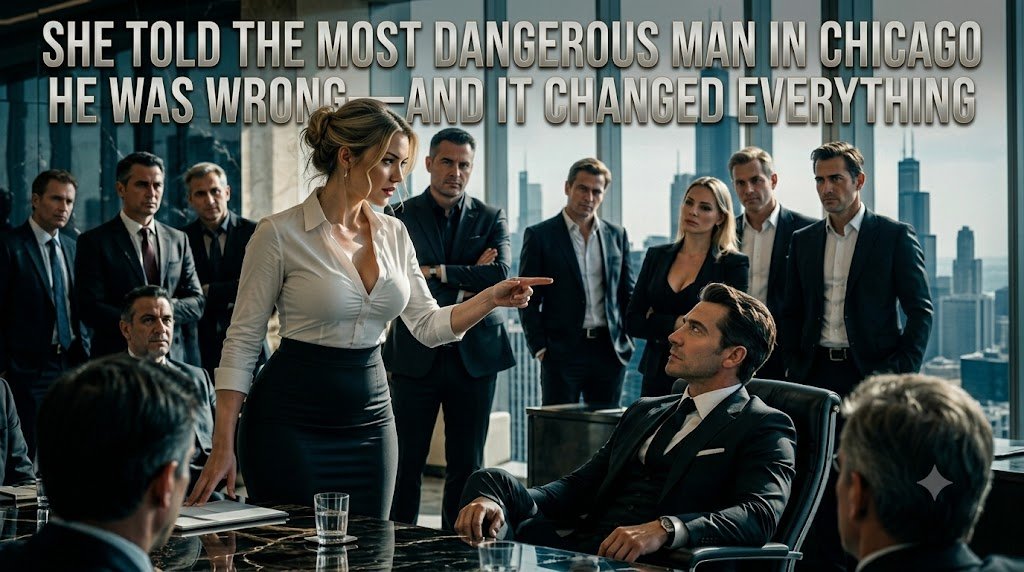
The quiet correction froze twenty-three executives in the middle of breathing.
Pens stopped above legal pads. Coffee cups hovered inches from nervous mouths. At the head of the forty-foot conference table, Dominic Valenti slowly lifted his eyes from the acquisition proposal projected across the wall.
For fifteen years, Dominic had controlled more than Valenti Holdings.
He controlled conversations.
Bank presidents lowered their voices around him. Union leaders returned his calls before the first ring ended. Men who had once carried guns for his late father now wore tailored suits and managed shipping terminals, hotels, construction firms, and investment companies.
Dominic had spent a decade dragging the Valenti name out of Chicago’s criminal shadows and into glass towers, legitimate contracts, and charitable foundations.
But everyone in the city still knew what he was.
A mafia boss with clean hands only because other people were terrified of making him dirty them.
No one interrupted Dominic Valenti.
No one contradicted him.
And no one, under any circumstances, told him he was wrong in front of the board.
Until Claire Bennett arrived.
Claire sat halfway down the table in a navy cardigan, black slacks, and sensible shoes. Her chestnut hair was pinned loosely at the back of her neck, and dark-framed glasses rested on her round face. She was soft-bodied and curvy in a room filled with people shaped by personal trainers and expensive tailoring.
She did not look threatening.
That made the silence worse.
Dominic leaned back in his chair.
“Excuse me?”
Claire adjusted her glasses and glanced again at the screen.
“I said the acquisition model is wrong.”
The chief legal officer closed his eyes as if silently preparing a condolence message.
Claire continued.
“The depreciation schedule for the Milwaukee distribution fleet was entered twice. Once under transportation assets and again under the subsidiary’s operating assumptions.”
Dominic’s expression remained unreadable.
“And you’re certain?”
“Yes.”
“How certain?”
Claire opened her laptop.
“Eighteen million dollars certain.”
A nervous sound escaped someone near the end of the table.
Dominic looked toward the screen, then toward his longtime adviser, Gabriel Russo.
Gabriel’s face gave nothing away, but his fingers had tightened around his pen.
Dominic returned his attention to Claire.
“Show me.”
Claire stood.
No one moved to hand her the presentation remote.
After three uncomfortable seconds, Dominic picked it up himself and extended it across the table.
Claire walked forward without hurrying.
She changed three figures, removed one duplicate assumption, and recalculated the financing schedule.
The projected acquisition cost dropped by $18.4 million.
The boardroom became so quiet that Claire could hear the ventilation system humming above them.
Two executives began calculating independently. Another opened the subsidiary’s audit report. Gabriel stared at the revised figure for almost a full minute.
Finally, he exhaled.
“She’s right.”
Every face turned toward Dominic.
They expected anger.
They expected humiliation.
Some expected Claire’s security badge to stop working before she reached the elevator.
Dominic studied the screen. Then he studied Claire.
There was no triumph in her expression. No smugness. No attempt to embarrass him.
Only patience.
As though numbers were incapable of understanding fear.
“Continue,” he said.
Several executives nearly dropped their pens.
Claire returned to her seat and finished explaining the correction.
By lunchtime, every floor in Valenti Tower knew the story.
The new forensic accountant had told Dominic Valenti he was wrong.
She had done it publicly.
And she was still employed.
Claire had joined Valenti Holdings nine days earlier after leaving a regional accounting firm where a senior partner routinely took credit for her work. She had not resigned dramatically. She had simply placed six years of evidence on the managing partner’s desk, accepted a better offer, and walked out before anyone could persuade her to remain invisible.
At Valenti Holdings, invisibility proved impossible.
By Wednesday, Claire had returned seven incomplete reports.
By Thursday, she had rejected two departmental budgets because their projections relied, in her words, “on hope wearing a necktie.”
By Friday, nearly every manager in the company knew her name.
“Does she understand who she’s talking to?” one director whispered outside the elevator.
“She understands,” another replied. “I don’t think she cares.”
Claire did care.
She cared about honest numbers, balanced ledgers, and employees whose retirement accounts depended on powerful people making responsible decisions.
She simply did not care about wounded egos.
Her second argument with Dominic happened eleven days after the first.
He was presenting an aggressive plan to build three regional logistics centers within eighteen months. The proposal was bold, expensive, and greeted with immediate approval.
Claire raised one hand.
“The timeline is unrealistic.”
Several executives stared down at the table.
Dominic’s jaw tightened slightly.
“Why?”
“The construction estimates assume perfect weather. The labor projections assume no contractor delays. The transportation budget ignores seasonal fuel increases, and the permitting schedule appears to have been written by someone who has never met a city inspector.”
A cough covered someone’s laugh.
Dominic folded his arms.
“How much time would you add?”
“Six months.”
“That delay costs us market share.”
“Not as much as opening unfinished facilities.”
“We can pressure the contractors.”
“You can pressure people. You cannot intimidate concrete into drying faster.”
This time, no one successfully hid their laughter.
Dominic stared at her.
Claire stared back.
Then, to everyone’s astonishment, one corner of his mouth lifted.
He asked her three questions.
She answered all three.
The revised timeline passed before the meeting ended.
That afternoon, employees began making private predictions over coffee.
“How many minutes before Bennett corrects him today?”
The predictions were wrong. Claire did not correct him on Monday, or Tuesday, or Wednesday.
Instead, she spent those three days buried in the basement archives, requesting thirty years of legacy accounts, shipping manifests, and subsidiary tax filings. She wore her hair in the same loose pin, carried the same oversized leather tote bag, and ate her turkey sandwich at her desk while the rest of the finance department went out for trendy lunches.
By Thursday afternoon, Gabriel Russo had seen enough.
He intercepted Claire in the hallway outside the executive washrooms, blocking her path with the effortless grace of a man who had survived four decades in Chicago’s underworld before trading his shoulder holster for an Italian-wool suit.
“Miss Bennett,” Gabriel said, his voice dropping into the smooth, gravelly cadence of an elder statesman. “A word.”
Claire adjusted her glasses, her expression polite but entirely unimpressed. “If this is about the fourth-quarter expense reports from the Oak Lawn terminal, I already sent an itemized memo to—”
“This isn’t about the terminals,” Gabriel interrupted, a faint smile touching the corners of his mouth. “It’s about you.”
Claire raised an eyebrow. “Me?”
“You’ve been digging through the Valenti family holding ledgers from 1994. Files that haven’t been touched since Dominic’s father passed away.” Gabriel leaned slightly against the wall, studying her with sharp, dark eyes. “People in this tower don’t usually look backward unless they’re hiding something or looking for leverage. Which one are you?”
“I’m an accountant, Mr. Russo,” Claire replied without missing a beat. “History isn’t leverage. It’s math. And your math from twenty-eight years ago has a three-point-two-million-dollar discrepancy in maritime insurance write-offs.”
Gabriel went completely still. The easygoing counselor vanished in a microsecond, replaced by the dangerous tactician who had once cleaned up after the city’s most feared enforcers.
“Maritime insurance,” Gabriel repeated softly. “That subsidiary was liquidated a decade ago.”
“And the payout was routed through an intermediary account that was closed three days before the federal statute of limitations expired,” Claire added, her voice entirely steady. “Whoever set up the ledger used a standard depreciation formula, but they transposed two digits on the final ledger entry. It looks like an administrative error. Except administrative errors don’t usually buy a controlling stake in a commercial dry dock in Indiana.”
Gabriel stared at her for a long, agonizing moment. The silence stretched between them until the elevator bell chimed down the hall.
“Did you show this to anyone else?” Gabriel asked, his voice low.
“No.”
“Why not?”
“Because I prefer to bring my work to the person responsible before I involve the board or federal regulators,” Claire said plainly. “I wanted to give Valenti Holdings a chance to balance its own books.”
Gabriel slowly exhaled, running a hand over his neatly trimmed gray hair. He let out a dry, disbelieving laugh.
“You have no idea where you are, do you, Miss Bennett?”
“I’m on the twelfth floor of Valenti Tower,” Claire said, turning to walk away. “And the numbers don’t lie, Mr. Russo. Whether the mob owns them or the municipal government does.”
That evening at 7:15 PM, the twelve-floor executive suite was empty except for the single pool of light glowing above Dominic Valenti’s mahogany desk.
Dominic was reviewing a manifest from the Port of Savannah when the double doors swung open without a knock.
He didn’t need to look up. Only one person in the building walked with that steady, unapologetic rhythm, refusing to adapt their pace to the luxury carpeted floors.
Dominic set his pen down and leaned back, steepling his fingers.
“Claire.”
She didn’t wait to be invited. She walked across the vast office, placed a thick manila folder directly on top of his private correspondence, and pulled out a chair without asking.
Dominic’s dark eyes narrowed slightly at the breach of protocol. No one sat in his office uninvited. No one placed files on his desk without sliding them deferentially across the polished wood.
“What is this?” Dominic asked, his deep voice vibrating with quiet authority.
“A twenty-eight-year-old ghost,” Claire said, crossing her hands in her lap. “Open page four.”
Dominic didn’t open it immediately. He looked at her instead. Up close, without the boardroom table between them, he noticed the small smudge of blue ink on her thumb, the slight wear on the leather of her tote bag, and the complete absence of intimidation in her posture.
Most people who sat in that chair—bankers, politicians, even hardened syndicate captains—exuded a subtle, nervous sweat.
Claire smelled like black coffee and spearmint gum.
Slowly, Dominic opened the folder. His eyes scanned the columns of figures, the circled discrepancy, and the handwritten notes in the margin—notes written in Claire’s precise, neat cursive.
The silence in the penthouse grew heavy.
Outside the floor-to-ceiling windows, the Chicago skyline twinkled against the dark lake, but inside, the temperature felt like it had dropped twenty degrees.
Dominic reached the bottom of the page, where Claire had stapled a certified corporate registry printout from the state of Indiana.
He didn’t flinch. His expression didn’t change by a single muscle. But the air around him shifted, turning dense and sharp.
“You found the Indiana dry dock,” Dominic said.
“I found the discrepancy that funded it,” Claire corrected. “Three point two million dollars, diverted from maritime loss reserves and filtered through four shell companies that were dissolved in 1996.”
Dominic lifted his gaze from the paper. His dark, intense eyes locked onto hers.
“Whose signature is on the original transfer order, Claire?”
“That’s the interesting part,” Claire said, leaning forward for the first time. “It isn’t your father’s signature. And it isn’t Gabriel Russo’s.”
Dominic went completely still.
“It belongs to Victor Vance,” Claire continued, naming the city’s notoriously corrupt former deputy mayor—a man who had conveniently died in a boating accident twenty-five years ago. “Victor Vance stole three point two million from Valenti Holdings. Or… someone inside Valenti Holdings used Victor Vance’s dead hand to sign away company assets.”
Dominic stood up.
He was over six feet tall, broad-shouldered, and tailored to perfection. When he moved, he moved with the predatory, controlled grace of a man who owned the streets he walked on. He walked around the massive desk, stopping just inches from Claire’s chair.
Most women would have shrunk back.
Claire simply looked up, tilting her chin slightly so her glasses didn’t slide down her nose.
“You’re playing a very dangerous game, Miss Bennett,” Dominic said softly, his voice a low, rumbling threat that could have terrified a seasoned prosecutor. “Digging into thirty-year-old ledgers in this city has a way of leading people to very short careers. And very permanent retirements.”
Claire didn’t blink. She didn’t look away.
“I’m an accountant, Mr. Valenti,” she said, her voice entirely steady. “I don’t dig graves. I dig balances. And right now, your balance sheet is carrying a three-point-two-million-dollar ghost that doesn’t want to stay buried.”
Dominic stared at her, the tension in the room stretching like a taut wire.
Then, unexpectedly, a slow, dangerous smile crept across his face.
The smile didn’t reach Dominic’s eyes, but it changed the air in the room. The oppressive weight shifted into something sharper, heavier with realization.
“A ghost,” Dominic repeated, tasting the word. He walked back to his desk, picked up the manila folder, and dropped it into his locked bottom drawer without looking at it again. “Ghosts are expensive, Claire. They take up space. They demand explanations nobody is alive to give.”
“Then we write off the loss, amend the subsidiary filings, and absorb the deficit legally,” Claire said smoothly, standing up and smoothing the front of her navy cardigan. “It’ll cost the holding company a fraction of a percentage point in quarterly earnings, but the audit trail will be clean before the federal tax commission starts its tri-annual review next month.”
Dominic stopped with his hand resting on the wooden drawer pull. He looked at her as if she were speaking a language he hadn’t heard in years—a language where problems were solved with ledgers instead of leverage.
“You want to fix a twenty-eight-year-old mafia theft… with a routine tax adjustment?”
“I want the books to balance,” Claire corrected. “How you clean up after your predecessors is your business. Making sure the numbers add up before I sign my name to them is mine.”
She gathered her tote bag, slung the strap over her shoulder, and walked toward the double doors without waiting for a dismissal.
“Claire.”
She paused with her hand on the brass handle, glancing back over her shoulder.
Dominic leaned against his desk, folding his arms across his chest. The dangerous aura had retreated, leaving behind the chilling composure of a man who owned the room he stood in.
“Gabriel was right about you,” Dominic said quietly. “You don’t care who you’re talking to.”
“People are variable, Mr. Valenti,” Claire replied, adjusting her glasses. “Numbers are honest. Get used to the math.”
She stepped out into the hallway and let the heavy doors close behind her.
By the following Friday, the three-point-two-million-dollar discrepancy had vanished from the Valenti Holdings legacy ledgers, quietly reallocated under corporate restructuring losses without a single word leaked to the press or the board. No one asked questions. In Dominic Valenti’s organization, when the boss buried a ghost, you didn’t mark the headstone.
Over the next six months, the dynamic inside Valenti Tower shifted in ways the executive board struggled to comprehend.
The curved, unassuming forensic accountant in sensible shoes didn’t just survive; she became indispensable.
When a rogue union local tried to inflate overtime claims at the South Chicago shipping terminal, Claire caught the payroll padding within forty-eight hours and sliced their fraudulent demands in half without a single punch being thrown. When an overextended luxury hotel subsidiary tried to hide a failing construction loan, she flagged the liquidity risk before the quarterly audit even began, saving the company millions in potential default penalties.
She corrected Dominic three more times in board meetings—once on a real estate tax provision, once on a supply chain logistics projection, and once on a charitable foundation disbursement that was technically illegal under federal non-profit guidelines.
Each time, the boardroom held its breath. Each time, Dominic accepted the correction with a nod, a sharp look, and a revised spreadsheet.
The whispers in the elevators changed.
They stopped calling her the new accountant who was going to get fired. They started calling her the one person in Chicago who could look the devil in the eye and tell him his math was sloppy.
And Dominic Valenti? He stopped looking at acquisition proposals alone.
One evening in late November, the rain lashing against the floor-to-ceiling windows of the twelfth-floor penthouse, Dominic sat at his desk reviewing a final portfolio merger. The office was dark except for the amber glow of his desk lamp.
The heavy double doors pushed open. Claire walked in, carrying a lukewarm cup of black coffee and a fresh stack of audit summaries.
She didn’t knock. She never knocked.
She dropped the stack onto the corner of his desk, pulled up her chair, and sat down without being asked.
Dominic looked up from his papers, a faint, familiar amusement in his dark eyes. “Did I miscalculate the freight forwarding margins again?”
“No,” Claire said, reaching into her tote bag and pulling out a small, foil-wrapped square. She slid it across the mahogany wood toward him. “You’ve been working since six this morning. Your blood sugar is dropping, and you’re starting to lean toward aggressive over-expansion in your commercial real estate bids.”
Dominic looked down at the offering.
It was a generic, gas-station peanut butter cup.
He looked back up at her, his expression a mix of absolute disbelief and reluctant fascination. For fifteen years, men had brought him millions of dollars in cash, million-dollar contracts, and bottles of thirty-year-old scotch.
Nobody had ever brought him gas station candy because his balance sheets looked low on glucose.
“Is this a bribe, Miss Bennett?” Dominic asked, his deep voice carrying a low, teasing hum.
“It’s a nutritional correction,” Claire replied deadpan, opening her laptop and bringing up the spreadsheet. “Eat the candy, Mr. Valenti. We have twenty minutes before the London futures market opens, and your preliminary projections for the steel import tariff are off by four percent.”
Dominic stared at the peanut butter cup for another second. Then, slowly, a genuine, unmasked smile broke across his face—a rare, dangerous expression that very few people in Chicago had ever lived to see.
He unwrapped the candy, tossed it into his mouth, and leaned forward over the ledgers.
“Show me,” he said.