COLD OPEN — THE SECRET BEHIND THE PERFECT HOUSE
For nearly four years, I sent more than $90,000 home while serving overseas, believing I was taking care of my wife, Celia.
Then I came back without warning.
The house looked perfect.
My mother and sister looked wealthy.
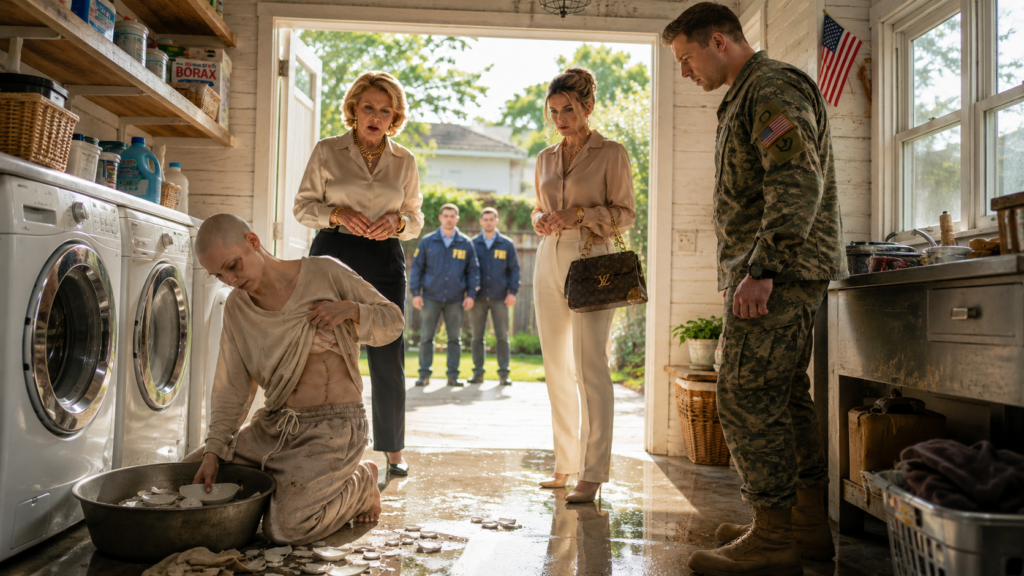
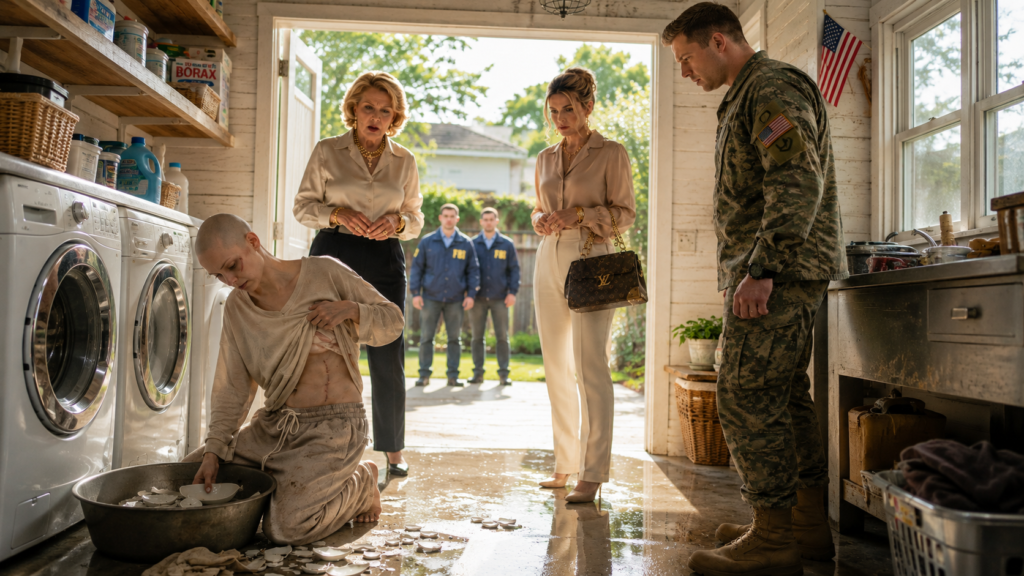
But behind the house, I found Celia painfully thin, completely bald, washing dishes beside an old outdoor sink.
“She did this to herself,” my mother said.
Then Celia’s sleeve slipped.
A hospital bracelet was wrapped around her wrist.
She looked at me and whispered:
“Adrian… they found a tumor months ago.”
That was when I realized the money I had sent home had been hiding a truth far darker than I could have imagined.
PART 1 — THE WIFE THEY TRIED TO HIDE
I had spent almost four years serving overseas with the U.S. Army.
Through every exhausting night away from home, I held onto one thought: returning to my wife.
My name is Adrian Cole. I was thirty-eight.
My wife, Celia, was thirty-two.
Before my deployment, we had been living near Savannah, Georgia, trying to build a quiet life together.
Every month I sent money home.
I covered the bills, household expenses, repairs, and whatever else my family might need.
By the end of those four years, I had sent home more than $90,000.
I never questioned where it went.
I trusted my family.
Then, in late October, my unit received unexpected emergency leave after our final operation.
I had only a short time before I was required to return.
So I made a decision.
I wouldn’t tell anyone I was coming home.
I wanted to surprise Celia.
In my mind, I could already see her opening the door, recognizing me, and running straight into my arms.
Instead, when I arrived, I saw something completely different.
The house looked like a dream.
Two freshly painted floors.
A tall wooden gate.
A new black pickup sitting in the driveway.
Expensive furniture visible through the windows.
For a moment, I felt proud.
I thought about all the money I had sent home.
Maybe it had finally given my family the comfortable life we’d always wanted.
Then I walked around the side of the house.
And I saw Celia.
She was kneeling beside an old plastic washing basin.
Her clothes hung loosely from her body.
She looked frighteningly thin.
A knitted scarf covered her head even though the afternoon was warm.
She was picking broken pieces of a plate from the dirt with trembling fingers.
Then my younger sister, Brooke, shouted from inside.
“Can’t she cover that head before our guests arrive?”
Celia froze.
Slowly, she turned around.
Then she saw me.
I expected her to smile.
I expected her to run toward me.
Instead, she stepped backward.
Both hands immediately went to her head.
Her face filled with fear.
That frightened me more than her appearance.
“Celia?”
She didn’t answer.
I walked toward her carefully and reached for the scarf.
She caught my hand.
“Please, Adrian.”
I gently pulled the scarf away.
Her head was completely shaved.
Several tiny cuts marked her scalp.
My chest tightened.
Before I could ask what had happened, the back door opened.
My mother, Judith, stepped outside.
She was sixty-five, dressed in an elegant blouse with gold earrings and an expensive watch.
Brooke followed behind her, holding a designer handbag and a new smartphone.
Judith stared at me for a second.
“You should have told us you were coming.”
I barely heard her.
I pointed toward Celia.
“What happened to my wife?”
My mother sighed.
“She did it to herself.”
Brooke folded her arms.
“She destroyed her hair with some cheap treatment. Then she started starving herself. She just wants people to feel sorry for her.”
I looked at Celia.
She remained silent.
That silence felt wrong.
After years in the military, I had learned to notice small details.
The hesitation in someone’s voice.
The way their eyes moved.
The difference between embarrassment and genuine fear.
Then Celia’s sleeve shifted.
A white hospital bracelet appeared around her wrist.
Beside it was a fading bruise from an IV.
My anger surged.
I wanted to demand an explanation right there.
But I stopped myself.
Military service had taught me something valuable:
When you suspect someone is lying, don’t show them everything you know.
Let them keep talking.
So I forced a smile.
“Actually,” I said, “I came home with some good news.”
Their expressions changed immediately.
I told them my deployment compensation and accumulated military benefits had been approved.
Almost $360,000.
The reaction was instant.
Judith began talking about renovating the kitchen.
Brooke started discussing a new truck.
Then came plans for vacations, expensive furniture, and shopping.
They suddenly had endless ideas for my money.
But nobody asked why Celia could barely stand.
Nobody asked about the hospital bracelet.
Nobody asked why she looked so sick.
That night, after everyone went upstairs, I searched for my wife.
I found her sleeping in a cramped storage room behind the laundry area.
Not a bedroom.
A storage room.
There was only a thin mattress, an old blanket, and a plastic chair.
I stared at her.
“Why are you sleeping here?”
Celia looked down.
For several seconds, she said nothing.
Then she sat beside me and slowly opened her blouse.
I saw a surgical scar along her side.
My breath caught.
“Adrian,” she whispered, “I have cancer.”
Everything inside me seemed to stop.
“They found the tumor almost six months ago.”
Six months.
For six months, my wife had been carrying this alone.
And all that time, I had been sending money home believing she was being cared for.
Celia told me she had begged Judith for $300 so she could see a specialist.
My mother refused.
She accused Celia of pretending to be sick because she wanted to get her hands on my military pay.
Brooke had also started monitoring Celia’s phone.
Every call.
Every message.
Every attempt to contact me.
The money I had sent home never reached Celia when she needed it.
Eventually, she became desperate.
She had almost nothing left that could be sold.
Except her hair.
So she cut it off herself.
Then she sold it to a local buyer for $150.
That money helped pay for transportation and her biopsy.
Celia wiped a tear from her cheek.
“I just wanted to know what was happening to me.”
I couldn’t speak.
Upstairs, my mother and sister were sleeping comfortably in a house filled with things purchased with the money I had earned overseas.
Downstairs, my wife had sold her own hair just to find out whether she would survive.
I pulled her into my arms.
“We’ll get through this,” I whispered.
She held onto me.
But then she slowly pulled away.
“Adrian…”
“What?”
Her voice became barely audible.
“There is something else you need to know.”
I looked into her eyes.
She was terrified.
“They never wanted you to come home.”
And suddenly, I understood that the cancer was only one part of the truth waiting for me inside that house.
PART 2 — THE MONEY, THE LIES, AND THE TRUTH
For several seconds, neither of us spoke.
The only sound was the faint hum of the washing machine outside the storage room.
I stared at Celia.
“What do you mean they didn’t want me to come home?”
She looked toward the door before answering.
“Because they knew I was going to tell you.”
“Tell me what?”
Celia reached beneath the mattress and pulled out a small envelope.
Her hands were shaking.
Inside were several folded papers.
Hospital receipts.
Prescription records.
Bank transfer slips.
And something else.
A notebook.
I opened it.
Every payment I had sent home over the previous three years had been written down.
The dates.
The amounts.
And beside them, handwritten notes about where the money had supposedly gone.
Mortgage.
Food.
Medical expenses.
Home repairs.
But Celia had marked several of them with red circles.
“I found these in Judith’s desk,” she whispered. “She kept everything.”
I looked at the numbers.
Hundreds of dollars.
Sometimes thousands.
The amounts didn’t match anything I’d seen in the house.
“Where did the money actually go?”
Celia swallowed.
“Your mother opened another account.”
My stomach tightened.
“She moved your money there. Some of it went to pay for this house. Some went toward Brooke’s truck. Some paid her credit cards.”
“And my medical money?”
Celia lowered her eyes.
“Your mother said there wasn’t any.”
I felt heat rise through my chest.
Then Celia pulled out one final document.
A bank statement.
The account belonged to Judith.
I recognized the transfer descriptions immediately.
My transfers.
My money.
Almost $94,000 in total.
I sat there staring at the page.
Four years of overtime.
Four years of deployments.
Four years of sleeping in unfamiliar places and missing birthdays.
Four years of believing I was building a future for my wife.
And someone had been quietly taking it apart.
“Why didn’t you call me?” I asked.
“I tried.”
Celia’s eyes filled with tears.
“Brooke changed the password to your old email account. She told me you didn’t want to hear from me.”
I looked at her.
“She told you that?”
“She showed me messages.”
“What messages?”
Celia hesitated.
“Messages that looked like they came from you.”
My blood went cold.
“She fabricated them.”
I stood up.
“How long?”
“Almost a year.”
A year.
For nearly twelve months, my own wife had been made to believe I wanted nothing to do with her.
I paced across the tiny room.
Then another thought hit me.
“If they were stealing my money, why keep you here?”
Celia looked at me with an expression I would never forget.
“Because they needed someone to blame.”
“For what?”
She pointed toward the hallway.
“The house.”
I stopped.
“What about it?”
“The property isn’t fully paid for.”
She took a breath.
“Your mother used your name to guarantee another loan.”
I felt as though the floor had shifted beneath me.
“How much?”
“More than $120,000.”
I stared at her.
“And if they can’t pay?”
“They told the bank you would.”
For the first time, the entire picture became clear.
The new house.
The truck.
The furniture.
The sudden interest in the $360,000 benefit.
It wasn’t greed alone.
They were desperate for another large payment.
My return had not ruined their plans.
It had interrupted them.
I looked at Celia.
“Did they know about my leave?”
She shook her head.
“No.”
“Then how did they know I was coming?”
Her face changed.
“I don’t know.”
A noise came from upstairs.
We both froze.
Footsteps.
Slow.
Careful.
Someone was coming down.
I quickly put the documents back inside the envelope.
The footsteps stopped outside the storage room.
Then Brooke’s voice came through the door.
“Celia?”
My wife looked at me.
I motioned for her to stay quiet.
The door opened.
Brooke stood there.
Her phone was in one hand.
She looked at me, then at the envelope.
For a moment, nobody moved.
Then she smiled.
“You two are still awake?”
I stepped forward.
“What were you doing with my email?”
Her smile disappeared.
“I don’t know what you’re talking about.”
“Don’t lie to me.”
Brooke took a step backward.
“Adrian, you’re exhausted. You just got back. You don’t understand what’s happening here.”
“I understand enough.”
She glanced toward Celia.
“You told him.”
Celia flinched.
Those three words told me everything.
Brooke knew.
She knew exactly what had been happening.
I moved closer.
“How long have you been controlling her calls?”
She said nothing.
“How long?”
“Mom handled the finances.”
“That wasn’t my question.”
Brooke’s expression hardened.
“You were never here. Someone had to manage things.”
“By stealing my money?”
“You sent it home!”
“Not to you.”
Her eyes flashed with anger.
“You think Celia is innocent?”
I turned toward my wife.
Brooke continued.
“She was sick long before you came back. She spent money recklessly. She refused to listen to Mom. She made everything difficult.”
I looked at the hospital bracelet on Celia’s wrist.
“Is that what you call a cancer diagnosis?”
Brooke suddenly went silent.
Then a voice came from behind her.
“That’s enough.”
Judith stood in the hallway.
She wasn’t wearing her jewelry anymore.
She looked older.
Much older.
“Adrian,” she said quietly, “you’ve misunderstood the situation.”
I laughed once.
There was nothing funny about it.
“Then explain it.”
She looked at Celia.
“Your wife has been unstable for months.”
“Stop.”
My voice was calm.
But even Judith seemed startled by it.
“I’ve seen the hospital records.”
She froze.
“I’ve seen the bank statements.”
Her face lost its color.
“And I’ve seen the messages Brooke sent pretending to be me.”
Brooke turned toward her mother.
“Mom…”
Judith raised a hand.
“Don’t.”
Then she looked directly at me.
“You weren’t supposed to come home yet.”
There it was.
The sentence that changed everything.
I stepped closer.
“Why?”
Judith’s eyes filled with something between anger and fear.
“Because the money was already committed.”
“To what?”
She didn’t answer.
I pulled out my phone.
“I’ve already contacted the bank.”
Brooke’s face went pale.
I continued.
“And tomorrow morning, I’m going to speak with a lawyer.”
Judith’s voice sharpened.
“You wouldn’t do that to your own family.”
I looked at Celia.
“My wife is family.”
Nobody answered.
Then, from the top of the stairs, I heard another sound.
A phone ringing.
Brooke looked up.
Judith looked up.
I looked at both of them.
The ringing stopped.
A second later, Brooke’s phone vibrated in her hand.
She checked the screen.
Her face changed completely.
“Who is it?” I asked.
She didn’t answer.
I reached for the phone.
Brooke pulled it away.
Then a notification appeared on the screen.
TRANSFER CONFIRMED: $75,000.
I stared at it.
The sender’s name was mine.
But I hadn’t made that transfer.
Someone had just moved another $75,000 using my identity.
And whoever had done it was still inside the house.
PART 3 — THE SECRET THAT CHANGED EVERYTHING
For a moment, nobody moved.
I stared at Brooke’s phone.
The transfer notification was still glowing on the screen.
Seventy-five thousand dollars.
Sent under my name.
I looked at my mother.
“Where did that money go?”
Judith said nothing.
Brooke’s hands began to shake.
Then Celia whispered from behind me.
“Adrian… check the account number.”
I pulled out my phone and contacted the bank’s emergency fraud department.
Within minutes, the truth began to surface.
The $75,000 had been transferred that evening into an account belonging to a company I had never heard of.
But the account had been opened using my personal information.
My mother’s address.
My identification details.
And a forged signature.
The bank representative told me something even worse.
There had been several attempted transfers during the previous month.
Whoever was behind them had been waiting for my military benefits to arrive.
That was why they needed me to stay away.
That was why my mother and Brooke had kept Celia isolated.
They weren’t simply stealing the money I had already sent.
They were preparing to take the new $360,000 as well.
I looked at Judith.
“Did you do this?”
She finally broke.
Tears ran down her face.
“I only borrowed it.”
“Borrowed?”
Her voice trembled.
“I thought I could fix everything before you found out.”
“Everything?”
She pointed toward the house.
“The house was already in debt. Brooke had loans. I used some of your transfers to cover them. Then I kept borrowing because I believed your benefits would clear the rest.”
I shook my head.
“And Celia?”
Judith looked away.
“I never thought she’d get this sick.”
Celia laughed bitterly.
“You knew.”
Judith said nothing.
“You knew I had cancer,” Celia continued. “You saw the medical reports.”
My mother finally whispered,
“I was afraid.”
“Afraid of what?”
“That Adrian would stop sending money.”
The words hung in the room.
That was the truth.
Not confusion.
Not misunderstanding.
Fear and greed.
I immediately called the bank again and froze every account connected to my identity.
Then I contacted military investigators and reported the fraudulent transfers.
Brooke started crying.
“Adrian, please. We can fix this.”
I looked at her.
“You had a year to fix it.”
She covered her face.
“You don’t understand. Mom said we had no choice.”
“You always had a choice.”
That night, I took Celia to a nearby emergency clinic.
The doctor examined her immediately.
She was severely malnourished and dehydrated, but she was stable enough to begin treatment.
For the first time in months, she slept in a real hospital bed.
I stayed beside her until sunrise.
The following morning, I met with a lawyer and gave him every bank statement, hospital record, message, and document Celia had saved.
The investigation moved quickly.
The forged loan was challenged.
The fraudulent transfer was stopped before the money could disappear completely.
The house was eventually sold to cover the legitimate debts.
My mother and Brooke were forced to account for the money they had taken.
It took months.
There were hearings.
Questions.
Documents.
And painful conversations I never imagined having with my own family.
But eventually, the truth was no longer something they could hide.
Celia began treatment.
Her recovery was slow.
There were difficult days when she barely had enough strength to speak.
But she was no longer alone.
I moved us to a small coastal town in northern Florida, far from the house where everything had happened.
We rented a modest place near the water.
There was no luxury.
No expensive furniture.
No new truck.
Just a small kitchen, two bedrooms, and a porch where Celia could sit in the morning sun.
Months later, her hair began growing back.
The first time I noticed it, I smiled.
She touched the short strands on her head.
“I look different.”
I took her hand.
“So do I.”
She laughed softly.
One evening, we sat together on the porch while the sun disappeared beyond the horizon.
Celia leaned against my shoulder.
“Do you regret coming home early?”
I thought about the house.
The lies.
The money.
The hospital.
Then I looked at her.
“No.”
I would have lost every dollar and every possession if it meant finding the truth in time.
The money could be earned again.
The house could be replaced.
But the chance to save the woman I loved could never be replaced.
A year after I returned, Celia received the news we’d been praying for.
Her latest scans showed no evidence of the tumor.
She cried.
So did I.
We didn’t celebrate with a mansion or an expensive vacation.
We bought two cups of coffee and sat on the beach.
That was enough.
Before leaving the house, Celia stopped beside the mirror.
Her hair had grown back unevenly, but she no longer tried to hide it.
She smiled at her reflection.
Then she turned to me.
“I used to think losing my hair was the worst thing that ever happened to me.”
I stepped closer.
“And now?”
She took my hand.
“Now I know it was the moment I started fighting for myself.”
I kissed her forehead.
The woman I had found behind that house was not broken.
She had survived.
And I finally understood something I should have known from the beginning:
Money can build walls.
It can buy beautiful furniture, expensive cars, and impressive houses.
But it cannot buy loyalty.
It cannot buy love.
And it certainly cannot hide the truth forever.
Celia and I started over with almost nothing.
But for the first time in years, everything we had belonged to us.
And that was worth more than every dollar I had ever sent home.
THE END.