COLD OPEN
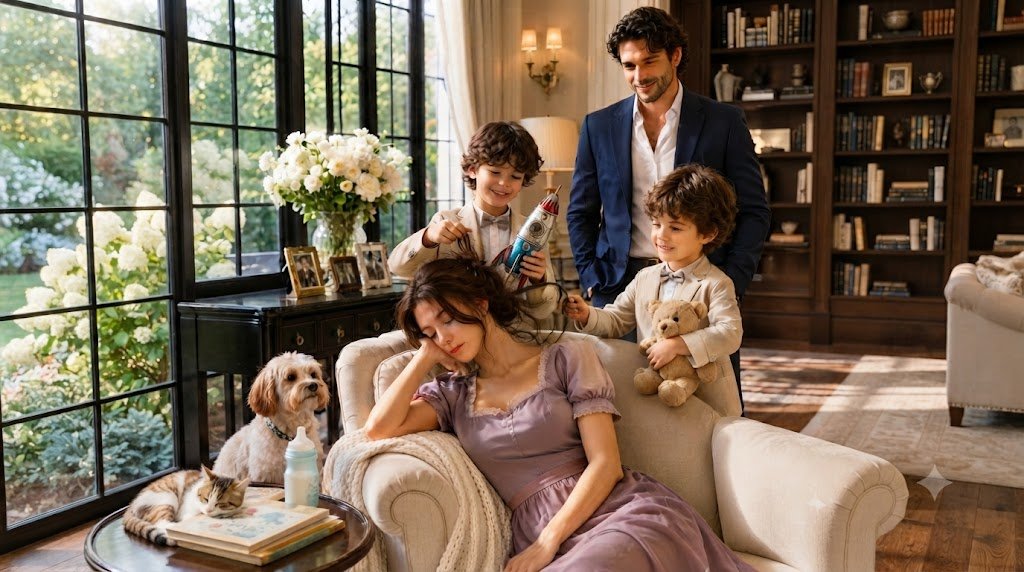
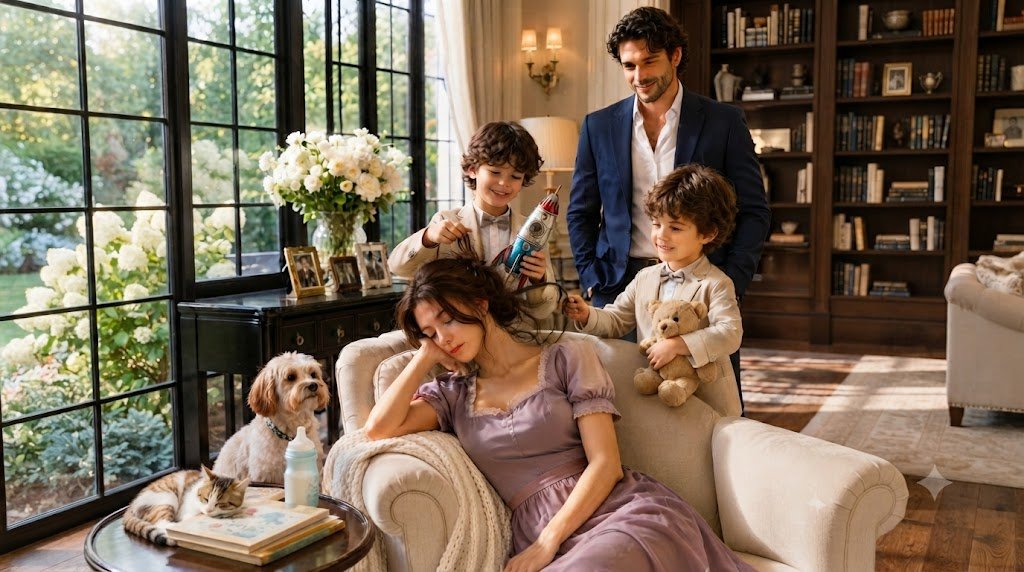
A 43-year-old billionaire had spent nearly four million dollars trying to discover why his twin sons were slowly becoming weaker. Every specialist blamed something different. Then I arrived as their live-in nanny, and while his arrogant family doctor mocked me, I noticed a strange smell coming from the ventilation system outside the boys’ bedrooms.
That was the moment I realized the answer might have been hiding inside his mansion all along.
PART 1
My name is Amelia Grant.
At thirty-two, I arrived at Sebastian DeLuca’s estate in northern Virginia with one battered suitcase and enough nerves to make my fingers tremble.
The gates opened onto a property that looked more like a luxury hotel than a private residence.
Stone walls. Floor-to-ceiling windows. Perfect gardens. Security cameras covering nearly every corner.
My inexpensive coat suddenly felt embarrassingly out of place.
Everyone knew Sebastian DeLuca’s public reputation.
At forty-three, he was a billionaire investor whose companies owned hotels, technology firms, and commercial properties throughout the Mid-Atlantic.
Privately, rumors suggested his influence extended far beyond legitimate business.
The nanny agency had contacted me less than a day earlier.
Live-in position. Seven-year-old twin boys. Unexplained medical condition. Extremely generous salary.
The estate manager, Mrs. Whitmore, led me into Sebastian’s study.
Medical files covered nearly the entire desk.
Sebastian looked nothing like the polished photographs in financial magazines.
He looked exhausted.
“You’ve worked with children who have complex medical needs?” he asked.
“For almost nine years.”
“What makes you different from the caregivers before you?”
“I pay attention to ordinary things.”
His eyes narrowed slightly.
“Such as?”
“Food. Sleep. Cleaning products. Daily routines. Small changes in behavior. What makes symptoms better or worse. Doctors see children for an hour. A caregiver sees what happens during the other twenty-three.”
For the first time, Sebastian seemed genuinely interested.
He pushed a thick folder toward me.
“My sons, Mason and Miles, have been getting weaker for almost two years.”
The records described constant fatigue, stomach discomfort, difficulty concentrating, appetite loss, and unexplained weight changes.
“They used to spend hours running through this house,” Sebastian said quietly. “Now some mornings they barely have enough energy to walk downstairs.”
“How many specialists have examined them?”
“I stopped counting.”
“And you’ve spent how much?”
“Close to four million dollars.”
“With no diagnosis?”
“Nothing definitive.”
I turned another page.
“Their mother?”
His expression immediately hardened.
“Natalie died in a highway accident five years ago.”
“I’m sorry.”
“The boys began having problems not long after.”
I looked back at the medical reports.
Something about the timeline bothered me.
Before I could ask another question, the study door opened without a knock.
A tall, silver-haired man walked inside.
Dr. Malcolm Reed.
His eyes moved over me with immediate disapproval.
“Who is she?”
“Amelia Grant,” Sebastian said. “Our new nanny.”
Dr. Reed gave a dismissive laugh.
“Another nanny?”
“Live-in caregiver,” I corrected politely.
His expression became even more condescending.
“These children need medical supervision, not someone wandering around the house searching for imaginary clues.”
“I agree.”
He paused, apparently surprised by my answer.
“Then we’re clear.”
“Not quite. How long have you been treating them?”
His eyes narrowed.
“Almost thirteen months.”
“And you’ve identified what’s causing the decline?”
The room went quiet.
Sebastian slowly looked at the doctor.
Dr. Reed’s jaw tightened.
“You should stay within your professional boundaries.”
“I intend to. My job is simply to notice what happens when the doctors leave.”
Sebastian watched us carefully.
Then he stood.
“She starts today.”
Dr. Reed stared at him.
“Sebastian, that’s unnecessary.”
“I wasn’t asking for your opinion.”
The doctor gathered his files and walked out, visibly furious.
Sebastian looked at me.
“Do you always challenge people?”
“Only when they mistake confidence for competence.”
For the first time, I saw the smallest hint of amusement on his face.
He led me upstairs.
Mason and Miles had adjoining bedrooms at the end of a quiet hallway.
Sebastian reached for the first door.
I suddenly stopped.
There was a smell in the air.
Very faint.
Sweet.
Almost like flowers.
But beneath it was something sharp and artificial.
“What is that?” I asked.
Sebastian turned.
“What?”
“That smell.”
He breathed in.
“I don’t notice anything.”
I walked toward a decorative ventilation panel positioned between the boys’ bedrooms.
The scent became stronger.
“When was this ventilation system last inspected?”
Sebastian’s expression changed.
“I don’t know.”
“Who maintains it?”
“The house systems are automated.”
I looked directly at him.
“That’s not what I asked.”
He said nothing.
Behind us, Mrs. Whitmore suddenly dropped the towels in her arms.
I turned around.
She wasn’t looking at me.
She was staring at the ventilation grate.
And the fear in her eyes told me something far more important than any medical report.
Someone inside that mansion already knew exactly what was coming through that vent.
PART 2
That night, I barely slept.
Mason and Miles had fallen asleep quickly, but their breathing sounded unusually shallow.
I sat between their beds, watching the rise and fall of their chests.
At 2:13 a.m., Miles suddenly coughed.
Then Mason did the same.
Both boys woke at almost exactly the same time.
“Mom?” Miles whispered.
I froze.
His mother had been dead for five years.
“Your mother isn’t here, sweetheart,” I said gently.
Miles looked toward the ventilation grate.
“She used to say the room smelled funny.”
My heart skipped.
“When did she say that?”
“Before she went away.”
Mason opened his eyes.
“Dad told us not to talk about it.”
I sat very still.
“What did your mother say?”
The boys exchanged a frightened glance.
“She said someone was making us sick.”
Before I could ask anything else, footsteps sounded in the hallway.
Sebastian appeared in the doorway.
“Why are you awake?”
“The boys were coughing.”
His gaze immediately moved toward the vent.
“Did they say anything?”
I hesitated.
“They mentioned their mother.”
Sebastian’s face changed.
“What exactly did they say?”
“That she believed someone was making them sick.”
For several seconds, he said nothing.
Then he walked to the window and looked outside.
“Natalie said a lot of things near the end.”
“Did you believe her?”
“I thought she was frightened.”
“Frightened of what?”
He turned toward me.
“I don’t know.”
I didn’t believe him.
Not completely.
The next morning, I asked Mrs. Whitmore about the ventilation system.
She immediately refused to answer.
“I don’t know anything about it.”
“You dropped the towels when you saw the vent.”
Her hands tightened around the laundry basket.
“You should leave this alone.”
“Why?”
She looked toward the security camera mounted above the hallway.
Then she lowered her voice.
“Because Mrs. DeLuca asked the same questions.”
My pulse quickened.
“What happened to her?”
Mrs. Whitmore looked at me sadly.
“She died before she could prove anything.”
That afternoon, I searched the children’s rooms.
I found nothing unusual at first.
Then I noticed something beneath Miles’s bed.
A small plastic box.
Inside were several drawings.
The boys had drawn the same thing over and over.
Their bedroom.
The vent.
And a black cloud coming from it.
On one drawing, someone had written in childish handwriting:
“It comes when Daddy leaves.”
My stomach tightened.
Sebastian had been away from the house for three days that week.
I immediately went downstairs.
His office door was open.
I knocked.
“Come in.”
Sebastian was standing behind his desk, speaking on the phone.
He ended the call when he saw me.
“What happened?”
I placed the drawing in front of him.
His face went pale.
“Where did you find this?”
“Under Miles’s bed.”
He stared at the picture.
“I thought these were just nightmares.”
“Did their mother ever show you drawings like this?”
He didn’t answer.
“Sebastian.”
He finally looked at me.
“Yes.”
“And you ignored them?”
His voice became quieter.
“I didn’t know what else to do.”
I studied him.
For the first time, the billionaire looked less like a powerful man and more like a father who had been terrified for years.
“I need access to the maintenance records.”
“Why?”
“Because if something is entering those rooms through the ventilation system, I need to know when it started.”
He hesitated.
Then he handed me a keycard.
“Basement level three.”
“Who has access?”
“Me. The estate manager. Security.”
“And Dr. Reed?”
Sebastian’s eyes hardened.
“No.”
That answer stayed with me.
Later that evening, I went downstairs.
The basement was colder than the rest of the house.
Rows of electrical panels lined the walls.
I found the ventilation control room at the end of the corridor.
The maintenance logs were stored on a computer.
I searched the boys’ wing.
The system had been modified nineteen months earlier.
Exactly one month before their symptoms began.
My hands went cold.
Someone had installed an additional device inside the ventilation system.
And according to the access records, the person who authorized the installation was not Sebastian.
It was Dr. Malcolm Reed.
I photographed the screen.
Then I heard footsteps behind me.
I turned.
Dr. Reed stood in the doorway.
“You shouldn’t be down here.”
I stepped away from the computer.
“Neither should you.”
His expression hardened.
“Give me your phone.”
“Why?”
“Because you have no idea what you’re dealing with.”
“I think I’m beginning to.”
He moved closer.
“Those children are sick. That’s all.”
“Then why did you modify their ventilation system?”
He stopped.
For one second, fear crossed his face.
Then he smiled.
“You really should have taken the advice I gave you.”
“Which was?”
“Stay within your qualifications.”
A loud alarm suddenly sounded upstairs.
Dr. Reed looked toward the ceiling.
Then he ran.
I followed him.
When I reached the boys’ hallway, Sebastian was already there.
Mason was lying on the floor.
Miles was beside him, struggling to breathe.
“Call an ambulance!” I shouted.
Sebastian dropped to his knees.
“What happened?”
I looked at the ventilation grate.
The sweet chemical smell was overwhelming.
“Get them outside!”
Sebastian lifted Mason into his arms while I carried Miles.
We rushed into the garden.
Within minutes, the boys began breathing more easily.
Sebastian looked at me.
His face was filled with horror.
“What is happening to my sons?”
I looked back at the mansion.
“Someone has been poisoning them.”
He stared at me.
“Who?”
Before I could answer, Mrs. Whitmore ran toward us holding a sealed envelope.
“Amelia,” she whispered.
“I found this in Mrs. DeLuca’s old room.”
I opened it.
Inside was a handwritten note dated five years earlier.
The final line made my blood run cold.
“If I die, don’t trust Dr. Reed. He isn’t treating my children. He’s testing on them.”
Sebastian read the note over my shoulder.
His face changed completely.
Then he whispered the words that made everything even more terrifying.
“Natalie knew.”
I looked at him.
“Knew what?”
He stared toward the house.
“She knew who was behind it.”
PART 3 — THE TRUTH NATALIE LEFT BEHIND
Sebastian’s words hung in the air.
“Who?” I asked.
He looked at the mansion.
“She never told me.”
“Then we find out.”
That night, Sebastian ordered everyone out of the estate except me, the boys, Mrs. Whitmore, and his security chief.
Dr. Reed was gone.
His office had been emptied.
His phone was disconnected.
But he had made one mistake.
He had forgotten about the old medical archive in the basement.
We searched it until nearly midnight.
Then I found a file marked with Natalie’s name.
Inside was a photograph of a laboratory.
The same ventilation equipment appeared in the background.
Beneath the photograph was a company name.
Northstar Therapeutics.
Sebastian stared at it.
“I’ve never heard of them.”
Mrs. Whitmore shook her head.
“Your wife had.”
She pulled another document from the file.
It was a contract signed shortly before Natalie’s death.
Dr. Reed had been receiving payments from Northstar for “experimental pediatric environmental studies.”
The boys weren’t being treated.
They were being monitored.
Their symptoms had been deliberately induced so Reed could study how their bodies reacted.
Sebastian’s face went white.
“Why my sons?”
I turned the page.
There was the answer.
Their rare genetic condition made them valuable to the company.
Someone wanted to develop a treatment based on their biological markers.
And Dr. Reed had decided the easiest way to study them was to make them sick.
Sebastian clenched his fists.
“I’m going to kill him.”
“No,” I said.
He looked at me.
“We’re going to expose him.”
The next morning, federal investigators arrived at the estate.
The evidence we had collected was enough to obtain warrants.
Security footage showed Dr. Reed entering the ventilation room repeatedly.
Financial records connected him to Northstar.
And Natalie’s note proved she had discovered the operation before her death.
But there was one final piece missing.
The original laboratory.
We found it three days later in an abandoned medical facility outside Richmond.
Dr. Reed was there.
Waiting.
When Sebastian entered, Reed smiled.
“You finally understand.”
Sebastian stepped forward.
“You poisoned my children.”
“I gave them symptoms.”
His cold expression made my stomach turn.
“There’s a difference.”
I stepped beside Sebastian.
“Not to a mother.”
Reed looked at me.
“You should have stayed a nanny.”
“And you should have remembered that caregivers notice everything.”
Federal agents entered behind us.
Reed’s smile disappeared.
He was arrested before he could escape.
The investigation eventually uncovered years of falsified medical records, illegal experiments, and payments made through shell companies.
Natalie’s death was also reopened.
Investigators discovered that the accident that killed her had been deliberately caused after she threatened to expose Northstar.
For five years, Sebastian had believed he had lost his wife to a tragic accident.
Now he finally knew the truth.
And the truth nearly destroyed him.
Months passed.
The twins slowly regained their strength.
Their appetite returned.
They began running through the house again.
One afternoon, I found Mason racing his brother across the garden.
Sebastian stood nearby, laughing for the first time since I’d met him.
“You were right,” he told me later.
“About what?”
“The ordinary things.”
I smiled.
“Sometimes the biggest answers hide in the smallest details.”
He looked toward the boys.
“You saved them.”
“Their father helped too.”
Sebastian was quiet for a moment.
“I spent millions searching for an answer.”
“And you found it in your own house.”
He nodded.
“Because you were willing to notice what everyone else ignored.”
I looked at the mansion behind us.
The place that had once felt cold and frightening now sounded different.
Children were laughing.
Windows were open.
Fresh air moved through every room.
For the first time in years, the house no longer smelled like chemicals and fear.
It smelled like home.
A year later, Sebastian asked me to stay permanently.
Not as a nanny.
As part of the family.
I didn’t give him an answer immediately.
Because some wounds need time before they become scars.
But when the boys ran toward me shouting my name, I already knew where I belonged.
I had arrived at Sebastian DeLuca’s mansion with one suitcase, expecting to care for two sick children.
Instead, I uncovered a conspiracy, exposed a doctor who had betrayed his patients, and helped uncover the truth about a woman whose final warning had been ignored for five years.
Natalie had left one message behind.
Someone would eventually notice.
She was right.
The answer had been there all along.
Inside the walls.
Inside the ventilation system.
Inside the records everyone stopped questioning.
And most importantly, inside the small details that everyone else was too busy to see.
Sometimes, the person who saves a family isn’t the richest person in the room.
Sometimes, it’s simply the one person willing to ask the question everyone else stopped asking.
THE END.