COLD OPEN
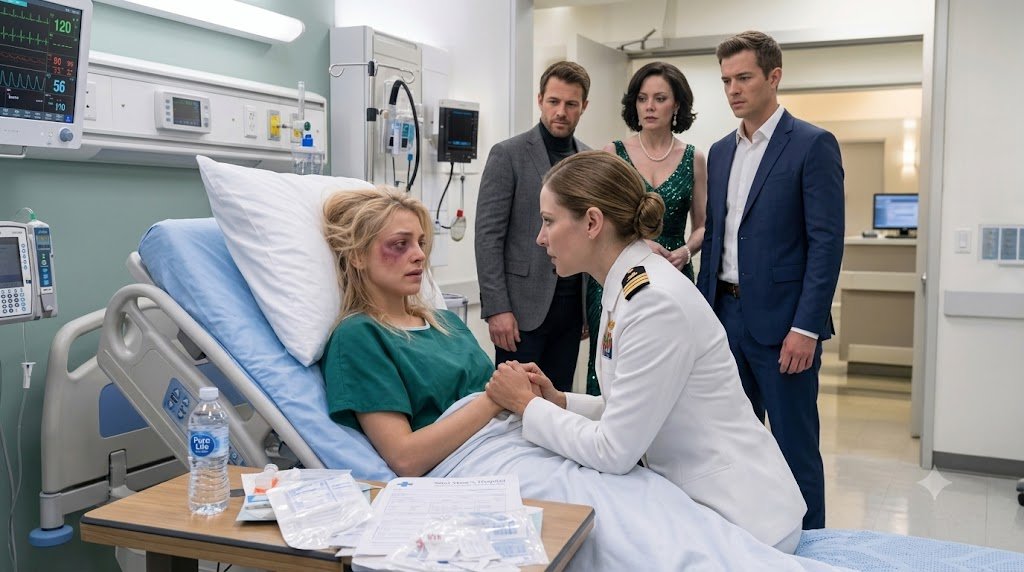
I drove straight from Fort Eisenhower to the hospital in my Army dress uniform after my daughter called me in tears. I found her bruised, shaking, and barely able to speak while her husband’s family stood nearby smiling as if nothing had happened. “Your rank means nothing to us,” one of them said. They had no idea that my silence was the beginning of the end.
PART 1: THE HOSPITAL
The phone call kept replaying in my mind as I left Fort Eisenhower that evening.
Every medal and ribbon on my uniform reflected the fading Georgia sunlight as I drove toward Augusta.
My hands tightened around the steering wheel.
“Mom… please come get me.”
Five words.
That was all she managed to say.
But those five words were enough to turn every protective instinct I had into something fierce and immediate.
I drove straight to Piedmont Augusta Hospital.
The automatic doors opened, and I walked inside faster than I had walked through a command briefing in years.
A nurse hurried toward me.
“Ma’am, you can’t go into the observation area without—”
“My daughter,” I interrupted calmly. “Her name is Tessa Holloway. Where is she?”
The nurse looked at my face.
Then her eyes dropped briefly to the insignia on my uniform.
Something in my expression must have convinced her that arguing would only waste time.
She quietly pointed down the corridor.
“Room twelve.”
I found Tessa alone.
And the moment I saw her, my heart nearly stopped.
She was curled beneath a hospital blanket, trembling so badly the bed rail shook.
One side of her face was swollen.
Her lower lip was split.
Purple bruises circled both wrists and upper arms.
Her pale blue dress was ripped at the shoulder and stained with dirt.
For a second, I couldn’t see the twenty-six-year-old woman lying in that bed.
I saw the little girl who used to sit beside me at the kitchen table while I polished my military boots.
The child who made handmade cards for soldiers overseas because she believed nobody serving far from home should feel forgotten.
The daughter who used to run across the driveway whenever I returned from deployment.
Now she could barely raise her eyes.
“Mom…”
I crossed the room immediately.
When I wrapped my arms around her, she began shaking harder.
I held her without asking questions.
Not yet.
She needed to know that she was safe first.
Then I heard laughter behind me.
Quiet.
Careless.
Almost amused.
I slowly turned around.
Three people stood in the doorway.
Tessa’s husband, Grant Holloway, was in a perfectly tailored charcoal suit.
Beside him stood his mother, Vivian Holloway, wearing a pearl necklace and an expression of polished concern.
His older sister, Lauren Holloway, leaned against the doorframe with her arms folded.
They looked completely comfortable.
As if the hospital room belonged to them.
Vivian smiled.
“Major Holloway, you’re finally here.”
I said nothing.
She continued.
“Your daughter has always been sensitive. She became upset during an argument, stumbled, and injured herself. It was unfortunate, but hardly the tragedy she is making it sound like.”
Tessa suddenly grabbed my sleeve.
Her fingers were cold.
“No.”
Her voice was barely audible.
I looked down at her.
“No, Mom. That’s not what happened.”
Grant sighed.
“Tessa, please don’t start this again.”
She flinched when he spoke.
That reaction told me more than his words ever could.
Tessa looked at me.
“They locked me in the carriage house.”
Vivian’s smile disappeared for half a second.
“They took my phone,” Tessa continued. “They wouldn’t let me leave.”
Grant shook his head.
“She’s confused.”
“They told me if I tried to leave you,” Tessa whispered, “they would destroy everything.”
Lauren gave a short, mocking laugh.
“She’s exaggerating.”
Tessa’s eyes filled with tears.
“They said nobody would believe me.”
I looked at Grant.
He didn’t look frightened.
He looked annoyed.
That was when I understood something important.
They weren’t worried about what had happened.
They were worried about who might find out.
Vivian stepped closer.
“Let’s be reasonable. This is a private family matter.”
I finally spoke.
“My daughter was brought here with bruises on both arms.”
Vivian’s expression hardened.
“Families have disagreements.”
“Disagreements don’t leave fingerprints.”
The room became silent.
Lauren straightened.
Grant’s jaw tightened.
Vivian recovered first.
“Your military position doesn’t give you the right to threaten my family.”
“I haven’t threatened anyone.”
“You’re standing there in uniform as though you expect us to be intimidated.”
I looked at her calmly.
“I didn’t come here to intimidate you.”
Lauren smiled.
“Good. Because your rank doesn’t mean anything to this family.”
She gestured toward Grant.
“We have attorneys.”
Vivian added, “We know people in government, the media, and the courts. If your daughter starts making accusations, this could become very unpleasant for everyone.”
Grant stepped closer.
“You should take her home and let this go.”
Then he smiled.
“If she keeps making these claims, we’ll have no choice but to protect ourselves legally.”
I looked at each of them.
Grant.
Vivian.
Lauren.
Three people who believed money could erase evidence.
Three people who had mistaken my silence for weakness.
Tessa was still holding my sleeve.
I placed my hand over hers.
“Are you finished?” I asked.
Grant laughed.
“You’re actually going to threaten us now?”
“No.”
I looked directly into his eyes.
“I’m going to do something much simpler.”
His smile faded.
I reached into my uniform pocket.
Not for a weapon.
For my phone.
I unlocked the screen and placed it on the table.
A recording was already running.
Grant’s face changed.
Vivian stopped breathing for a moment.
Lauren stared at the phone.
I had not started recording in the hospital.
I had started it the moment I stepped out of my car.
And they had just spent the last several minutes telling me exactly what they were afraid of.
I picked up my daughter’s hand.
“Now,” I said quietly, “we can talk about what happened.”
For the first time that evening, nobody in the room was smiling.
PART 2: THE RECORDING THEY NEVER EXPECTED
For several seconds, nobody spoke.
Grant stared at the phone on the table as though it had suddenly become a weapon.
Vivian was the first to recover.
“You recorded us without permission?”
I looked at her.
“You just admitted there was something to hide.”
Her expression tightened.
“That is not what I said.”
“No,” I replied. “But your attorney can explain the difference.”
Grant stepped forward.
“You can’t use a private conversation against us.”
I picked up the phone.
“I didn’t come here looking for a fight.”
Then I looked at Tessa.
“I came because my daughter asked me for help.”
That silenced him.
A doctor entered the room a moment later.
He glanced at the three family members and immediately noticed the tension.
“Ms. Holloway needs rest,” he said. “Visitors should step outside.”
Vivian lifted her chin.
“We’re family.”
The doctor didn’t move.
“She is my patient.”
I walked to the door.
“You heard him.”
Grant’s face hardened.
“This isn’t over.”
I met his eyes.
“No. It isn’t.”
He left with Vivian and Lauren.
The door closed behind them.
Only then did Tessa finally breathe.
“Mom, I thought you weren’t going to believe me.”
I sat beside her.
“Why would you think that?”
“Because they said you would.”
My heart sank.
“They told me nobody would believe me because they’re powerful. They said your military career wouldn’t save you if they decided to destroy you.”
I reached for her hand.
“They were wrong.”
Tessa looked toward the door.
“Mom… there’s more.”
I waited.
She lowered her voice.
“They weren’t just trying to scare me.”
“What were they doing?”
“They wanted me to sign something.”
“What?”
“A statement saying I was mentally unstable.”
I stared at her.
“They wanted me to accuse myself.”
She nodded.
“Grant said if I signed it, everything would disappear. If I refused, he said they would make sure I lost my job, my friends, and eventually you.”
I felt something cold settle inside me.
“Where is the document?”
“In my purse.”
I retrieved it from the chair.
At first glance, it looked like a standard legal declaration.
Then I read the final paragraph.
It stated that Tessa had suffered emotional instability, had become delusional about her marriage, and had voluntarily injured herself during an argument.
There was a signature line at the bottom.
Unsigned.
I photographed every page.
Then I called someone I trusted.
Not a friend.
Not a relative.
A military attorney who had spent years handling cases where powerful people believed uniforms were easier to intimidate than lawyers.
His name was David Mercer.
He answered on the second ring.
“What’s going on?”
“I need you to listen carefully.”
I sent him the recording.
He listened in silence.
When he called back, his voice was different.
“Where are you?”
“St. Catherine’s Medical Center.”
“Stay there.”
“I wasn’t planning to leave.”
“Good. Don’t confront them again.”
I looked at Tessa.
“They’re already outside.”
David paused.
“Then let them wait.”
An hour later, two attorneys entered the hospital.
Not Vivian’s lawyers.
Mine.
They reviewed Tessa’s injuries, photographed the bruising, copied the document, and requested the hospital’s security footage.
That footage changed everything.
The camera outside the emergency entrance showed Grant arriving with Tessa.
He wasn’t carrying her.
He wasn’t helping her.
He was arguing with her.
At one point, Tessa tried to walk away.
Grant grabbed her wrist.
The recording had no audio, but the video was clear.
His hand remained around her arm for several seconds.
Then Vivian arrived.
Lauren followed.
All three entered the hospital together.
None of them looked surprised by Tessa’s injuries.
They looked irritated.
The attorneys requested another recording.
The hospital security manager hesitated.
“We normally need a formal request.”
David placed a document on the desk.
“You have one.”
Within minutes, the footage was secured.
But there was another piece of evidence.
Tessa remembered something.
“The guest house has cameras.”
I looked at her.
“Are you sure?”
“Yes.”
“Where?”
“Above the back door. Grant installed them after we got married.”
David immediately called a private investigator.
His name was Samuel Ortiz.
Samuel arrived before midnight.
By 1:00 a.m., he had obtained something that made everyone in the room go silent.
The guest house cameras had recorded everything.
Not just the argument.
Not just the moment Grant grabbed Tessa.
The footage showed Vivian entering the guest house with a folder.
It showed Lauren removing Tessa’s phone.
And it showed Grant locking the exterior door.
Then came the part that destroyed their story.
Tessa was not alone.
A housekeeper had entered the property several hours later.
She heard Tessa pounding on the door.
She tried to help.
But Vivian stopped her.
The camera captured Vivian saying:
“Don’t get involved unless you want to lose your job.”
Samuel froze the video.
David leaned closer to the screen.
“There.”
A second person appeared in the hallway.
An elderly woman.
She was carrying a cleaning cart.
Samuel identified her as Rosa Delgado, a housekeeper who had worked for the family for eleven years.
I looked at Tessa.
“Did Rosa help you?”
Tessa nodded.
“She tried.”
“What happened?”
“They told her to leave.”
David looked at me.
“We have a witness.”
But I knew we weren’t finished.
Because powerful families rarely survive on one secret.
They survive because there are usually several.
And when Samuel searched the family’s records, he found something unexpected.
Three years earlier, another woman had filed a complaint against Grant.
The complaint had disappeared.
Two years before that, another accusation had been settled privately.
Different women.
Same pattern.
Same threats.
Same family lawyers.
Same silence.
Tessa stared at the documents.
“How many?”
Samuel answered quietly.
“Four that we can verify.”
I felt my daughter’s hand tighten around mine.
Grant hadn’t simply hurt her.
He had been protected by a system built around him.
And now that system was beginning to crack.
At 6:40 the next morning, my phone rang.
It was David.
“Major, you need to turn on the news.”
I did.
A reporter stood outside the courthouse.
Behind her were several police vehicles.
Then she said the words that changed everything.
“Breaking this morning: authorities have opened a criminal investigation into allegations of unlawful confinement, witness intimidation, and assault involving the Holloway family.”
Tessa stared at the television.
Her eyes filled with tears.
Not tears of fear.
Relief.
Then my phone buzzed again.
A message from Samuel.
We found the original files.
I opened the attachment.
There were dozens of pages.
Medical reports.
Security logs.
Witness statements.
And one document dated six months before Tessa had ever met Grant.
At the bottom was a name.
Vivian Holloway.
I looked at my daughter.
She saw my expression.
“What is it?”
I slowly turned the screen toward her.
“This isn’t just about what they did to you.”
Tessa stared at the document.
“Then what is it?”
I took a breath.
“It looks like your husband’s family has been doing this for years.”
And somewhere across town, Grant Holloway was about to discover that the family secret he had spent years protecting was no longer a secret.
PART 3: THE FAMILY SECRET
The document dated six months before Tessa had met Grant was a settlement agreement.
But it wasn’t between Grant and another woman.
It was between Vivian Holloway and a former employee named Caroline Brooks.
Caroline had worked for the family as a personal assistant.
The agreement contained one condition that immediately caught my attention.
Caroline was forbidden from speaking publicly about what she had witnessed inside the Holloway home.
David read the document twice.
Then he looked at me.
“This is bigger than Tessa.”
Samuel nodded.
“And there are more.”
Over the next forty-eight hours, investigators uncovered a pattern that had been hidden behind money, reputation, and carefully written legal agreements.
Women who had challenged Grant were pressured into silence.
Employees who witnessed confrontations were threatened with losing their jobs.
One former employee had even been offered a large payment to withdraw a police statement.
The Holloways had never needed to prove everyone was lying.
They only needed to make people afraid to tell the truth.
But Tessa’s case was different.
This time, they had made one mistake.
They had left evidence behind.
By the third day, the police had obtained warrants for the Holloway residence and guest house.
I was standing beside Tessa when the investigators entered.
She watched silently as officers carried boxes from the property.
One contained phones.
Another contained documents.
A third contained surveillance equipment.
Then an investigator found a locked cabinet in Vivian’s office.
Inside were folders.
Names.
Dates.
Payments.
Every woman who had ever threatened to expose the family had a file.
Tessa covered her mouth.
“Mom…”
I put my arm around her.
“You don’t have to look.”
But she did.
She needed to see it.
Not because she wanted revenge.
Because for the first time, she understood that what happened to her had never been her fault.
A week later, Grant was arrested.
Vivian and Lauren were also questioned as part of the investigation.
The family lawyers who had once warned me about their connections suddenly stopped returning phone calls.
The reporters they had supposedly controlled began reporting the story.
And the people who had once laughed at my military uniform now refused to make eye contact.
But none of that mattered as much as what happened inside Tessa’s hospital room.
She sat beside the window one morning, staring at the city.
“I keep thinking I should have fought harder.”
I sat beside her.
“You survived.”
“I should have left sooner.”
“You survived.”
“I should have told you.”
“You did.”
She looked at me.
“Five words.”
I smiled.
“Five words were enough.”
Her eyes filled with tears.
“I was so scared.”
“I know.”
She leaned against my shoulder.
For the first time since I arrived at the hospital, I allowed myself to cry too.
Not because we had lost.
Because we had finally made it out.
Three months later, Tessa stood in a courtroom.
She wasn’t wearing the torn dress from the hospital.
She wore a simple navy suit.
Her hands trembled when she approached the witness stand.
Grant was sitting across the room.
For the first time, he looked smaller.
No tailored confidence.
No arrogant smile.
No family standing behind him.
Just a man facing the consequences of his choices.
The prosecutor asked Tessa to describe what happened.
She took a breath.
Then she spoke.
Her voice wasn’t loud.
But it didn’t shake.
“I spent months believing that if I stayed quiet, things would become normal.”
She looked directly at Grant.
“They didn’t.”
The courtroom remained silent.
“I was told that nobody would believe me.”
She paused.
“But my mother did.”
I felt tears gathering in my eyes.
Tessa continued.
“And once someone believed me, I finally remembered that I was allowed to believe myself too.”
That sentence became the most quoted moment of the trial.
The evidence was overwhelming.
The recordings.
The hospital footage.
The guest-house cameras.
The witness testimony.
The documents hidden in Vivian’s office.
The case lasted several weeks.
When the verdict finally came, Grant was convicted on multiple charges related to assault and unlawful confinement.
Vivian and Lauren also faced convictions connected to witness intimidation and obstruction.
The family that had once believed its reputation could protect everyone had finally discovered the limit of money.
It could delay consequences.
It could frighten people.
It could bury stories.
But it couldn’t erase evidence forever.
Months later, Tessa moved into a small apartment near my home.
She started therapy.
She returned to work.
And slowly, she began rebuilding the life she had thought was gone forever.
One Saturday morning, I found her sitting on the porch with a cup of coffee.
She looked different.
Not completely healed.
But stronger.
She smiled.
“You know what the strangest part is?”
“What?”
“I thought the day I left him would be the hardest day of my life.”
“And?”
She looked at me.
“The hardest day was the day I almost believed him.”
I sat beside her.
“You don’t have to carry that anymore.”
She nodded.
Then she looked down at the medals on my old uniform jacket hanging by the door.
“You know what they said?”
“Who?”
“The Holloways.”
“What?”
“They said your rank didn’t scare them.”
I smiled.
“It wasn’t supposed to.”
Tessa laughed for the first time in months.
“Then what did?”
I looked at her.
“The truth.”
She became quiet.
Then she reached for my hand.
I realized something that day.
I had spent my career learning how to fight battles.
How to stay calm under pressure.
How to protect people when everything around them was falling apart.
But the most important lesson wasn’t about combat.
It was about listening.
Because when my daughter called me that night and whispered, “Mom, please come get me,” she wasn’t asking me to rescue her from a family.
She was asking me to believe her.
And sometimes, believing someone is the first step toward saving them.
The Holloways thought my silence meant fear.
They were wrong.
My silence was patience.
I was waiting for the truth to speak.
And when it finally did, it was louder than every threat they had ever made.
THE END.