COLD OPEN
My daughter was sixteen when she finally met my eyes and whispered, “I stopped telling Dad when it hurts. He says I’m only saying it because I want attention.” The following afternoon, I signed her out of school and drove her to a hospital without telling my husband. In the middle of the scan, the technician suddenly went quiet. A few minutes later, the doctor entered, shut the door behind him, and asked me a question that made my blood run cold.
“How long has her father known about this?”
PART 1
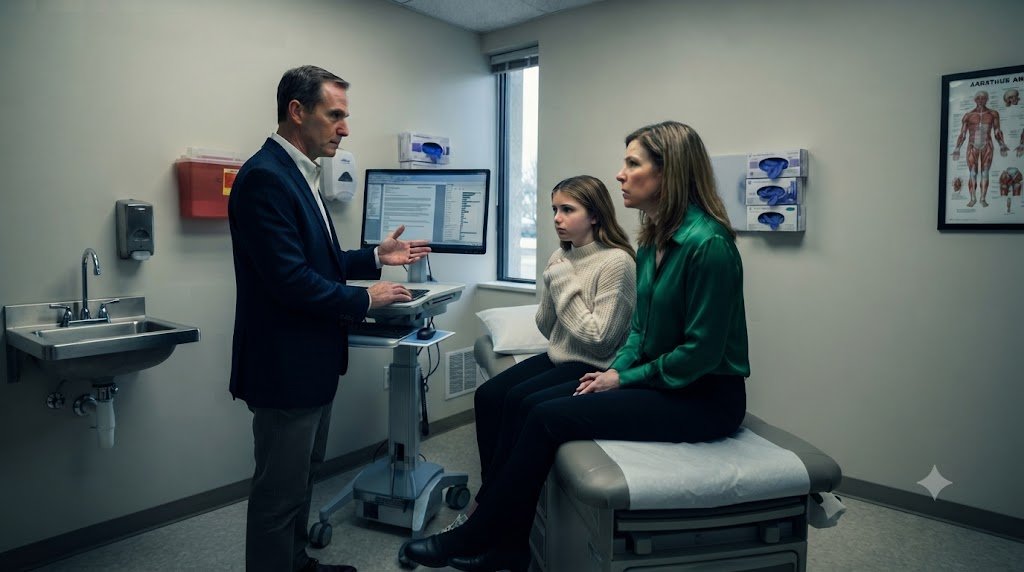
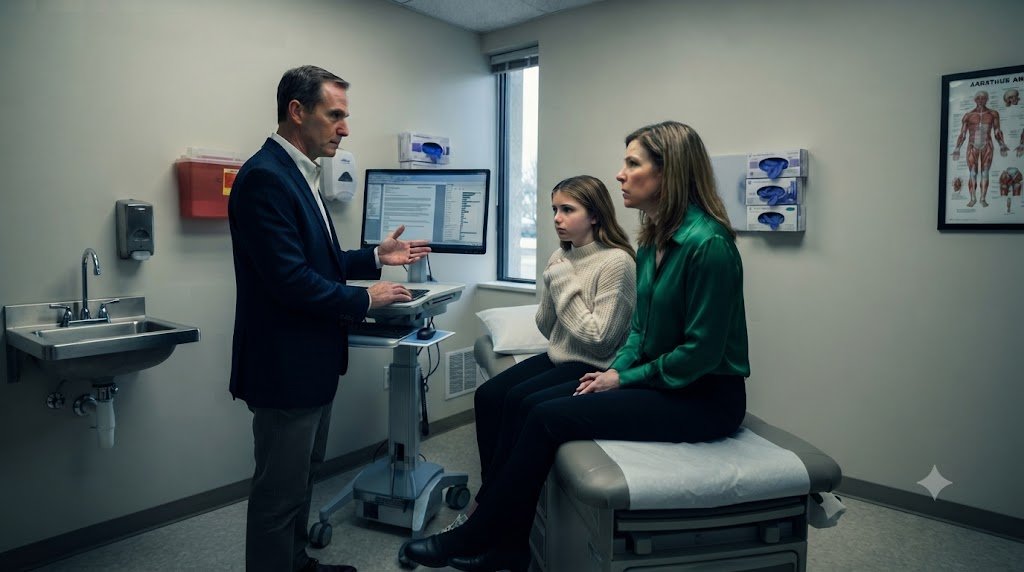
The examination room smelled strongly of disinfectant, and the thin paper covering the bed rustled whenever my daughter moved. I stared at the doctor, struggling to understand what he was asking.
“He doesn’t know,” I answered. “I didn’t tell him we were coming here.”
The doctor looked toward my daughter before returning his attention to me.
“I’m not talking about this appointment.”
He tapped the computer screen and opened an older section of her medical record.
Six weeks earlier, my daughter had been seen for the same pain. According to the chart, her father had brought her in. The doctor at that visit had recommended additional imaging and further evaluation because her symptoms required follow-up.
I had never heard about that appointment.
My daughter sat quietly, pulling the cuffs of her sweatshirt over her fingers while keeping her eyes fixed on the edge of the examination table.
“Did Dad bring you here before?” I asked softly.
She nodded.
The doctor continued in a calm voice. He explained that the results they were seeing now were concerning enough to require prompt attention and several additional tests. He wasn’t blaming anyone. He simply wanted to understand why the follow-up that had been recommended six weeks ago had never taken place.
I wanted to know the same thing.
“What did Dad tell you after that visit?”
She hesitated before answering.
“He said they didn’t find anything serious.”
I turned toward the doctor.
He didn’t correct her. Instead, he angled the monitor so I could read the earlier discharge instructions myself.
The follow-up had not been an optional suggestion tucked away somewhere in the paperwork. It was clearly included in the treatment plan.
My stomach tightened.
For months, I had noticed little things I couldn’t quite explain. My daughter had begun moving carefully when she got out of bed in the morning. She often pushed food around her plate instead of finishing dinner. More than once, I had seen the heating pad disappear beneath her bedroom door.
I told myself it was normal.
Cramps. Stress. School pressure. The ordinary problems teenagers sometimes kept private.
Whenever I asked whether something was wrong, she always gave me the same answer.
“I’m fine.”
But sitting there in that room, the word sounded completely different.
I left my chair and sat beside her. I lowered my voice.
“You’re not in trouble. I need you to tell me what happened, even if you’re afraid I’ll be upset.”
Her eyes became glossy, but she refused to look away.
“He got angry after the appointment,” she finally said. “He told me you already had too much to worry about with work and money. He said I was making things harder for everyone.”
The words struck me because they sounded exactly like something my husband would say.
He had never handled problems well when he believed they were unnecessary. An unexpected expense, a missed day at work, a problem that required time or patience—he wanted all of it dealt with quickly and then forgotten.
Even then, I found myself trying to make excuses for him.
Maybe he had misunderstood the doctor.
Maybe he thought the pain had gone away.
Maybe my daughter had interpreted his fear as anger.
Maybe there was some explanation that would make everything less frightening.
Then the doctor asked her something simple.
“Did your father ever tell you that you shouldn’t tell your mother about the follow-up?”
My daughter’s hands disappeared deeper inside her sleeves.
For several seconds, she said nothing.
Then she slowly pulled one sleeve over her knuckles, lowered her eyes, and nodded.
PART 2
For a moment, nobody spoke.
I could hear the low hum of the ventilation system above us and the faint movement of carts passing in the hallway outside. My daughter kept staring at her hands.
“How long?” I asked.
She looked confused.
“How long has he been telling you not to tell me?”
Her lips trembled.
“Since the first appointment.”
Something inside me seemed to drop.
“Why didn’t you tell me?”
She finally looked up.
“Because he said you’d panic.”
The doctor quietly stepped away from the computer, giving us a little space.
My daughter continued.
“He said you’d start asking questions and calling everyone. He said you’d miss work. He said we couldn’t afford more tests unless they were really necessary.”
I closed my eyes for a second.
The explanation sounded practical enough to be believable.
That was what made it so dangerous.
My husband had always known exactly how to make something cruel sound reasonable.
I reached for my daughter’s hand.
“You should never have had to decide whether you were worth the cost of medical care.”
Her face crumpled.
“I thought he was right.”
“No,” I said immediately. “He was wrong.”
She started crying then, quietly at first, as though even her tears needed permission.
I pulled her toward me.
The doctor waited until she had calmed down before explaining what would happen next. He wanted more imaging, blood work, and a specialist consultation. He also told me that the earlier recommendation should have been followed much sooner.
I asked the question that had been sitting in my throat.
“Would things be different if we had come six weeks ago?”
The doctor paused.
“I can’t tell you that with certainty,” he said carefully. “But earlier evaluation would have given us more information sooner. Right now, our priority is understanding exactly what we’re dealing with.”
I nodded.
It was not the answer I wanted, but it was honest.
While the nurse prepared the paperwork, I stepped into the hallway and called my husband.
He answered on the fourth ring.
“Hey. Everything okay?”
I looked through the glass panel in the door. My daughter was sitting on the examination bed, holding a cup of water with both hands.
“Where did you take her six weeks ago?”
There was silence.
“What are you talking about?”
“The hospital.”
Another pause.
Then his voice changed.
“I took her because she said her stomach hurt. They checked her. They said it was probably nothing.”
“Did they recommend follow-up testing?”
He exhaled.
“I don’t remember.”
“You don’t remember?”
“Why are you interrogating me?”
My grip tightened around the phone.
“Because the doctor just showed me the record.”
He went quiet.
For several seconds, neither of us spoke.
Then he said, “You’re making this into something it isn’t.”
I felt a strange calm settle over me.
Not relief.
Not anger.
Something colder.
“What did they tell you?”
“I already told you. Nothing serious.”
“That isn’t what the chart says.”
He raised his voice.
“Are you seriously doing this while I’m at work?”
I looked back at my daughter.
She had stopped drinking. She was watching me through the glass.
“I’m not doing anything,” I said. “I’m trying to find out what happened to our daughter.”
“She was fine when I brought her home.”
“She wasn’t fine.”
“She told me she felt better.”
“And you believed that was enough?”
He didn’t answer.
That silence told me more than his words had.
I lowered my voice.
“Did you tell her not to tell me?”
“No.”
The answer came too quickly.
My daughter was still watching me.
I asked again.
“Did you tell her to keep the follow-up from me?”
“No. I never said that.”
I ended the call.
When I walked back into the room, my daughter immediately asked, “Is Dad mad?”
I sat beside her.
“He’s upset.”
She looked down.
“I’m sorry.”
“For what?”
“For causing all this.”
I turned her face gently toward mine.
“You didn’t cause anything.”
She swallowed.
“Dad said if I told you, you’d make everything worse.”
I stared at her.
“What did he mean by that?”
She hesitated.
Then she whispered, “He said you would leave.”
The room seemed to become completely still.
“Leave him?”
She nodded.
“He said you’d take me away, and then everything would fall apart.”
I had spent years believing my husband’s anger was simply his way of dealing with pressure.
That afternoon, sitting beside my daughter, I began to wonder whether I had misunderstood him all along.
The doctor returned with another nurse and explained that they wanted to continue the evaluation immediately.
I signed every form they placed in front of me.
This time, I read every line.
And when the nurse asked who should be listed as the primary contact, I gave her my number.
Then I added one sentence.
“Please call me directly about every result, every appointment, and every recommendation.”
My daughter looked at me.
For the first time that day, she gave the smallest nod.
And I knew something had changed.
Not in the hospital.
Not in her medical chart.
In me.
PART 3
My husband appeared in the doorway less than ten minutes later.
He looked irritated rather than worried.
His eyes moved from me to our daughter, then to the doctor.
“What is going on?”
I stood up.
“You tell me.”
He frowned.
“I came here because you stopped answering my calls.”
“You shouldn’t have come.”
His expression hardened.
“She’s my daughter too.”
“Yes,” I said. “Which is why I need you to explain why you took her to a hospital six weeks ago and never told me.”
He glanced at our daughter.
She immediately looked down.
“I already told you,” he said. “They said it wasn’t serious.”
“Then why did they order another scan?”
He didn’t answer.
The doctor remained silent, watching him carefully.
I took the discharge report from the table and held it out.
“You were told to bring her back.”
He glanced at the page.
“I must have misunderstood.”
“You understood enough to bring her home.”
He sighed.
“You’re making this much bigger than it needs to be.”
That sentence changed something in me.
For years, whenever I had questioned him, he had used the same strategy. Make the problem sound smaller. Make me sound emotional. Make me doubt whether I had the right to be concerned.
But this time, there was a medical record sitting between us.
And our daughter was sitting beside me.
I looked at him.
“Did you tell her not to tell me?”
He shook his head.
“No.”
My daughter suddenly spoke.
“Yes, you did.”
My husband froze.
She was crying, but her voice was steady.
“You told me Mom would freak out. You said she’d blame you, and then we’d have to move.”
“That isn’t what I said.”
“You did.”
He looked at me.
“She misunderstood.”
I felt something inside me go completely still.
“She’s sixteen,” I said. “Not six.”
He opened his mouth, but I didn’t let him continue.
“You didn’t just hide an appointment from me. You made our daughter believe she had to protect you from me.”
He became defensive.
“I was trying to keep this family together.”
“No,” I said quietly. “You were trying to keep me from knowing.”
Silence filled the room.
The doctor finally stepped forward.
“For the moment, our concern is your daughter’s health. Any further discussion about family matters can happen later.”
My husband looked at her.
“Is she in danger?”
The doctor answered carefully.
“We don’t know yet. That’s why the additional testing matters.”
He looked at me.
“Then we’ll do whatever they recommend.”
I almost laughed.
“Now you will?”
His face changed.
I could see that he understood exactly what I meant.
The next several hours passed in a blur.
More tests.
More questions.
More waiting.
My daughter held my hand through nearly all of them.
Just after midnight, the doctor finally returned.
She sat across from us.
“The results give us a clearer picture now,” she said. “There is a condition that requires treatment, but we have a path forward.”
My daughter looked at me.
“Am I going to be okay?”
I squeezed her hand.
The doctor nodded.
“With the treatment and follow-up care, we are optimistic.”
The breath I had been holding seemed to leave my body all at once.
I cried.
My daughter cried.
Even the doctor gave us a small, reassuring smile.
My husband stood near the window without saying anything.
For the first time that night, he looked afraid.
But I wasn’t ready to comfort him.
Not yet.
After the doctor left, he approached the bed.
“I’m sorry.”
My daughter didn’t answer.
He looked at me.
“I thought I was protecting her.”
I shook my head.
“You were protecting yourself from inconvenience.”
He looked down.
“I was scared.”
“So was she.”
He had no answer.
The following morning, I took my daughter home with me.
Not to our house.
To my sister’s apartment across town.
I needed somewhere quiet where my daughter could rest without wondering whether every conversation was going to become an argument.
Over the next few weeks, appointments filled our calendar.
Treatment began.
My daughter slowly regained her strength.
She started eating more.
She slept better.
And one morning, while we were sitting by the kitchen window, she laughed at something on her phone.
It was the first completely natural laugh I’d heard from her in months.
I looked at her and realized how much fear she had been carrying.
“Mom?”
“Yes?”
“Are you mad at Dad?”
I thought about it.
“I am.”
She looked down.
“But I’m not mad at you.”
“I know.”
She smiled faintly.
Then she asked the question I knew was coming.
“Are we going back?”
I reached across the table and took her hand.
“I don’t know what will happen with your father and me.”
She nodded.
“But I do know one thing.”
“What?”
“You will never again have to hide pain because you’re afraid of upsetting someone.”
Her eyes filled with tears.
“Promise?”
I squeezed her hand.
“Promise.”
Months later, the medical crisis was no longer the center of every day.
There were still appointments.
Still difficult conversations.
Still consequences.
But there was also something new.
Trust.
Not the blind kind I had once confused with love.
The kind built slowly, through honesty and showing up when it mattered.
My husband and I eventually separated.
The marriage had survived difficult years before, but this was different.
It wasn’t the missed appointment alone.
It was the decision to make our daughter carry a secret because the truth was inconvenient.
Some things can be repaired.
Others can only be acknowledged and left behind.
My daughter continued her treatment and eventually returned to school full-time.
One afternoon, months after that hospital visit, I found her standing in the kitchen with her backpack over one shoulder.
“Mom?”
“Yeah?”
“My stomach hurts a little.”
I immediately turned toward her.
“Do you want me to call the doctor?”
She smiled.
“No. I just wanted to tell you.”
I stopped.
Then I smiled back.
“Good.”
She walked over and hugged me.
And in that moment, I understood what she had really been trying to say all those months ago.
She wasn’t asking me to fix everything.
She had only needed to know that when something hurt, she could tell me.
And this time, she knew she could.
THE END.