PART 1
On September 1, I drove two hours north with a cooler full of sandwiches, a trunk packed with muddy sneakers, and two children who had spent the entire ride arguing over who would reach the old tire swing first. The morning sun flashed through the maple trees along the county road. My eight-year-old son, Noah, pressed his forehead against the window whenever he spotted a horse, while my six-year-old daughter, Ellie, kept asking whether the blackberries behind the farmhouse would still be ripe.
“They were sweet last year,” she said.
“They were sour last year,” Noah corrected.
“You ate twelve.”
“That doesn’t mean they were good.”
Their bickering made me smile. For months, I had promised them one quiet weekend at Hawthorne Farm before school started again. The farmhouse had belonged to my grandmother, and every September she used to fill the kitchen with cinnamon bread, sliced peaches, and enough coffee to keep the entire county awake.
After she died, the place changed.
My parents began treating it like their private vacation home. My younger sister, Vanessa, treated it like a backdrop for photographs. I became the person who paid the taxes, answered the insurance company, replaced broken pipes, and arranged repairs no one else noticed until they were completed.
Still, I had not expected trouble that morning.
My mother had texted three days earlier, “We’ll probably be at the farm over Labor Day weekend.”
Probably was not a reservation.
I had replied, “Great. The kids and I will come Saturday morning. I also need to meet someone about the west field.”
She had sent back a thumbs-up.
That was why the sight of fifteen cars lining the gravel driveway made me slow down.
A white rental van sat beside the barn. Inflatable pool toys floated in the pond. Music thumped from speakers on the back patio, and the smell of grilled meat drifted through the open gate.
“This looks like a party,” Noah said.
“It must be the family trip Grandma mentioned,” Ellie replied happily.
I parked beside the fence and lifted our bags from the trunk. The children raced ahead, sneakers crunching over gravel.
Then Vanessa saw us.
She stood beside the pool in a cream-colored dress that probably cost more than my monthly grocery bill. One hand held a glass of chilled wine. The other rested on her hip.
Her face did not brighten.
It hardened.
“Why did you come?” she called.
I stopped near the gate. “Good morning to you, too.”
Her husband, Grant, turned down the music. Conversations around the patio thinned into silence. My parents sat beneath a striped umbrella with Vanessa’s three children, two of Grant’s cousins, and several people I barely recognized.
Vanessa looked past me toward Noah and Ellie.
Then she laughed.
“Seriously, Mara? Why did you bring your maggots on our family trip?”
For one second, I thought I had misheard her.
The word hung in the warm air, uglier than a curse.
PART 2
Noah froze halfway to the tire swing, his small shoulders tensing under his striped shirt. Ellie stopped beside him, looking back at me with wide, confused eyes. They didn’t fully understand the venom behind the word, but they felt the violence of it.
My mother finally stood up from beneath the striped umbrella, smoothing down her linen shorts with a look of extreme irritation.
“Vanessa, keep your voice down,” she muttered, walking over to the gate. She didn’t look at Noah or Ellie. She looked only at me, her expression pinched as if I were the one who had committed an offense. “Mara, we sent word that we were hosting Grant’s family this weekend. Didn’t you get the group text?”
“You said you’d probably be at the farm,” I said, my voice dropping into a register that felt dangerously cold. “You didn’t say you were throwing an exclusive house party, and you certainly didn’t say my children weren’t welcome.”
“Well, it’s just not convenient,” my mother said, waving a dismissive hand toward the crowded patio. “There are twenty-five people here. Grant’s mother is visiting. The house is completely full, and the kids are running everywhere. Honestly, I don’t know why you always have to force yourself where you aren’t needed.”
Force myself.
Into the home I legally maintained. Into the place where my grandmother had taught me to bake.
From across the yard, Vanessa strolled over, taking a slow sip of her wine. “Besides, Mara, look at them. They’re filthy. They’ve been sweating in the car for two hours. Grant’s family is very particular about who they associate with. We’re trying to impress some business partners of his dad’s this afternoon.”
My fists clenched inside my jacket pockets so hard my fingernails bit into my palms. I looked past my mother and Vanessa. My father was sitting under the umbrella, refusing to meet my eyes, staring intently into his plastic cup of beer.
Across the grass, Noah grabbed Ellie’s hand.
“Mom,” Noah whispered, his voice trembling slightly. “Can we go home?”
The simple question broke something fragile inside me. For years, I had absorbed their slights, paid the property taxes without a complaint, fixed the roof after the winter storms, and swallowed my pride every time they acted like Hawthorne Farm was their exclusive country club. I had done it all because I loved my grandmother’s memory, and because I foolishly believed family was worth the strain.
But calling my children maggots? Treating them like garbage to impress Grant’s wealthy business associates?
No. The bill had finally come due.
I took a slow, deliberate breath. I didn’t yell. I didn’t cry. I simply pulled my phone from my pocket, unlocked the screen, and tapped on my calendar app.
“You’re right, Mom,” I said, my voice cutting cleanly through the quiet hum of the yard. “It’s not convenient for you to have us here.”
My mother blinked, clearly startled that I wasn’t arguing, begging, or turning around to slink away. A cautious look of relief crossed her face. “See? I knew you’d understand. Just drop the kids off with your aunt in town and maybe you can come back tomorrow evening after everyone leaves—”
“Oh, I’m not leaving,” I interrupted, stepping past her and unlatching the gate.
Noah and Ellie followed closely at my heels, sticking tight to my sides.
“Mara, what do you think you’re doing?” Vanessa snapped, blocking the walkway. “You heard me. You and your little freeloaders aren’t wanted here today.”
I stopped inches from her, looking down into her aggressively made-up face.
“This isn’t your house, Vanessa,” I said softly.
“Dad practically lives here—”
“Dad doesn’t own a single shingle on this roof,” I said, raising my voice just enough for every single person on the patio to hear. “Neither do you, Mom. And neither does Grant.”
Grant stood up from the patio table, his chest puffed out. “Now listen here, Mara—”
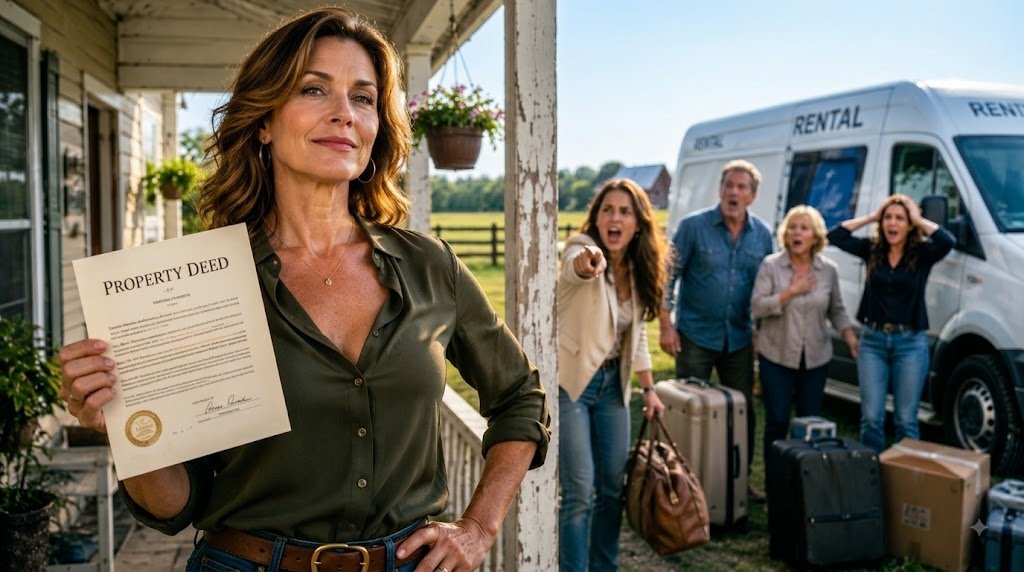
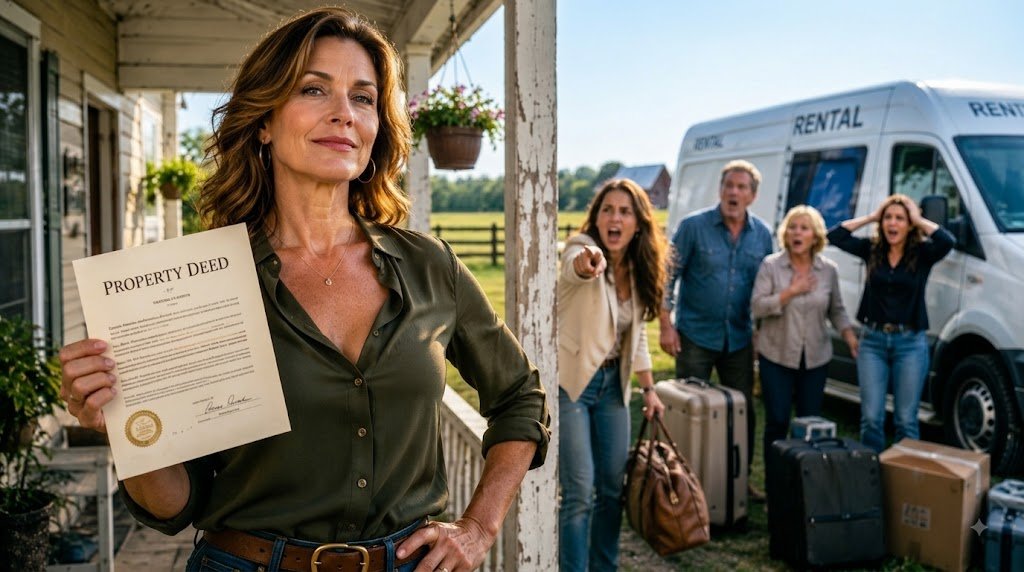
“No, you listen, Grant,” I said, pulling a folded legal document from my tote bag and holding it up for the entire yard to see. “You’re all enjoying the pool, the Wi-Fi, the electricity, and the well water. But none of you seem to remember who actually pays the county property taxes every November. None of you remember who signed the insurance policy when the barn roof collapsed last spring. And absolutely none of you bothered to read the deed transfer Grandmother filed three weeks before she passed away.”
My mother’s face went chalk white. “Mara… what is that?”
“It’s an eviction notice,” I said smoothly. “Well, technically, it’s a notice of private property trespass. But since you’re all currently standing on my land without a formal lease or invitation, I suppose it’s a bit of both.”
Dead silence fell over Hawthorne Farm.
The music from the patio speakers kept playing, a jaunty pop tune that sounded completely absurd against the sudden wall of tension.
Grant took two slow steps forward, forcing a disbelieving laugh. “Are you bluffing? Your dad said—’
“My dad doesn’t own a square inch of dirt in this county,” I cut him off. “Grandmother left the entire farm, the house, and the outbuildings to me. Sole owner. 100% equity. No shared family trust. Just me.”
I looked directly at my mother, who looked like she was about to faint.
“So here are your choices,” I said, my voice as steady as stone. “You have thirty minutes to pack your coolers, your inflatable pool toys, and your rental van. You can take Grant’s business partners to a nice, expensive country club in town. But you will clear off my property before the clock hits noon.”
Vanessa’s wine glass slipped from her hand.
It hit the gravel driveway, shattering into a hundred glittering pieces, red wine staining the white stones like blood.
PART 3
For three agonizing seconds, nobody moved.
The shattered wine glass lay on the white gravel, a small pool of deep red seeping into the dust. Vanessa stared down at it, her mouth slightly open, as if her brain couldn’t process the sudden shift in reality.
Then Grant found his voice.
“You’re bluffing,” he barked, stepping forward with his jaw clenched. “This is a family property. Parents don’t just cut out their own children. Helen, tell your daughter to stop playing games.”
He turned expectantly toward my mother, waiting for her to restore order, to wave her hand and dismiss my words like she always did.
My mother didn’t wave her hand. She was staring at the legal document in my hand with wide, terrified eyes. She knew. Deep down, she had probably always suspected that Grandmother Hawthorne hadn’t trusted her with the homestead.
“Grant,” my mother whispered, her voice tight and strained. “She… she’s not bluffing. Mother never liked you.”
Grant’s face twisted in disgust. “Are you kidding me? You’re just going to let her kick us out? We have twenty-five guests here! My business associates are sitting right over there!”
“Then I suggest you go tell your business associates that the party is relocated,” I said, stepping past Vanessa and walking toward the front porch. “You have twenty-five minutes left, Grant. Every minute past noon, I’m calling the county sheriff to have your rental van towed.”
Noah and Ellie trailed right behind me, their earlier fear replaced by wide-eyed awe. They didn’t fully understand legal deeds or property lines, but they understood one thing: Mommy had just won.
As I opened the heavy wooden front door of the farmhouse, my father finally stood up from beneath the striped umbrella. He looked tired—older than his years, weighed down by decades of playing peacekeeper to a wife and daughter who ran roughshod over everyone around them.
“Mara,” he called out quietly, taking a tentative step toward the porch.
I stopped in the doorway, looking back at him.
“Can we… can we talk inside?” he asked, glancing awkwardly at the small crowd of Grant’s bewildered friends whispering on the patio.
I hesitated, then nodded. “Just you, Dad. Nobody else.”
He walked up the steps slowly, his boots dragging against the wood. I led him into the kitchen—the same kitchen where Grandmother Hawthorne used to smell perpetually of cinnamon, yeast, and freshly brewed coffee.
The counters were cluttered with open chip bags, plastic cups, and half-empty cans of beer. It looked nothing like the sanctuary it used to be.
My father sank heavily into one of the wooden chairs at the table. He didn’t look at me right away. He stared down at his calloused hands, rubbing his thumbs together.
“I didn’t know she was going to call the kids that,” he said softly, his voice rough. “What Vanessa said… it was vile. Even for her.”
“You didn’t stop her, Dad,” I pointed out, leaning against the counter. “You sat under the umbrella and drank your beer.”
He flinched, but he didn’t argue. He knew it was true.
“Your mother likes the illusion of things,” he murmured, staring out the window toward the pond where the inflatable pool toys bobbed in the breeze. “She likes the idea of owning this farm, of showing it off to Grant’s fancy friends. But she never wanted to fix the plumbing. She never wanted to patch the roof. She just wanted the crown without the kingdom.”
“Well, she doesn’t even get the crown anymore,” I replied evenly. “I’m changing the locks this afternoon.”
My father looked up, his eyes a little wet. “Are you going to kick us out too? Me and your mother?”
I looked at him—really looked at him. Beneath the cowardice and the lifelong habit of enabling my mother’s narcissism, he was still the man who had taught me how to fish in the old creek out back. He was still my father.
“You can stay, Dad,” I said quietly. “On one condition.”
He sat up straighter, hope flickering in his tired eyes. “Name it.”
“Mom goes home. She gets an apartment, or she stays with Vanessa. But she does not set foot on this farm ever again unless she writes a formal, written apology to Noah and Ellie for what she allowed to happen today.”
My father swallowed hard, knowing exactly how impossible that demand was. My mother would rather chew glass than apologize to children she considered beneath her.
“That’s… that’s going to start a war,” he warned.
“Let her declare war,” I said, crossing my arms. “She’s fighting on my land now.”
Outside, the frantic sounds of packing began. Car doors slammed. Voices raised in angry, panicked arguments drifted through the open windows. Grant was shouting at my mother, and Vanessa was throwing a full-scale tantrum near the white rental van, demanding to know how her life had become such a disaster in a span of ten minutes.
Ten minutes later, the gravel driveway erupted in a chorus of spinning tires and furious horn honking. Car after car peeled out, kicking up thick clouds of white dust that settled over the maple trees.
Finally, the silence returned to Hawthorne Farm.
It was a heavy, profound silence, broken only by the chirping of crickets and the gentle rustle of the wind through the screen door.
Noah and Ellie wandered back into the kitchen, looking around tentatively.
“Are they gone?” Ellie asked, clutching her favorite stuffed rabbit.
“They’re gone,” I smiled, walking over and kneeling down to hug them both. “The farm is all ours for the weekend.”
“Can we go pick blackberries now?” Noah asked, his eyes brightening.
“We can pick as many as you want,” I promised. “Sweet or sour.”
My father sat quietly at the head of the kitchen table, watching us with a mixture of sadness and quiet relief. He didn’t say anything, but as I stood up to grab a broom and start cleaning up the mess, he reached down, picked up a stray plastic cup from the floor, and threw it into the trash can.
It was a small gesture. But for the first time in a very long time, it felt like a start.
THE END.