PART 1
The funeral was over. The last notes of the hymn faded into the icy afternoon as guests slowly left the cemetery. Friends embraced. Former Army officers saluted my father’s grave. My mother stood beside the hearse, surrounded by relatives who believed they were comforting a grieving widow. I remained frozen beside the fresh mound of earth.
Something felt… wrong.
My name is Colonel Beatrice Sinclair. For more than twenty years, I served in the United States Army, leading soldiers through missions where one wrong decision could cost lives. I’ve faced ambushes. Explosions. Death. Yet nothing prepared me for burying my own father.
Everyone accepted the official version. Richard Sinclair. Sixty-six years old. Dead from a sudden heart attack in his home office. For three exhausting days, I handled funeral arrangements, signed paperwork, and comforted my devastated mother. I never questioned a single detail.
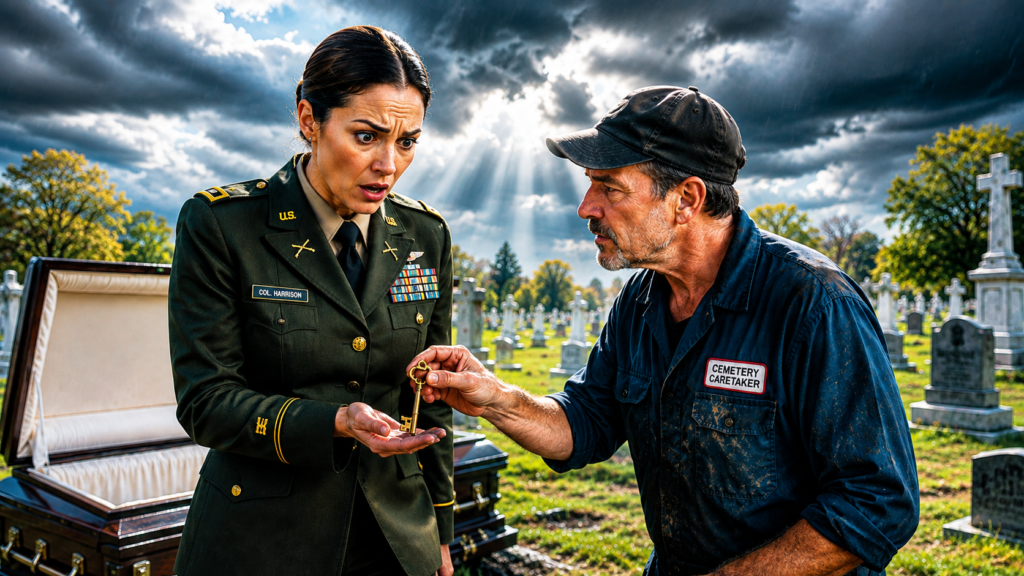
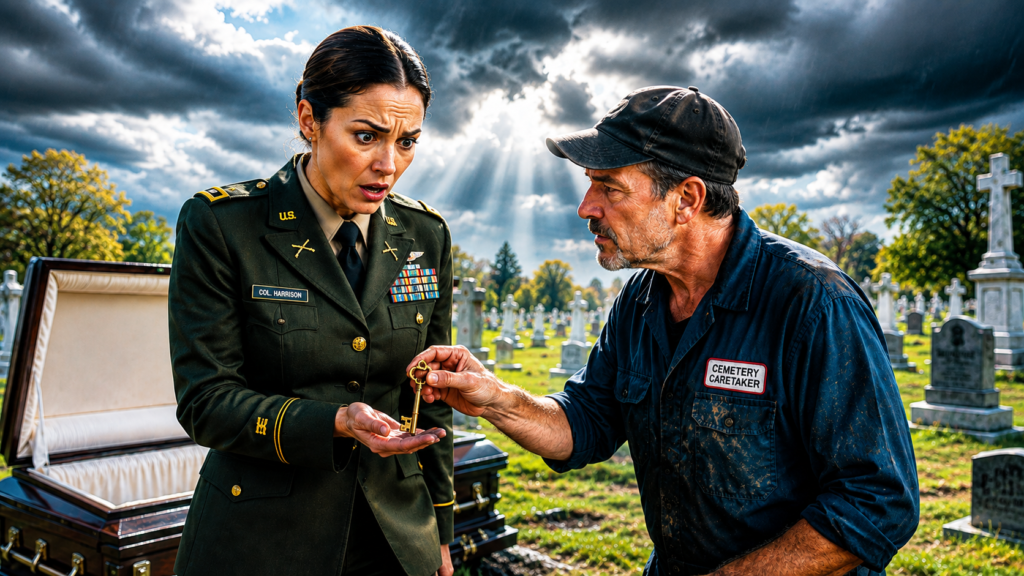
Until the cemetery caretaker quietly walked toward me. He looked nervous. Terrified, even. He leaned close enough that only I could hear him.
“Your father hired me.”
I frowned. “Hired you for what?”
He scanned the cemetery before lowering his voice. “To bury an empty coffin.”
The world stopped. “That’s impossible. I identified his body.”
The old man slowly shook his head. “No. You saw exactly what your father wanted you to see.”
Every military instinct I possessed roared awake. Without another word, he reached into his coat and pressed a cold brass key into my hand. Only one number was engraved on it: 17.
His voice dropped to a whisper. “Don’t go home. No matter who calls. No matter who begs. Go straight to Route Nine Storage. Unit Seventeen.”
I stared at him in disbelief. “My father died three days ago.”
The caretaker never blinked. “He started planning this more than twenty years ago.”
Before I could ask another question… My phone vibrated. A message from my mother: Come home alone.
A chill crawled down my spine. Something wasn’t right. She never texted me. She always called. She always ended every message with “Sweetheart.” This one contained only four cold words. Even stranger… She was standing less than fifty yards away. Why send a message instead of walking over?
The caretaker noticed my expression. His face drained of color. “Don’t answer.”
He reached into another pocket and carefully handed me a weathered envelope sealed with aging tape. Across the front, written in my father’s unmistakable handwriting, was my name: Beatrice.
“I’ve kept this hidden for twenty years,” the old man whispered. “Your father told me I’d know exactly when to give it to you.”
Twenty years. Before West Point. Before the Army. Before I became the woman standing in that cemetery. My father had prepared this long before I understood what secrets really cost.
The caretaker disappeared between the headstones without another word. Inside my SUV, I opened the envelope. One sheet of paper. No farewell. No explanation. Just three instructions:
Go to Unit 17.
Trust the woman waiting there.
Do not return home until you know the truth.
I started the engine. Dark storm clouds swallowed the afternoon sky as I drove toward Route Nine Storage. When I arrived… A woman wearing a long black coat was already waiting. She calmly raised an FBI badge.
“Colonel Sinclair,” she said. “Your father knew you’d come.”
I looked at the brass key still resting in my palm. “What is inside Unit Seventeen?”
Her expression hardened. “Everything your father risked his life to protect.”
Before I could respond… My phone rang. Mom.
The FBI agent looked at the screen… then quietly whispered, “Whatever happens… do not answer that call.”
At that exact moment… A slow electronic beeping echoed from inside Storage Unit 17. And in that instant… I understood one terrifying truth. My father’s funeral had never been his ending. It was the opening move of a plan that had been waiting decades to unfold.
PART 2
The rhythmic beeping inside Storage Unit 17 sounded like a delayed countdown.
Agent Miller—the woman with the FBI badge—stepped past me, inserting the heavy brass key into the padlock. The mechanism clicked with a cold, metallic finality, and the rolling metal door groaned upward, releasing a wave of chilled air mixed with the scent of old dust and ozone.
Inside, the unit didn’t look like a standard storage locker filled with old furniture or stacked cardboard boxes.
It was a makeshift command center.
Corkboards covered the walls, densely pinned with newspaper clippings, photographs, financial spreadsheets, and red yarn connecting names I recognized from the Pentagon to international defense contractors. A heavy-duty tactical radio sat on a steel folding table next to the source of the beeping: a secure, military-grade encrypted terminal blinking with a blinking amber light.
“What is all of this?” I demanded, my military instincts flaring as I stepped inside. “My father was a retired civil engineer. He wasn’t intelligence.”
“That’s what the government personnel files said, yes,” Agent Miller replied calmly, walking over to the terminal and hitting a sequence of keys to silence the alarm. “Richard Sinclair retired from the Army Corps of Engineers twenty-five years ago. But what the public records didn’t show was his covert secondary assignment.”
She tapped a black-and-white photograph pinned to the corkboard. It showed a much younger version of my father standing alongside three men in civilian suits outside a courthouse in Vienna, Austria.
“Your father was deep-cover counter-intelligence,” Miller continued. “He spent decades tracking a high-level military syndicate that was siphoning classified defense technology to foreign adversaries. Three weeks ago, he got too close to identifying the ringleader within the Pentagon.”
My chest tightened. The air in the unit suddenly felt entirely too thin.
“He didn’t die of a heart attack,” I said, the realization hitting me like a physical blow.
“No,” Miller confirmed, turning to face me. “He was poisoned. His home office was breached. The medical examiner who signed off on the natural causes report is currently on our payroll, but the syndicate knew it was only a matter of time before an independent autopsy caught the anomaly.”
She gestured toward the open door behind us.
“That’s why he had to disappear. The funeral was staged to buy us forty-eight hours to secure this facility before the assassins realized the body in that coffin wasn’t him.”
The room spun. My father—the man who taught me how to fish, who pinned my West Point lieutenant bars to my shoulders, who had supposedly been lowered into the freezing ground just an hour ago—was alive.
Or at least, he had been when this plan was set into motion.
“Where is he?” I demanded, stepping close to Miller, my voice dropping into a hard, commanding military cadence. “Where is my father?”
Before Miller could answer, my phone buzzed violently in my hand.
It was still vibrating with incoming calls from my mother. Mom.
I stared at the glowing screen. The FBI agent watched me closely, saying nothing, leaving the choice entirely in my hands.
“You told me not to answer,” I whispered.
“I did,” Miller replied. “Because the woman currently standing by that hearse in the cemetery is not your mother.”
The words hit me harder than any flashbang I had ever encountered in the field.
“What did you say?”
“Her name is Elena Vance. She’s an active sleeper agent embedded with the syndicate your father was investigating,” Miller said, her voice completely devoid of emotion. “She hasn’t been your mother since you were five years old. The real Helen Sinclair was eliminated decades ago, and Vance took her place to monitor your father’s every move.”
The memory of my childhood flashed violently through my mind.
The way “Mom” always checked the locks twice. The way she kept her watch set to Washington D.C. time even when we lived in Germany. The cold, calculating way she looked at people, disguised behind a mask of maternal warmth.
And her text message from the cemetery: Come home alone.
It wasn’t a grieving widow asking for comfort. It was a handler summoning a target into a trap.
My phone stopped vibrating, then immediately began ringing again.
“She knows you didn’t answer,” Miller said, checking her wristwatch. “And she knows you didn’t go home. Which means she’s sending a clean-up crew to find you.”
As if on cue, the distant rumble of a heavy diesel engine echoed from the narrow gravel access road outside the storage facility.
Headlights swept across the corrugated metal walls of Unit 17, cutting through the gathering dusk.
Miller drew her service weapon, stepping smoothly into a tactical stance beside the rolling door. She looked back at me, her eyes sharp.
“Colonel Sinclair,” she said quietly. “Your father left you this command center because you are the only soldier he trusted to finish the mission. Are you ready to go to war?”
I reached inside my coat, my fingers wrapping around the cold steel handle of my backup sidearm—a Sig Sauer P226 I always carried in my shoulder holster.
The ghost of my father’s past had just been dropped at my feet.
And the fake mother waiting at my house was about to find out exactly what happens when you corner a decorated combat veteran.
PART 3
The heavy rumble of the diesel engine cut out abruptly just outside the open metal door of Storage Unit 17.
Footsteps crunched against the frozen gravel—heavy, measured, and completely disciplined. Amateurs made noise; professionals moved with lethal efficiency. These were professionals.
Agent Miller raised a hand, signaling me to hold my position behind a heavy steel shelving unit stacked with document boxes. She flicked off the overhead fluorescent light, plunging the unit into deep shadows illuminated only by the blinking amber light of the encrypted terminal.
“Two tangoes,” Miller whispered, her voice barely a breath against the cold air. “Standard urban clearing formation. They’re checking lockers from the far end.”
I drew my Sig Sauer P226, the familiar weight of the firearm anchoring my nerves. Years of tactical training in the Hindu Kush and urban combat zones flooded back into my muscles. Fear vanished, replaced by the crystal-clear focus of a combat commander in an active engagement zone.
“They aren’t here to negotiate,” I whispered back, my eyes fixed on the sliver of pale twilight visible through the open doorway.
“No,” Miller agreed. “And if they find this terminal, they trace our entire network. We take them down fast, or we don’t walk out.”
Outside, the crunch of gravel grew closer.
“Unit fourteen is clear,” a harsh, heavily accented voice murmured through a tactical comms unit just around the corner. “Moving on fifteen and sixteen.”
They were three lockers away.
I slid silently along the metal shelving unit, positioning myself in the blind spot beside the rolling metal door. My breathing was slow and steady. In, out. Controlled.
The silhouette of a man in a black tactical jacket filled the doorway. He held a suppressed submachine gun raised in a ready position, his eyes scanning the dark interior of the unit.
He took one step inside.
Miller moved instantly. She closed the distance with terrifying speed, sweeping his legs out from under him while simultaneously driving the butt of her Glock into his temple. The operative hit the concrete floor with a heavy thud, unconscious before he even struck the ground.
Before the second operative could round the corner to react, I stepped out of the shadows, raised my sidearm, and leveled the barrel squarely at his chest.
“Drop the weapon,” I ordered, my voice ringing with absolute, unyielding authority. “Drop it now or you die where you stand.”
The second operative froze, his eyes darting to his unconscious partner, then back to my steady aim. He slowly unclasped his fingers, letting his rifle clatter uselessly against the concrete.
“Hands behind your head! Interlace your fingers!” Miller commanded, kicking his weapon away into the dark corner of the unit and slamming him hard against the exterior metal wall to secure him with zip-ties.
Within thirty seconds, the entire threat was neutralized.
Miller patted down the conscious operative, pulling a secure satellite phone from his tactical vest. She powered it on, tapped the screen twice, and held it to her ear.
“Secure line active,” Miller muttered, listening intently to the encrypted chatter on the captured radio frequency. Her face went pale in the dim light. “Colonel… you need to hear this.”
She handed the device to me.
I pressed it to my ear.
“…target Beatrice has gone off grid,” a cold, synthetic voice was broadcasting through the secure channel. “Execute secondary protocol immediately. Eliminate the primary asset at the residence. Leave no witnesses.”
My blood ran instantly cold.
The primary asset.
My mother—or rather, the sleeper agent Elena Vance who had posed as my mother for thirty years—wasn’t just waiting for me to walk into a trap at the house. The syndicate was about to purge her too, erasing all loose ends in one clean sweep.
“They’re going to kill her,” I said, looking up at Miller.
“She’s a syndicate operative, Colonel,” Miller reminded me sharply. “She’s the enemy.”
“She raised me,” I retorted, the painful conflict tearing through my chest. “She was the mother who kissed my scraped knees, who sat by my bed when I had the flu, who was there when I graduated West Point. Even if the memories were a lie to her… they were real to me.”
Miller stared at me for a long, hard moment, recognizing the soldier making a tactical decision that defied protocol. She sighed, tossing me a set of tactical vehicle keys from her pocket.
“Unit 17 has served its purpose,” Miller said, grabbing her tactical gear. “If we move fast, we can intercept the clean-up team before they hit your house. But understand this, Colonel—your father is waiting at the safehouse. If you go back there, you walk right back into the war he tried to protect you from.”
I looked down at my sidearm, clicked the safety into place, and holstered it.
“My father trained me to finish every mission I start,” I said coldly. “Let’s go home.”
We loaded into the unmarked SUV, tires spitting gravel as we tore out of the Route Nine Storage facility, racing back through the stormy night toward the house where my entire past had just been ripped away and replaced by a lie.
THE END.