PART 1.
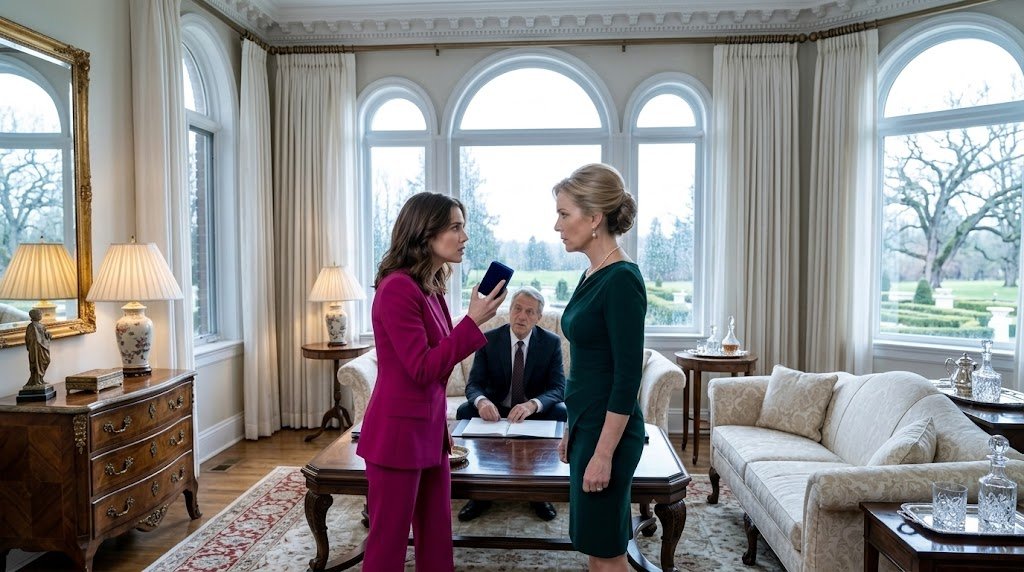
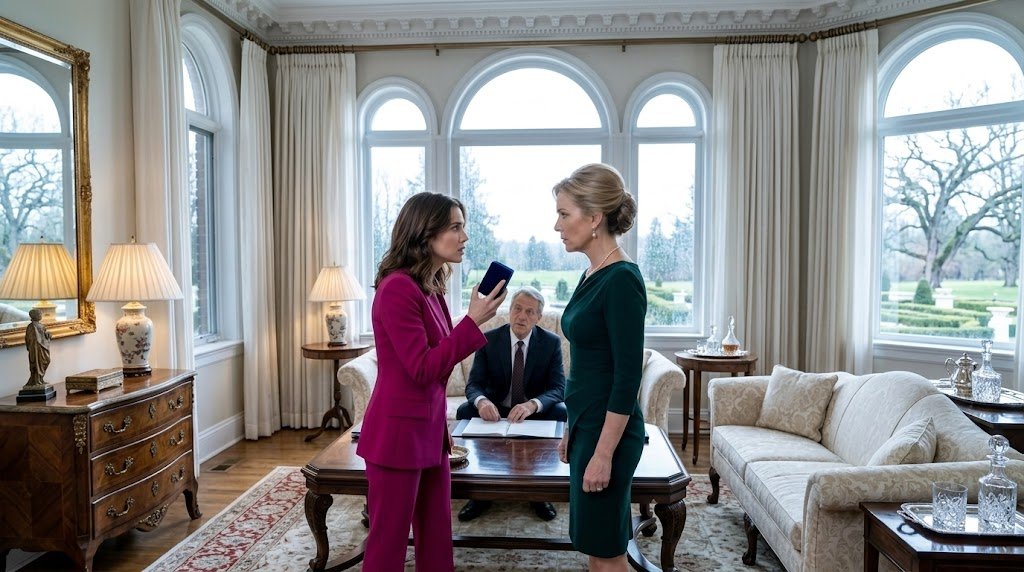
My name is Sarah Whitaker, and for most of my life, my grandmother was the only person in my family who made me feel wanted. Nana lived in a little blue cottage off a county road in New Jersey. Nothing fancy. A porch with a faded American flag. Tomato plants in coffee cans. Banana bread cooling by the window. A kitchen table where I learned that one bad report card did not mean I had a bad life. My parents hated that I loved her house. They loved polished things. Clean cars. Perfect holiday photos. Quiet children. Nice zip codes. Nana loved real things. Warm food. Honest words. People who showed up when it mattered. When she got sick, my parents pushed me out. They told the hospital I was “disruptive.” They told the nurses Nana needed peace. My father had the medical paperwork, so the staff listened to him. I spent two days in the cafeteria of St. Catherine’s Medical Center drinking cold coffee and watching elevators open for everyone but me. Then I stopped asking permission. On the third night, I waited for a shift change and slipped in through the service entrance like I was doing something wrong by loving my own grandmother. When I found her room, she looked so small that my knees nearly gave out. But when I whispered, “Nana,” her eyes opened. “I knew you’d come,” she breathed. Then she squeezed my hand and whispered something I have not forgotten. “Don’t let them win, Sarah. Check the blue velvet box.” Before I could ask what she meant, footsteps came down the hall. I had to leave quietly. Two days later, she was gone. I did not find out from my parents. I found out from my mother’s Facebook post. A polished little paragraph about “a beloved mother passing peacefully surrounded by family.” Surrounded by family. I read that line three times with my phone shaking in my hand. Six days later, they invited me to the will reading. Not because they wanted me there. Because they wanted me to watch them win. We sat in my parents’ living room, the same spotless room where I had spent half my childhood being told not to touch anything, not to speak too loudly, not to embarrass them. My mother wore black cashmere and pearl earrings. My father stood near the fireplace, calm as ever. Across from us, Mr. Caldwell opened Nana’s will. Before he read a word, my mother leaned close. “If you get a single penny,” she whispered, “I’ll make sure you regret it.” Years ago, that would have made me shrink. That day, I only thought of Nana. Mr. Caldwell began reading. The first page was formal. The second gave my parents authority over the bank accounts. The third gave my mother Nana’s personal belongings. The fourth gave my father control over the sale of certain property. The fifth made it clear that almost everything my parents had circled for years was going to them. My mother’s grip on my arm loosened. A small smile touched her mouth. My father let out a quiet breath. Then Mr. Caldwell stopped. It was not a long pause. But it changed the room. He looked at the folder again. Then at the papers beneath the will. My mother’s smile faded. “Is there a problem?” my father asked. Mr. Caldwell lifted one document from the back of the file. “There appears to be an amendment,” he said, “filed three days before Mrs. Whitaker’s death.” My mother went still. My father took one step away from the fireplace. And I felt Nana’s last words burn through me. The blue velvet box. Because I had found it that morning. And inside it was not jewelry. It was not a keepsake. It was the one thing my parents never thought Nana had been strong enough to leave behind. Mr. Caldwell looked at me. Then he looked at my mother. And when he read the first line of the amendment, the room became so quiet I could hear the rain tapping against the windows. For the first time in my life, my mother looked afraid of me.
PART 2
Mr. Caldwell adjusted his glasses, clearing his throat against the sudden chill that seemed to settle over the pristine living room.
“This codicil,” the attorney said, his voice measured and professional, “was drawn up and formally executed at St. Catherine’s Medical Center three days prior to Mrs. Whitaker’s passing. It bears her legal signature, witnessed by two attending nurses and notarized by the hospital’s legal liaison.”
My mother’s face lost the last remaining trace of color. She looked like she had just been slapped across the face with a wet towel.
“That’s impossible,” my mother hissed, leaning forward so abruptly her pearl earrings swung sharply against her jaw. “My mother was heavily medicated! She wasn’t of sound mind! Whatever piece of paper you’re holding is legally invalid, Mr. Caldwell, and you know it!”
Mr. Caldwell didn’t blink. He simply turned the page toward her.
“The hospital’s psychiatric evaluation, conducted the exact same morning, explicitly certified her mental competency,” Mr. Caldwell replied evenly. “Furthermore, Mrs. Whitaker was entirely clear-headed when she dictated the terms.”
My father finally stepped away from the fireplace, his face darkening with a dangerous, controlled fury. “Cut the legal games, Caldwell. What does the amendment say? Who gets the cottage?”
Mr. Caldwell looked down at the cream-colored document, reading the bold text aloud.
“‘To my granddaughter, Sarah Whitaker, I leave full, unencumbered ownership of my blue cottage on County Road, along with the acreage, the original furnishings, and the entirety of my private investment accounts, valued at eight hundred and fifty thousand dollars.’”
The room erupted.
“Eight hundred and fifty thousand dollars?!” my mother shrieked, jumping to her feet. Her chair scraped loudly against the hardwood floor. “That money was supposed to help pay off our mortgage and fund your father’s retirement! That old woman had no right! She’s hoarding money that belongs to her children!”
“It was her money, Eleanor,” Mr. Caldwell reminded her coldly, closing the leather folder with a soft thud. “She earned it through her late husband’s pension and her own prudent investments. She had every legal right to leave it to whoever she chose.”
My father’s fists clenched at his sides. He looked at me, his eyes blazing with a bitter hatred that he didn’t even bother trying to hide anymore.
“You,” my father spat, pointing a trembling finger at my chest. “You manipulated her. You snuck into that hospital room behind our backs and coerced a dying woman into cutting us out of her will.”
I didn’t cower. I didn’t shrink back the way I used to when I was a little girl sitting at this exact table. I stood up slowly, looking right back at the man who had treated me like an unwanted guest in my own family for twenty-eight years.
“I didn’t have to coerce her, Dad,” I said, my voice steady and clear. “I just showed up. Something neither of you bothered to do for three days while she was dying alone.”
My mother let out a hysterical, breathless laugh, her hands shaking as she grabbed a decorative vase off the side table as if she wanted to throw it at my head.
“You think you’ve won, don’t you?” my mother snarled, taking a step toward me. “You think you can just take my mother’s home and her money and walk away? We will sue you! We will tie you up in court until you are completely bankrupt! You’ll spend every single penny of that inheritance just trying to defend it!”
“You can try,” I said, slipping my hand into the pocket of my coat, feeling the cold metal edges of the old brass key. “But it won’t change what’s written in the amendment.”
I turned toward the front door, ready to leave their spotless, suffocating house for good.
“Sarah,” Mr. Caldwell called out softly before I reached the hallway.
I paused, looking back over my shoulder.
The attorney reached into his briefcase and pulled out a small, heavy object wrapped in dark blue flannel. He held it out across the room toward me.
“There is one more thing,” Mr. Caldwell said. “Your grandmother left explicit instructions that this be handed to you the moment the will reading concluded.”
My mother lunged forward, trying to intercept him. “Give that to me! That’s family property!”
Mr. Caldwell effortlessly pulled his hand back, keeping the package out of her reach. He handed it directly to me.
I took it from his hands, the fabric feeling heavy and dense. Slowly, I peeled back the flannel layers.
Inside rested an old, rusted brass key.
And resting beneath it was a handwritten note from Nana.
“Dear Sarah,” I read silently in my head, “if you’re holding this, it means you found the blue velvet box. And it means you know about the cottage. But there is one more secret my children refused to believe. Go to the cellar beneath the cottage kitchen, turn the old wine rack to the left, and open the iron door. What’s down there isn’t mine, Sarah. It’s what your grandfather left behind when the government came looking for him in the sixties. Use it wisely. Protect yourself. Love always, Nana.”
My breath caught in my throat.
A secret cellar. A hidden past my parents had spent my entire life lying about.
I clutched the blue flannel package tight against my chest, turned my back on my furious, screaming parents, and walked out of the house into the cool, steady rain.
PART 3
The rain was falling harder now, drumming a steady, relentless beat against the roof of my car as I drove north toward New Jersey. The windshield wipers swished back and forth, cutting through the blur of taillights and slick asphalt, but my mind wasn’t on the road. It was spinning with Nana’s final words.
“What’s down there isn’t mine, Sarah. It’s what your grandfather left behind…”
For as long as I could remember, my parents had spoken of my grandfather—Nana’s husband—with a tight-lipped, chilling disdain. Whenever I asked about him, my mother would change the subject or snap that he had been a reckless, irresponsible man who brought nothing but shame to the family name before disappearing entirely when my mother was just a little girl.
They had always painted him as the family skeleton, locked away in a closet of bitter memories.
Now, holding the heavy brass key in the passenger seat beside me, I realized the entire story was a fabricated lie designed to keep anyone from looking too closely at the blue cottage.
By the time I pulled into the gravel driveway of the little blue cottage, the sun had fully set, casting long, eerie shadows across the overgrown lawn and the tomato plants in their coffee cans. The porch light was off, and the house looked dark and lonely against the stormy night.
I sat in my car for a moment, listening to the rain drumming against the metal roof.
My parents wouldn’t give up easily. Mr. Caldwell had made it clear the will and its amendment were legally bulletproof, but desperation made people reckless. They might try to break into the cottage tonight, believing they could find the hidden assets before I did.
I grabbed my flashlight from the glove box, slipped the heavy brass key into my coat pocket, and pushed open the car door, running through the cold downpour up to the wooden porch.
The front door unlocked with a familiar, easy click.
Inside, the cottage smelled of cinnamon, old wood, and the lingering, comforting scent of Nana’s baking. It was dark and quiet, but stepping inside felt like walking into an embrace.
I didn’t turn on the overhead lights. Instead, I clicked on my flashlight, its bright beam cutting through the gloom, guiding my steps toward the back of the house.
The kitchen was just as Nana had left it. A ceramic teapot on the stove. A jar of homemade strawberry jam on the counter. And a heavy wooden door in the corner leading down to the cellar—a door I had never seen opened in all the years I visited her.
My heart hammered against my ribs as I approached it.
I knelt down, examining the iron latch. It wasn’t locked with a modern padlock, but rather a heavy, old-fashioned bolt mechanism encrusted with dust and rust.
I reached into my pocket, pulling out the heavy brass key Mr. Caldwell had given me.
I slid it into the keyhole. It was a tight fit, the metal scraping against neglected tumblers, but with a firm twist, I felt the internal mechanism give way with a loud, echoing clack.
I pulled the bolt open and hauled the heavy wooden door upward.
A rush of cold, stagnant air billowed up from the darkness below, carrying the sharp scent of damp earth, old iron, and something else—something metallic and sharp, like sealed metal and decades of isolation.
I switched on my flashlight, pointing the beam down the steep, narrow stone steps leading into the blackness.
Taking a deep, steadying breath, I began to descend.
My boots clicked against the damp stone. The beam of my flashlight bounced off rough walls until it hit a blank wooden barrier at the base of the stairs—the old wine rack Nana’s note had mentioned.
I reached out, my hand brushing against the cold, splintered wood of the rack.
“Turn it to the left,” the letter had instructed.
I gripped the side of the heavy structure and pushed.
At first, it didn’t budge. Decades of dust and settling earth had locked it in place. I braced my shoulder against the wall, gritted my teeth, and shoved with all my weight.
With a grinding, metallic screech, the entire wine rack pivoted inward on a hidden pivot hinge.
Behind it was a second door—a thick, steel reinforced vault door bearing an old, heavy combination lock and a rotating wheel handle.
I stared at it in stunned silence.
This wasn’t just a cellar. This was a bunker.
Resting on a small wooden table directly beside the vault was a folded piece of paper with my name on it, written in the same steady handwriting as the note Mr. Caldwell had given me.
I picked it up, unfolding it under the beam of my flashlight.
“Sarah,” Nana had written, “if you’ve made it this far, you’re just as stubborn as your grandfather was. They called him a criminal because he refused to hand over his inventions to a corrupt government agency in the sixties. He hid down here, and I protected him, and then I protected this room for fifty years. Inside this vault isn’t just money, sweetheart. It’s patent designs worth a fortune, letters your grandfather wrote me every day he was in hiding, and enough evidence to clear his name once and for all. Your parents wanted to bury this family’s true legacy. I saved it for the only one brave enough to dig it up.
Open the wheel, honey. The combination is your birthday, followed by mine.
It’s all yours now.”
Tears pricked my eyes as I looked at the heavy steel wheel of the vault.
My parents thought they were punishing me by letting me take the old, broken wardrobe and the “useless” blue cottage. They thought they had left me with nothing.
They had no idea they had just handed me the keys to an empire.
I stepped forward, placed my hand on the cold iron wheel, and began to dial the numbers of my birthday.
THE END.