COLD OPEN
An eight-year-old boy was rushed into my emergency department with a 103.8-degree fever, purple fingertips, and a month-old cast giving off the unmistakable odor of decay. But his condition wasn’t the most disturbing thing.
It was his mother.
She looked directly at me and calmly said, “It’s only the flu.” Then, the moment I told her I needed to cut the cast open, panic shattered her composure.
The smell reached me before the stretcher did.
Sweet. Metallic. Putrid.
It cut through the disinfectant-heavy air of Riverton Children’s Medical Center, making two nurses at the station instinctively turn away.
PART 1
I’m Dr. Vivian Cole, and after nearly nine years working emergency medicine, I’ve learned that the most frightening cases don’t always announce themselves with sirens, screaming parents, or chaos.
Sometimes they arrive quietly.
Sometimes they come with a dangerously sick child and a parent who appears completely certain that everything is under control.
“Eight-year-old male,” Jonah Reed called as he hurried toward me, pulling his mask tighter over his face. “Temperature 103.8, heart rate close to 140, blood pressure falling. He’s barely answering questions.”
He pointed toward Trauma Room 4.
“His mother says it’s influenza. But, Vivian… you need to see his arm.”
I pushed through the door.
The odor hit me so hard I stopped for half a second.
The boy looked smaller than eight. His lips were dry and split, his cheeks hollow, and his skin had a pale, wax-like color I had learned to associate with patients whose bodies had been battling a serious infection for far too long.
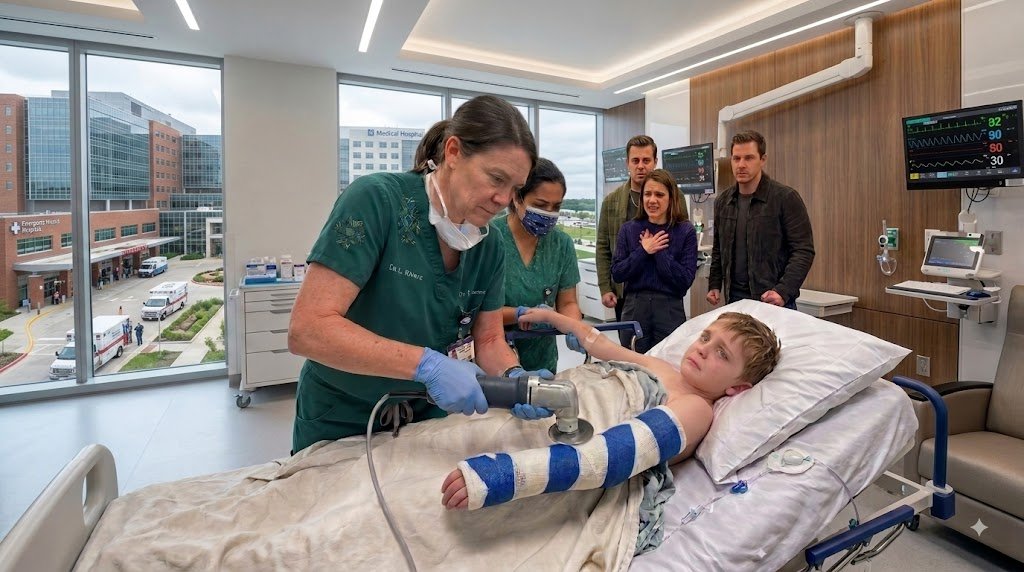
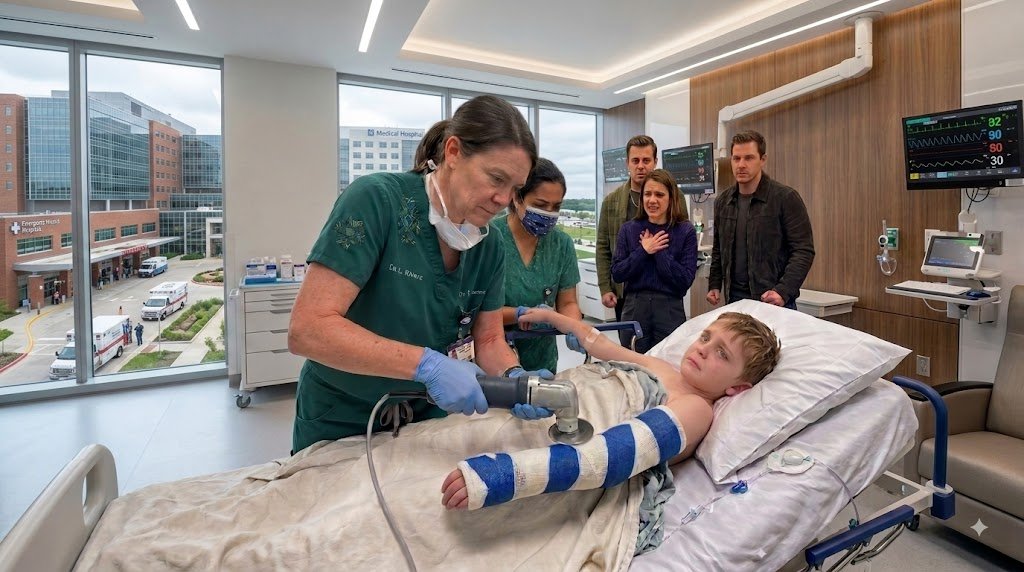
His right arm was encased in a fiberglass cast running from his knuckles to several inches above the elbow.
The cast was filthy, discolored, and damp around the hand.
His fingers were swollen.
Purple.
Several fingertips were already turning blue.
I pressed lightly against one nail bed and watched the color disappear beneath my thumb.
I waited.
Nothing.
“How long has he had the cast?” I asked.
A woman standing near the wall turned toward me.
Her name was Celeste Ward.
She held a paper coffee cup between perfectly manicured fingers, looking more like someone waiting for a business meeting than the mother of a critically ill child.
Cream-colored coat. Small gold earrings. Immaculate makeup. Carefully styled dark hair.
“Just over five weeks,” she replied casually. “He’s always getting himself into trouble. He fell off the old climbing frame behind our house.”
She took another sip.
“He felt hot earlier this morning. I figured he picked up one of those viruses going around.”
My stomach tightened.
The monitor was telling me something very different.
His heart was racing. His blood pressure was collapsing. His temperature was dangerously high.
And the color of his fingers suggested that the swelling trapped beneath that cast was severely compromising blood flow.
“Mrs. Ward, your son is critically ill,” I said. “We need to remove this cast now. There may be a serious infection underneath it, and the circulation to his hand is already threatened.”
I expected terror.
Instead, irritation flashed across her face.
“No. His orthopedic specialist told me the cast stays on for another ten days. Give him antibiotics. Once his fever comes down, we’re leaving.”
Tessa Morgan, one of our senior nurses, had already put on a second mask. She dabbed a little menthol beneath her nose as the odor intensified.
Jonah was establishing pediatric IV access while another nurse activated our sepsis protocol.
I had encountered medical neglect before.
It didn’t always look obvious.
Sometimes it arrived in designer clothing, carrying expensive coffee, speaking with such confidence that everyone in the room briefly questioned what their own eyes were telling them.
Four years earlier, I had believed a caregiver’s reassuring explanation when a child’s injuries didn’t quite add up.
That child returned days later in devastating condition.
I had never completely forgiven myself for trusting the wrong person.
I wasn’t going to repeat that mistake.
“Tessa,” I said firmly, “call hospital security. And bring me the cast saw.”
Celeste suddenly erupted.
“You are not cutting that cast! You don’t have permission. I’ll take this hospital to court!”
She rushed toward the stretcher.
Tessa stepped between her and the child.
Two security officers entered moments later and restrained Celeste as she struggled against them, her polished appearance finally beginning to unravel.
Then Tessa placed the cast saw on the tray beside the boy.
Celeste stopped fighting.
Completely.
The anger drained from her expression.
What replaced it was something much worse.
Fear.
“Please,” she whispered.
I looked at her.
“Please what?”
Her eyes remained locked on the cast.
For several seconds, she said nothing.
Then her voice dropped almost to nothing.
“He’s been telling me for days that something inside that cast was hurting him.”
My chest tightened.
“What kind of pain?”
Celeste swallowed.
“I don’t know.”
She looked at the boy, then back at the cast.
“Just… don’t open it.”
The room seemed to go silent around us.
I stared at her.
And in that instant, I understood something terrifying:
Celeste Ward might already know exactly what was waiting beneath the cast.
PART 2
I looked at the boy.
His eyes were half-open, unfocused, but when our gazes met, something changed.
Fear.
Not the ordinary fear of a child in an emergency room.
This was recognition.
As if he knew I was finally going to discover something he had been trying to tell people for weeks.
“Buddy,” I said softly, moving closer to the stretcher, “what’s your name?”
His lips barely moved.
“Caleb.”
“Caleb, I’m Dr. Cole. I need to help your arm, okay?”
He swallowed with difficulty.
“Mom said… don’t tell.”
Behind me, I heard Celeste gasp.
“Caleb!”
The boy flinched.
That single reaction told me more than any medical chart could have.
I turned toward her.
“Everyone except medical staff, step back.”
Celeste immediately protested.
“He’s confused. He has a high fever. He doesn’t know what he’s saying.”
“Maybe,” I replied. “But we’re going to take every word seriously.”
Tessa positioned the cast saw.
The motor whined to life.
Caleb began trembling.
I placed my hand gently on his shoulder.
“Look at me. You’re safe.”
The saw touched the fiberglass.
A thin line opened along the outside of the cast.
The smell became unbearable.
Tessa turned her head away.
Jonah muttered, “Oh, God.”
I didn’t answer.
I kept cutting.
When the final section separated, I carefully spread the cast apart.
What I saw made my blood run cold.
The skin around Caleb’s forearm was swollen almost twice its normal size.
There were deep pressure wounds where the cast had been pressing into his flesh.
Several areas were blackened.
And beneath the swelling, a thin, dark-red line disappeared toward his wrist.
I touched the skin beside it.
Caleb screamed.
“Easy,” I said immediately. “Don’t move.”
The tissue was hot.
Far too hot.
I knew we were dealing with a deep infection, possibly involving the bone.
But then I noticed something else.
A small piece of white material was embedded near the inside of his wrist.
It didn’t look like bone.
“Tessa, light.”
She angled the examination lamp closer.
I leaned in.
It was plastic.
A narrow strip of something had been placed beneath the cast.
“What is that?” Jonah asked.
“I don’t know.”
I carefully exposed more of it.
Then Caleb whispered something.
“Mom put it there.”
Every person in the room froze.
Celeste’s face went completely pale.
“That’s not true.”
Caleb closed his eyes.
“You said it would help.”
I looked at Celeste.
“What did you put under his cast?”
“Nothing.”
“Then why does your son remember you putting something there?”
“He’s delirious!”
Her voice cracked.
For the first time, the calm, polished mother from minutes earlier was gone.
I signaled to the nurse.
“Draw blood cultures. CBC, metabolic panel, lactate. Start broad-spectrum antibiotics. We need pediatric surgery and orthopedics here immediately.”
Tessa nodded and moved.
I returned my attention to Caleb.
“Did something hurt your arm before the cast was put on?”
He hesitated.
Then he nodded.
“How?”
His lower lip trembled.
“I fell.”
Celeste quickly interrupted.
“He fell from the tree.”
I ignored her.
“Caleb, did you really fall?”
He looked toward his mother.
That was enough.
I lowered my voice.
“You can tell me the truth. Nobody is going to punish you.”
His eyes filled with tears.
“I didn’t fall from a tree.”
Celeste stepped forward.
“Caleb, stop.”
Security immediately blocked her path.
The boy began crying silently.
I felt my jaw tighten.
“Where did you fall?”
He shook his head.
“Tell me what happened.”
A long pause.
Then he whispered:
“Mom locked me in the basement.”
The room went dead quiet.
Jonah stopped typing.
Tessa stared at me.
Celeste’s expression collapsed.
“That is a lie.”
Caleb continued, his voice barely audible.
“I hit the table.”
I looked at his arm again.
The original injury suddenly made far more sense.
But one question remained.
Why had someone deliberately placed plastic beneath his cast?
And why had the infection been allowed to progress for more than a month?
I carefully examined the exposed strip.
There were tiny markings along one edge.
Numbers.
Not medical markings.
Something had been written there.
I leaned closer.
My stomach dropped.
It wasn’t random.
It was a date.
And the date was from three days before Caleb had supposedly fallen from the tree.
I straightened slowly.
“Someone needs to call the police.”
Celeste stared at me.
“You don’t understand.”
“No,” I said. “I don’t.”
She looked toward Caleb.
Then toward the exposed arm.
And finally at the little plastic strip sitting beneath the cast.
Her voice became almost inaudible.
“I was trying to protect him.”
I stared at her.
“Protect him from whom?”
Celeste didn’t answer.
Instead, she looked toward the hospital door.
And when she finally spoke, the words made every instinct in my body scream.
“From the person who put that thing inside his cast.”
PART 3
For several seconds, nobody moved.
“Who?” I asked.
Celeste looked at the security officers.
Then at me.
Then at her son.
“I don’t know.”
It was the wrong answer.
Not because it was impossible.
Because she said it like someone trying to decide which lie would keep her alive.
I pulled the curtain around Caleb’s bed.
“Mrs. Ward, I need the truth right now. Your son could die from this infection.”
Her eyes filled with tears.
“I was scared.”
“Of whom?”
She finally whispered a name.
“Dr. Adrian Vale.”
Jonah looked up from the computer.
“The orthopedic surgeon?”
Celeste nodded.
I knew the name. Adrian Vale was a respected pediatric orthopedic specialist at a private clinic across town. He had treated Caleb after the injury.
“What does he have to do with this?”
Celeste shook her head.
“He told me Caleb needed another procedure. He said the cast had to stay on. He said if I took it off, the damage would become permanent.”
“That still doesn’t explain the plastic.”
“I didn’t put it there.”
“Then who did?”
Celeste stared at the floor.
“He did.”
The room became painfully quiet.
According to Celeste, Caleb had originally injured his arm at home. She claimed she panicked because she was afraid authorities would investigate the circumstances surrounding the injury.
So she took him to Vale.
The doctor had placed the cast.
But three days later, Caleb began complaining that something inside it was scratching his skin.
Then came the fever.
Then the swelling.
Then the smell.
Celeste admitted she had called Vale repeatedly.
“He told me it was normal.”
My anger rose.
“Normal?”
“He said children sometimes imagined pain because they were frightened.”
I looked at Caleb.
The boy was barely conscious now.
His blood pressure continued falling.
“Where is Dr. Vale?”
Celeste shook her head.
“He left town yesterday.”
That was when Jonah rushed toward me.
“Vivian, the lab just called. His lactate is extremely high.”
I didn’t need another warning.
“Get him to surgery.”
The pediatric surgical team arrived within minutes.
Caleb was wheeled out while Tessa squeezed his hand.
“Stay with us, sweetheart.”
His eyes opened slightly.
“Am I gonna die?”
Tessa looked at me.
I crouched beside him.
“We’re going to fight very hard to make sure you don’t.”
The operating-room doors closed.
Celeste remained in the hallway under security supervision.
For the first time since she had arrived, she looked like a mother rather than a woman trying to control a situation.
She sat down and covered her face.
“I should have told someone.”
“Yes,” I said.
She looked up.
“I thought he would kill us.”
My expression hardened.
“Who?”
She whispered:
“Vale.”
The police arrived shortly afterward.
And then Celeste finally told them everything.
The plastic strip wasn’t part of a medical device.
It was a coded marker.
Vale had been placing similar strips beneath casts on several patients.
Each one contained a date and a number.
The police later discovered that the numbers corresponded to private patient files that had been improperly accessed.
It appeared someone had been using children’s medical records for a scheme involving fraudulent insurance claims and unnecessary procedures.
Caleb had accidentally become a problem when his mother threatened to report Vale after realizing something was wrong.
That explained the warnings.
The pressure.
The insistence that the cast remain untouched.
And the terrifying panic when I reached for the saw.
But there was one thing Celeste had still not told us.
Why had Caleb been locked in the basement?
The answer came several hours later.
She admitted she had hidden him there after an argument because she was terrified that social services would take him away.
She had not intended to hurt him.
But fear had turned into secrecy.
And secrecy had nearly killed her son.
Just before midnight, the surgeon came out.
Everyone stood.
“He made it through.”
Celeste burst into tears.
I closed my eyes for a moment.
Relief washed through me.
“He had extensive tissue damage,” the surgeon continued, “but we were able to restore circulation. He’ll need more treatment and rehabilitation, but his hand has a chance.”
Celeste collapsed into the nearest chair.
I watched her for a moment.
Then I walked toward the pediatric ICU.
Through the glass, Caleb lay beneath a blanket, surrounded by monitors.
His little hand was wrapped in fresh bandages.
He looked impossibly small.
But alive.
The next morning, Caleb opened his eyes.
I stepped beside his bed.
“How are you feeling?”
He thought about it.
“My arm hurts.”
“That’s understandable.”
He looked at me.
“Did you cut the bad thing out?”
I smiled.
“We did.”
He nodded.
Then he whispered, “I tried to tell Mom.”
“I know.”
“She didn’t listen.”
I glanced through the window toward the hallway.
“Sometimes adults become so frightened that they stop hearing what matters most.”
Caleb was quiet.
Then he asked, “Am I safe now?”
I took his hand carefully.
“Yes.”
This time, I meant it.
Weeks later, Dr. Vale was arrested after investigators found evidence connecting him to the fraudulent scheme and to several other patients who had suffered unexplained complications.
Celeste faced consequences too.
The investigation confirmed that her decisions had placed Caleb in grave danger.
But she cooperated fully and helped investigators uncover what had happened.
Caleb eventually left the hospital with his arm healing.
Before he went, he gave me a small drawing.
It showed a doctor standing beside a little boy.
Above them, in uneven blue letters, he had written:
THANK YOU FOR LISTENING.
I kept that picture.
Because medicine teaches you to watch vital signs, read scans, recognize patterns, and act quickly.
But sometimes the most important warning isn’t on a monitor.
Sometimes it comes from a frightened child whispering that something is wrong.
And sometimes saving a life begins with one simple decision:
Listen.
THE END.