COLD OPEN — THE DELIVERY THAT SILENCED MY FATHER
On my younger brother’s sixteenth birthday, my parents gave him a luxury SUV worth nearly $95,000.
For my sixteenth birthday, they gave me a rusty bicycle with a dead tire.
“Some people need hardship to become strong,” my father told me.
My grandmother heard him.
She said nothing.
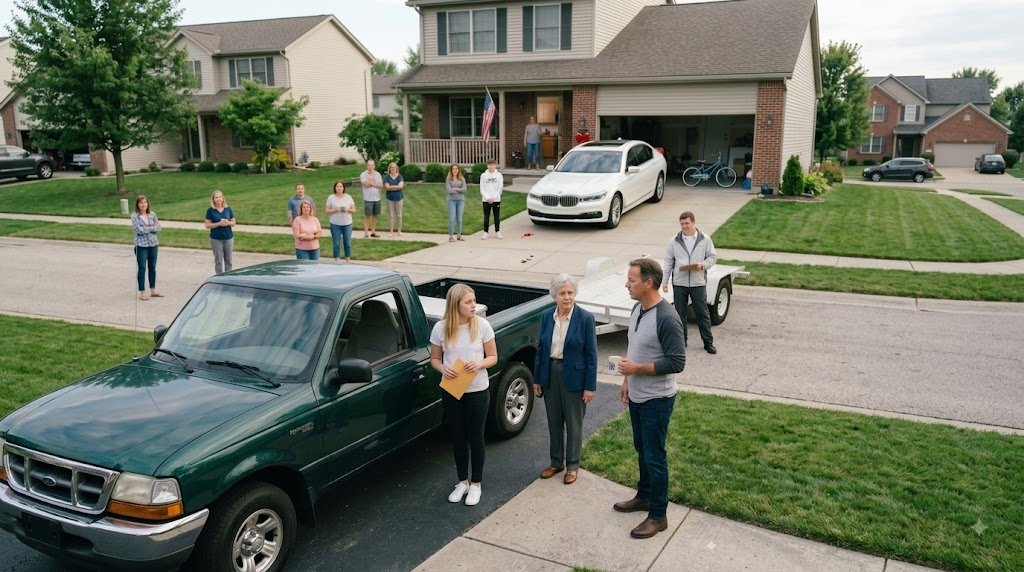
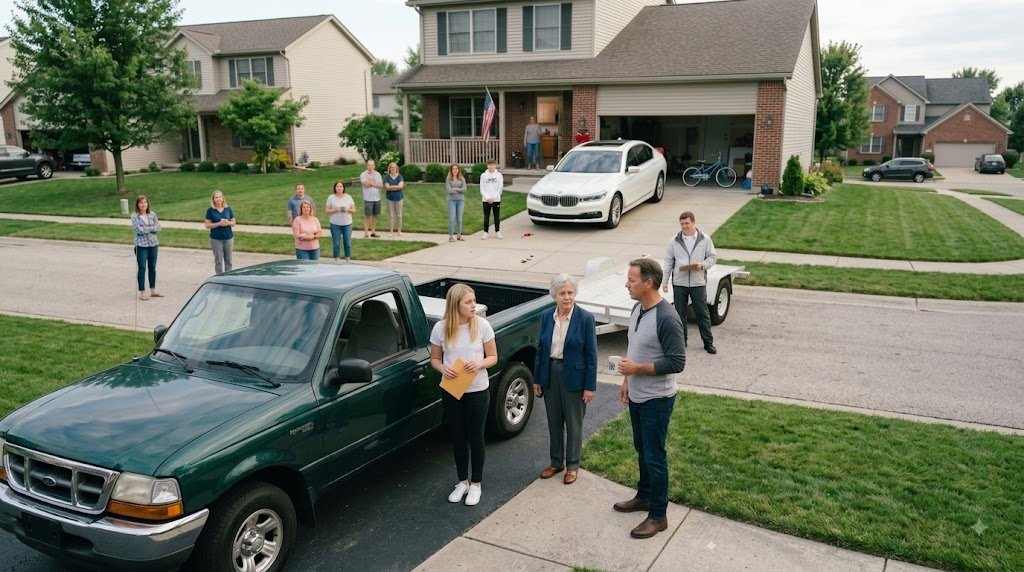
Two years later, on the morning I turned eighteen, a delivery truck stopped outside our house.
The driver stepped down and asked, “Are you Nora Caldwell?”
I nodded.
He pointed toward the trailer.
My father came running outside.
The moment he saw what was waiting for me, the coffee cup slipped from his hand.
Then Grandma walked down the porch steps and said six words that changed everything:
“Your father has been lying to you.”
PART 1 — THE DAUGHTER WHO WAS TAUGHT TO STRUGGLE
The luxury SUV arrived at nine-thirty on a Sunday morning.
It rolled into our driveway on the back of a transport truck, its deep-black paint shining beneath the pale Ohio sunlight.
A giant silver bow covered the hood.
The windows were spotless.
The interior still smelled new.
My younger brother, Brandon Caldwell, came flying out of the house before the driver had even finished unloading it.
He was sixteen.
He was still wearing sweatpants and a basketball jersey.
“You actually got it!” he yelled.
My father, Raymond Caldwell, laughed.
“I told you I’d make your birthday unforgettable.”
My mother, Patricia, stood beside him with tears in her eyes.
She took pictures.
Then more pictures.
Brandon climbed into the driver’s seat and immediately started exploring the dashboard.
He wasn’t interested in how much it cost.
He only wanted to know whether it had the upgraded sound system.
I already knew the price.
Dad had mentioned it several times that week.
Ninety-four thousand seven hundred dollars.
I stood at the end of the driveway with my backpack over one shoulder.
Inside was my supermarket uniform.
My shift started in less than an hour.
No one asked why I was leaving.
No one wished me a good day.
Everyone was focused on Brandon.
Two years earlier, my own sixteenth birthday had been very different.
Dad had called me into the shed behind the house.
A bicycle was waiting there.
Not a new bicycle.
Not even a decent used one.
It was a faded blue cruiser with peeling grips, a crooked handlebar, and rust around the chain.
One tire was completely flat.
A small secondhand-store sticker was still attached beneath the seat.
$29.95.
Dad pointed toward it.
“This is yours.”
I stared at him.
“Seriously?”
He folded his arms.
“Nora, you’re old enough to understand that nobody owes you an easy life.”
I waited for him to smile.
He didn’t.
“You need to learn how to struggle.”
That was it.
No cake.
No birthday dinner.
No card.
Just four words I would remember for years.
Through the window behind him, I saw my grandmother, June Caldwell.
She had heard everything.
She was standing at the kitchen counter with a dish towel in her hands.
She didn’t come outside.
She didn’t defend me.
She didn’t say a word.
At sixteen, I assumed she was disappointed in me.
Years later, I realized I had misunderstood her completely.
She wasn’t disappointed.
She was watching.
And remembering.
I kept the bicycle.
I didn’t keep it because I liked it.
I kept it because throwing it away felt like surrender.
Dad had wanted that bicycle to teach me something.
Instead, it became a reminder.
Every time I looked at the flat tire, I remembered exactly how differently my parents treated Brandon and me.
The bicycle followed me whenever I moved.
The sticker stayed on it.
The tire stayed flat.
I never repaired it.
Meanwhile, Brandon received almost everything he asked for.
Expensive shoes.
A new phone every year.
Private basketball camps.
Concert tickets.
And now a vehicle that cost more than some people’s houses.
That Sunday, he started the SUV’s engine.
Dad stood beside him explaining the driving modes.
Mom photographed him through the windshield.
Brandon complained that the dealership had forgotten the upgraded floor mats.
I turned around and walked to work.
On the way, I kept thinking about the money.
My father worked as an insurance claims supervisor.
My mother was an office manager at a small medical clinic.
We weren’t poor.
But we weren’t wealthy either.
Our house was comfortable.
We had two older cars.
We took modest vacations.
There was no obvious reason they could afford a nearly $95,000 vehicle for a sixteen-year-old.
I had asked once.
Dad’s response was immediate.
“Don’t concern yourself with things you don’t understand.”
Mom had been gentler.
“You’re just upset because Brandon got something special.”
After that, I stopped asking.
Questions were dangerous in our house.
Dad interpreted curiosity as disrespect.
Mom interpreted disagreement as jealousy.
So I learned to stay quiet.
Grandma did too.
At least she appeared to.
But every once in a while, I caught her watching Dad.
Her expression was impossible to read.
And she always seemed to know more than she said.
Then came my eighteenth birthday.
The morning started before sunrise.
A low diesel rumble shook the windows of my bedroom.
I opened my eyes.
The sound grew louder.
Heavy machinery wasn’t normal on our street.
I pulled on sweatpants and hurried downstairs.
Orange warning lights flashed across the curtains.
When I opened the front door, I saw another flatbed truck parked along the curb.
For a second, I thought it might be another delivery for Brandon.
Then I saw what was sitting on the trailer.
A dark-blue pickup truck.
It was a few years old.
There were scratches along the passenger door.
The tires were built for work rather than appearance.
A steel storage box was mounted behind the cab.
It wasn’t luxurious.
It wasn’t impressive.
But it looked dependable.
A delivery man in a brown jacket climbed down from the truck.
He held a clipboard.
When he saw me, he checked the paperwork.
“Are you Nora Caldwell?”
“Yes.”
He smiled.
“Good. I’ve been looking for you.”
He pointed behind him.
“This truck is yours.”
I stared at him.
“I think you’ve made a mistake.”
He shook his head.
“No mistake.”
He handed me a thick folder.
“It’s paid in full. Title, registration, insurance documents, and service history are all included.”
I couldn’t speak.
Then the front door slammed behind me.
Dad stepped onto the porch.
He had a coffee mug in one hand.
His car keys were in the other.
He looked at the delivery driver.
Then the truck.
Then me.
His expression changed immediately.
“What is going on?”
The driver looked at his clipboard.
“I’m delivering a vehicle to Miss Caldwell.”
Dad’s voice hardened.
“Who ordered it?”
Before the driver could answer, another voice came from the porch.
“I did.”
Grandma June was standing behind my father.
She wore a simple gray cardigan.
No makeup.
No jewelry.
But there was something different about her that morning.
She looked completely certain.
Dad turned toward her.
“Mom?”
She walked down the steps.
Slowly.
She stopped beside me.
Then she placed a sealed envelope in my hand.
“I’ve been waiting for this day.”
Dad’s face tightened.
“Mom, don’t.”
She looked at him.
“You’ve had eighteen years to tell her the truth.”
He took one step forward.
“That’s enough.”
Grandma didn’t move.
“No.”
Her voice was quiet.
But it stopped him.
She turned toward me.
“Open it.”
My fingers trembled as I broke the seal.
Inside was a bank statement.
Then another document.
Then a legal agreement.
I read the first page.
My heart began pounding.
There was an account in my name.
It had been opened when I was born.
The balance was far beyond anything I had expected.
I looked at Grandma.
“What is this?”
She took a breath.
“Your father has been telling you that your family couldn’t afford certain things.”
She glanced toward the expensive SUV parked across the driveway.
“He wasn’t telling you the whole story.”
Dad’s face had gone pale.
I looked at him.
“What did you do?”
He didn’t answer.
Grandma did.
“The money was supposed to belong to you.”
I stared at the documents again.
Suddenly, the bicycle made sense.
The cheap birthday.
The excuses.
The endless reminders that I needed to struggle.
And the $94,700 SUV sitting only a few feet away.
My father’s keys slipped from his fingers.
They hit the porch.
This time, nobody laughed.
Grandma placed her hand on my shoulder.
“You deserve to know everything now.”
I looked at my father.
For the first time in my life, he wasn’t angry.
He wasn’t dismissive.
He wasn’t in control.
He was afraid.
And I had no idea yet what was written on the final page of the envelope.
PART 2 — THE MONEY MY FATHER HID
I stared at the final document for almost a full minute before I understood what I was looking at.
It wasn’t a normal bank statement.
It was a trust agreement.
My name appeared at the top.
So did my birth date.
Beneath it was a number that made my stomach tighten.
$186,400.
I looked at Grandma June.
“Why is this in my name?”
She pulled out a chair at the kitchen table.
“Because your grandfather created it for you.”
I looked toward Dad.
He had gone completely silent.
“My grandfather?”
June nodded.
“Your grandfather believed every grandchild should have something of their own.”
I looked at the papers again.
“Then why didn’t I know about this?”
Grandma’s eyes moved toward my father.
“Because Raymond convinced him to let him manage it.”
Dad finally spoke.
“That isn’t what happened.”
Grandma turned toward him.
“Then tell her what did happen.”
He said nothing.
I felt something cold settle inside me.
“Dad?”
He rubbed his forehead.
“Your grandfather trusted me.”
“And?”
“I handled the account.”
“For eighteen years?”
“Yes.”
“Then why did I get a twenty-nine-dollar bicycle?”
His jaw tightened.
“That wasn’t about the money.”
“Then what was it about?”
He looked at me.
“You needed discipline.”
I almost laughed.
“Discipline?”
I pointed toward the driveway.
“Brandon got a $94,700 truck.”
Dad’s expression hardened.
“He’s different.”
The words landed harder than anything else he had said.
“Different how?”
He didn’t answer.
I looked at Grandma.
She did.
“Because Raymond always believed Brandon was the child who would carry the family name forward.”
I stared at her.
“And me?”
June’s expression softened.
“You were the child he thought would leave.”
The kitchen went silent.
I felt tears forming, but I refused to let them fall.
“So you knew?”
“I knew enough.”
“You watched him treat me like this for years.”
“Yes.”
“And you did nothing.”
June lowered her eyes.
“I was waiting until you were old enough to make your own decisions.”
Dad suddenly stood.
“This conversation is over.”
Grandma didn’t even look at him.
“No, Raymond. It is finally beginning.”
He grabbed the folder.
I pulled it away.
“Don’t touch that.”
His hand froze.
I had never spoken to him like that before.
Maybe he realized it too.
Because he slowly lowered his arm.
I opened another document.
It was a transaction history.
The account had started with $75,000.
Over the years, deposits had been added.
Investment earnings.
Dividends.
Interest.
But there were also withdrawals.
Several of them.
I traced my finger down the page.
“What’s this?”
Dad looked away.
I read the amounts aloud.
“Twenty thousand dollars.”
Another.
“Thirty-five thousand.”
Another.
“Forty thousand.”
My voice shook.
“Where did this money go?”
Dad said nothing.
Grandma answered.
“Your brother’s school.”
I looked at Dad.
“You used my trust fund for Brandon?”
“He needed it.”
I couldn’t believe what I was hearing.
“So I needed a bicycle, but he needed my money?”
Dad’s face reddened.
“You weren’t using it.”
“That doesn’t make it yours.”
Mom had entered the kitchen without me noticing.
She stood near the doorway.
“Raymond,” she whispered.
He turned toward her.
“Not now, Patricia.”
She looked at me.
“I didn’t know all of it.”
I believed her.
But that didn’t make it easier.
“How much is left?”
Grandma looked at the papers.
“Enough.”
“Enough for what?”
“For you to leave this house.”
Dad suddenly laughed.
It was short and bitter.
“She’s not going anywhere.”
I looked at him.
“Why?”
“Because this is your home.”
I shook my head.
“No.”
I looked around the kitchen.
The same kitchen where I had eaten birthday dinners without birthday cakes.
The same kitchen where Grandma had silently watched me learn to swallow disappointment.
“This was your home.”
I picked up the envelope.
“I think it’s time I found my own.”
Dad’s face changed.
“You’re eighteen.”
“Yes.”
“You don’t understand what you’re doing.”
“Maybe.”
I looked at the pickup outside.
“But for the first time, I get to decide.”
Grandma smiled.
Not proudly.
Not triumphantly.
Relieved.
She reached into her purse and pulled out another envelope.
“There is one more thing.”
I stared at her.
“What now?”
“This came from your grandfather’s attorney.”
I opened it.
Inside was a letter dated three months before his death.
The handwriting was unmistakably his.
Dear Nora,
I stopped reading.
My vision blurred.
Grandpa had written my name.
He had known.
He had known I might never understand why things were different.
The letter continued:
If you’re reading this, you’re old enough to know that love should never be measured by what someone gives your brother instead of you.
I pressed my fingers against my mouth.
Then I read the final paragraph.
Your father may tell you that I wanted him to manage this money for the family. That is not true. I created it for you. Only you.
I looked up.
Dad was staring at the letter.
“You knew about this?”
He didn’t answer.
Grandma did.
“He knew.”
My father sat down.
For the first time, he looked old.
Not powerful.
Not intimidating.
Just tired.
“I was going to put it back.”
I stared at him.
“When?”
He looked at the floor.
“When Brandon finished school.”
“So you planned to keep using it?”
“No.”
“Then what were you planning to do?”
He had no answer.
Grandma stood beside me.
“Your father made a choice.”
I looked at Dad.
“So did I.”
I picked up the truck keys the delivery driver had left on the counter.
They felt strangely heavy.
Not because of the vehicle.
Because they represented something I had never been given before.
A choice.
That afternoon, I packed one suitcase.
The old bicycle stayed in the garage.
I didn’t need it anymore.
But I wasn’t ready to throw it away.
Before leaving, I walked past Brandon’s room.
His new SUV was visible through the window.
For years, I had wondered what it would feel like to have what he had.
Now I understood.
It wasn’t the vehicle I wanted.
It was the respect behind it.
I walked outside.
Grandma was waiting beside the pickup.
She handed me the last envelope.
I looked at her.
“What is this?”
She smiled.
“Something your grandfather left for the day you finally chose yourself.”
I opened it.
Inside was a key.
Not for the truck.
A small brass key.
Attached to it was a handwritten address.
I recognized the town immediately.
It was where my grandfather had owned a small lakeside property before he died.
I looked at Grandma.
“What am I supposed to do with this?”
She smiled.
“Go find out what belongs to you.”
I climbed into the truck.
As I started the engine, I looked back at the house.
Dad stood on the porch.
Mom stood behind him.
Neither waved.
Grandma did.
I drove away.
But I didn’t know that the property waiting for me at the lake contained one final document.
And that document would prove my father hadn’t just taken money from me.
He had been hiding something about the day my grandfather died.
PART 3 — THE SECRET GRANDPA LEFT BEHIND
The address led me forty-three miles north of town, to a small lake I hadn’t visited since I was a child.
By the time I arrived, the sun was disappearing behind the trees.
The property looked nothing like I remembered.
The old cabin was smaller than it had seemed when I was eight.
The paint was peeling.
The porch sagged slightly.
But the brass key Grandma had given me fit the front door perfectly.
Inside, everything smelled like cedar and dust.
I walked from room to room until I noticed a wooden desk beside the fireplace.
On top sat a sealed envelope.
My name was written across it.
Nora.
My hands began to shake.
I opened it.
Inside was a letter from Grandpa.
If June gave you this, then you’re finally old enough to know the whole truth.
I sat down.
The letter explained that the trust wasn’t the only thing Grandpa had created for me.
He had also purchased this property and placed it in my name.
But there was more.
Much more.
According to the documents, my father had been appointed temporary financial manager of my trust when I was a child.
He was supposed to provide annual statements.
He never did.
Instead, Grandpa had discovered that Raymond was using money from my account to cover Brandon’s expenses.
Grandpa confronted him.
And that confrontation happened only weeks before Grandpa died.
I stopped reading.
My grandfather hadn’t died peacefully without knowing what was happening.
He had fought my father over it.
The final paragraph was only two sentences.
I wanted to tell Nora myself.
Raymond promised me he would make things right.
I lowered the letter.
“He never did.”
My voice echoed through the empty cabin.
Then I noticed another envelope beneath the first.
This one was from a law firm.
Inside was a copy of a document dated six years earlier.
It was an amendment to my trust.
My father had attempted to change the beneficiary instructions.
But Grandpa had rejected the amendment before his death.
At the bottom was a handwritten note:
“Do not trust Raymond with Nora’s inheritance again.”
I stared at those words.
Then my phone rang.
It was Dad.
I almost didn’t answer.
But I did.
“What?”
His voice was different.
Not angry.
Panicked.
“Where are you?”
“At Grandpa’s cabin.”
Silence.
Then:
“You shouldn’t be there.”
I stood up.
“Why?”
“Nora, listen to me. There are things you don’t understand.”
“I understand enough.”
“No, you don’t.”
His breathing became uneven.
“You need to leave that property.”
“Why?”
Another silence.
Then he said something that made my blood run cold.
“Because your grandfather didn’t die knowing you were going to inherit everything.”
I frowned.
“What does that mean?”
Dad hung up.
I immediately called Grandma.
She answered on the first ring.
“Did he call you?”
“Yes.”
Her voice became quiet.
“Then he knows you’ve found the second letter.”
“What isn’t Grandpa telling me?”
June took a long breath.
“Your grandfather suspected Raymond had forged one of the financial records.”
I stared at the papers.
“Forged?”
“Yes.”
“To hide the withdrawals?”
“Not just the withdrawals.”
I felt my stomach drop.
“What else?”
“He changed the date of one transaction.”
“Why?”
“Because the money was transferred shortly before your grandfather died.”
I looked at the document again.
There it was.
A transfer.
$62,000.
The recipient wasn’t Brandon.
It wasn’t my father.
It was a company I didn’t recognize.
I searched the company name on my phone.
My heart stopped.
It was a business registered to my father’s closest friend.
The man who had supposedly helped Dad with investments for years.
I took screenshots of everything.
Then I heard tires crunching outside.
I froze.
Headlights appeared through the trees.
A vehicle stopped beside the cabin.
Dad stepped out.
He was alone.
He walked toward the porch.
I locked the door.
“Nora.”
I didn’t answer.
“Open the door.”
“No.”
“I just want to talk.”
“You had eighteen years.”
He closed his eyes.
“I made mistakes.”
“You stole from me.”
“I borrowed it.”
“You spent it.”
“I was going to replace it.”
“When?”
He didn’t answer.
I held the documents against my chest.
Then I said the question I had wanted to ask since I was sixteen.
“Why did you always make me feel like I was worth less than Brandon?”
Dad looked through the window.
His face crumpled.
“Because I thought you would leave.”
I stared at him.
“What?”
“I knew you were different.”
He swallowed.
“You were independent. You questioned everything. You didn’t need me.”
“And Brandon?”
“He needed me.”
I almost laughed.
“So you punished me for being strong?”
He looked down.
“I thought if I made you believe you needed to struggle, you’d stay.”
The words hurt more than any insult.
I unlocked the door.
Not because I forgave him.
Because I wanted him to hear what I had to say.
“You didn’t make me stay.”
I stepped onto the porch.
“You taught me to leave.”
Dad’s eyes filled with tears.
For several seconds, neither of us spoke.
Then I handed him a copy of the financial documents.
“I’ve already sent everything to Grandpa’s attorney.”
His face went pale.
“You did what?”
“The original documents are in a safe place.”
He looked at the papers.
“You wouldn’t.”
“I already did.”
He stepped backward.
“Nora, please.”
I shook my head.
“You spent years telling me I needed to learn how to struggle.”
I looked toward the old cabin.
“You were right about one thing.”
Dad looked at me.
“I learned.”
I walked past him.
“But I also learned something you never expected.”
He waited.
“I don’t have to struggle because you decided I should.”
I got into the pickup.
Before closing the door, I looked at him one final time.
“I can build my own life now.”
Then I drove away.
ENDING — THE BICYCLE I FINALLY LEFT BEHIND
Three months later, the investigation confirmed what Grandpa had suspected.
Money had been improperly removed from my trust.
The financial records had been altered.
My father’s friend admitted helping him move the money through his company.
My father was forced to repay everything.
The trust was restored.
The cabin was officially transferred to me.
And the old bicycle?
I finally repaired it.
Not because I needed it.
Because I wanted to.
I hung it inside the cabin beside a photograph of Grandpa.
The flat tire was gone.
The rust had been cleaned.
The old $29.95 sticker was still there.
I kept it as a reminder.
Not of what my father thought I deserved.
But of what I survived.
Brandon eventually apologized.
My mother did too.
I accepted their apologies.
But forgiveness didn’t mean returning to the life I had escaped.
I stayed at the cabin for a while.
I started working on my own business.
I learned how to manage my finances.
And, for the first time, every decision belonged to me.
One evening, Grandma came to visit.
She stood beside the repaired bicycle and smiled.
“You kept it.”
I nodded.
“I almost threw it away.”
“Why didn’t you?”
I looked at the old frame.
“Because it reminds me how far I’ve come.”
Grandma squeezed my hand.
“You never needed to prove your worth, Nora.”
I smiled.
“I know that now.”
Outside, the lake reflected the orange sunset.
For eighteen years, I had thought my father’s favorite lesson was that life was supposed to be hard.
I finally understood the real lesson.
Sometimes the greatest gift isn’t what someone gives you.
It’s the moment you stop believing you deserve less.
THE END.