The courthouse doors had barely opened when a federal agent grabbed my wrist.
“Do not go inside,” he whispered. “If they see you, your son dies before sunset.”
I stared at him, unable to breathe.
Across the street, twelve black SUVs lined the curb. Men in tailored suits stood beneath the rain, watching the courthouse like they owned the building.
At the center was Victor Hale—the billionaire shipping magnate whose name had been whispered in connection with half a dozen disappearances.
He looked directly at me.
Then he smiled.
I thought he was there to silence me.
I was wrong.
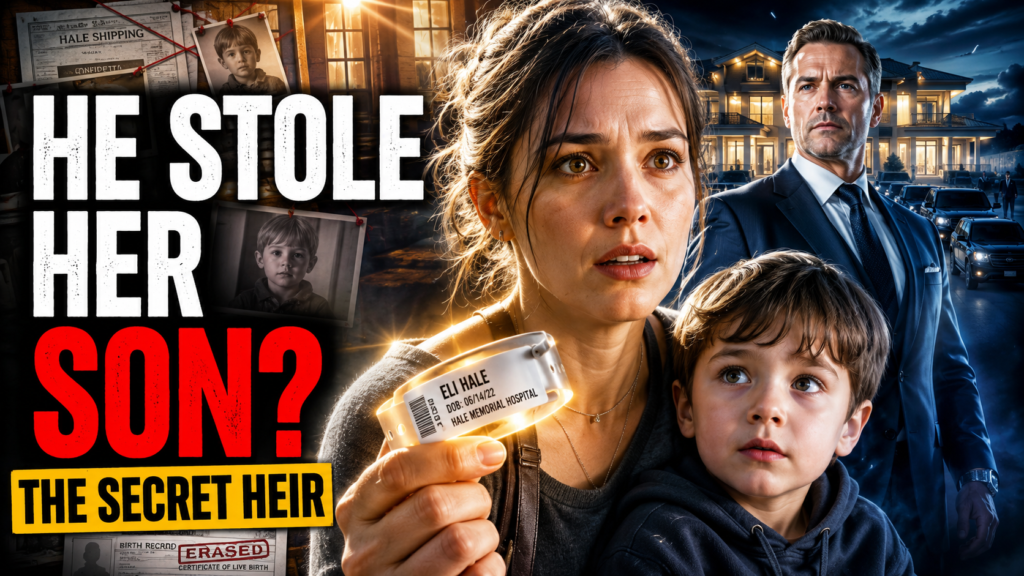
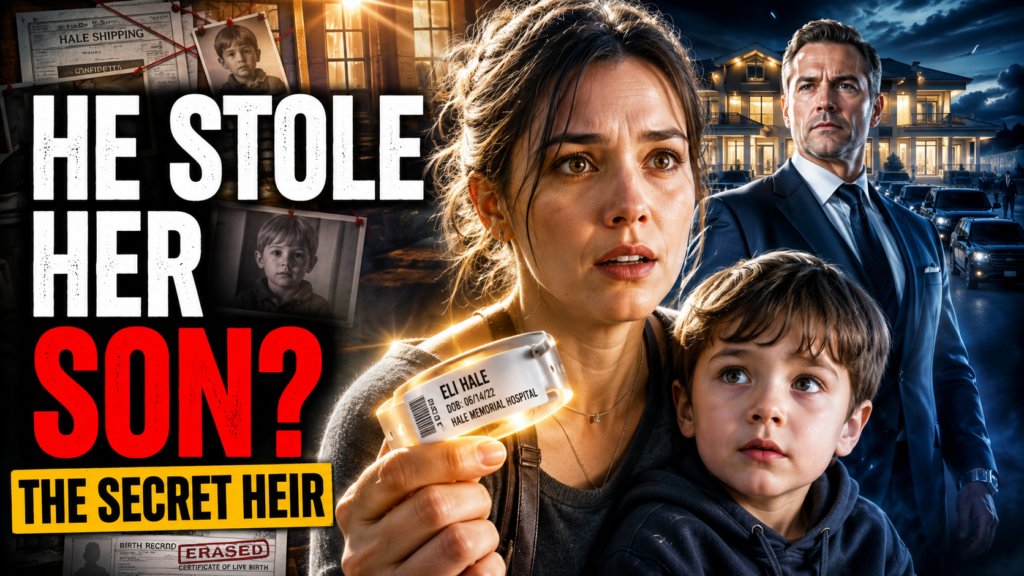
He had come because someone had stolen something from his family twenty-two years earlier—and the proof was hidden inside the hospital bracelet around my son’s wrist.
Twenty-four hours earlier, I still believed my biggest problem was paying my electricity bill.
THE BRACELET
I had learned to measure my life in overdue notices.
Rent. Electricity. Daycare. My son’s asthma medication.
At thirty-two, I worked the night shift as a records clerk at St. Agnes Medical Center in Providence, Rhode Island. It wasn’t glamorous, but I was good at it. I knew how to find files nobody else could find, how to spot altered dates, and how to recognize when a document had been quietly removed from a system.
My eight-year-old son, Eli, was the reason I never complained.
His father had disappeared before Eli was born, leaving behind nothing but a debt collector’s number and a faded photograph I had thrown away years ago.
That Thursday night, I was closing the pediatric archives when I noticed something strange.
A medical bracelet had been placed inside an old file box.
It belonged to a child named Noah Bell.
The date was twenty-two years old.
I almost tossed it into the lost-and-found bin.
Then I saw the handwriting on the back.
Three words.
NOT HIS NAME.
My stomach tightened.
Before I could examine it further, the archive lights went out.
I heard footsteps.
Slow.
Heavy.
Coming toward me.
I grabbed my phone and slipped behind a filing cabinet.
A man entered the room carrying a flashlight.
He wasn’t hospital security.
He wore a charcoal suit and black gloves.
He opened the exact box I had been holding.
“Where is the bracelet?” he muttered.
I stopped breathing.
Then his phone rang.
“Yes, Mr. Hale,” he said. “We’re searching now.”
Victor Hale.
I’d heard the name.
Everyone had.
He had built Hale Maritime into a global shipping empire before forty-five, owned hotels, ports, warehouses, and enough politicians to make investigations disappear.
But there was something nobody talked about.
His infant son had vanished twenty-two years earlier.
The case had never been solved.
The man left.
I waited ten minutes before crawling out.
I should have gone home.
Instead, I took the bracelet.
Not because I was brave.
Because something about those three words felt personal.
The next morning, I brought it to a jeweler I trusted.
He examined the metal clasp under a magnifying lamp.
“This isn’t hospital jewelry,” he said.
“What is it?”
His expression changed.
“It’s a tracking seal.”
Before I could ask what that meant, my phone buzzed.
A photograph appeared on the screen.
It was Eli.
Walking home from school.
Taken from across the street.
Underneath it was one sentence:
Bring back what belongs to the Hale family—or your son becomes the next missing child.
My hands went numb.
Then the jeweler looked at the bracelet again.
“There’s something engraved inside.”
He turned it toward the light.
I saw four tiny numbers.
0719.
My son’s birthday.
And suddenly, I realized the man in the archive hadn’t been looking for Victor Hale’s missing child.
He had been looking for evidence that my son was connected to him.
THE NAME THAT WAS ERASED
I didn’t call the police. That decision still haunts me. I knew enough about Providence to understand that powerful people didn’t always fear the law. Sometimes, they owned the people who enforced it. So I drove straight to the only person I trusted. Dr. Marcus Reed had been my supervisor at St. Agnes for six years. He was sixty-one, stubborn, divorced, and the kind of man who kept paper records because he didn’t trust computers. When I showed him the bracelet, the color drained from his face. “Where did you get this?” “From the pediatric archive.” He locked his office door. Then he pulled an old ledger from beneath his desk. “I was told this file never existed.” “What file?” Marcus opened to a page dated July 19, 2004. There was a handwritten entry. Male infant. Unidentified. Emergency admission. No birth certificate. Beside it was a second note. Transferred by private request. Hale Foundation. My pulse hammered. “My son was born July 19,” I whispered. Marcus stared at me. “No. Your son was born September third.” I felt the room tilt. “What?” “You’ve always told everyone September third.” “That’s because that’s what’s on his birth certificate.” Marcus shook his head. “Then someone changed it.” Before I could respond, his computer suddenly powered on. A message appeared across the screen. STOP DIGGING. Then every file in the office began deleting itself. Marcus grabbed a flash drive. “Run.” We barely made it through the rear exit. Outside, a black sedan was waiting. The driver’s door opened. A woman stepped out. She looked to be in her fifties, elegant, perfectly composed. “I’m Evelyn Shaw,” she said. “Victor Hale’s attorney.” I stepped backward. “If you’re here for the bracelet—” “I’m here because your son is alive.” My throat closed. She handed me an envelope. Inside was an old photograph. A newborn baby. A silver bracelet around his wrist. And beside him stood a younger Victor Hale. But Victor wasn’t smiling. He was crying. On the back of the photograph were six words: His mother saved him from us. “Who is his mother?” I asked. Evelyn looked directly at me. “You.” I laughed. It came out broken. “That’s impossible.” “You were sixteen years old in 2004,” she said. “Your medical records show you were hospitalized that summer.” I had no memory of that. None. Evelyn continued. “Someone erased three weeks of your life.” Then a gunshot shattered the rear window of the sedan. Evelyn shoved me to the ground. Marcus screamed. A second shot struck the pavement inches from my hand. We ran into an alley. Behind us, Evelyn shouted, “They’re not trying to kill you!” I turned. “Then what do they want?” Her answer stopped me cold. “They want you to remember where you hid the original birth record.” That night, I broke into my mother’s abandoned house. She had died four years earlier. I searched every drawer, every closet, every box. Nothing. Then I noticed something strange beneath the kitchen floor. One loose wooden plank. Underneath it was a metal lockbox. Inside were my mother’s passport, three photographs, and a sealed letter addressed to me. My hands shook as I opened it. The first line read: Claire, if you’re reading this, Victor Hale has already found Eli. I read faster. Then I reached the final paragraph. My mother had written that Eli wasn’t Victor Hale’s grandson. He was something much more dangerous. He was the legal heir to a fortune Victor had stolen from his own brother. And my mother had spent twenty-two years hiding the one piece of evidence that could destroy Hale Maritime forever. A sound came from the hallway. Someone was inside the house. I grabbed the letter. Then I heard a man’s voice in the darkness. “Claire.” He knew my name. And then he said the one thing that made me realize my mother hadn’t been protecting me from Victor Hale. She had been protecting Victor Hale from me.
THE LAST RECORD
The man stepped into the kitchen.
I raised the metal box like a weapon.
He stopped beneath the doorway light.
It was Victor Hale.
Not his lawyer.
Not an assassin.
Victor himself.
“You came alone?” I whispered.
“Yes.”
“Where’s Eli?”
“Safe.”
I didn’t believe him.
He slowly placed his phone on the table. The screen showed Eli asleep in a hospital room, an oxygen monitor glowing beside him.
“He had an asthma attack,” Victor said. “My security team found him before the men following you did.”
My anger collapsed into terror.
“Why should I trust you?”
“You shouldn’t.”
That answer surprised me.
Victor opened the metal box and removed my mother’s letter.
“She lied to you because she believed the truth would get you killed.”
“Then tell me the truth.”
Victor looked older suddenly.
“My father and my uncle built Hale Maritime together. When my uncle discovered they were laundering money through the company, he threatened to expose them.”
Victor paused.
“They killed him.”
I stared at him.
“Then what happened to his son?”
Victor’s eyes filled with something I had never expected to see.
Shame.
“My father ordered the child erased.”
The room went silent.
“Your mother worked at the hospital,” he continued. “She discovered the baby had survived. She changed his identity and secretly raised him through a private guardianship arrangement.”
My breath caught.
“Eli?”
Victor nodded.
“But why me?”
“Because your mother was the only person who knew the original records existed.”
I opened the letter again.
A second page had been hidden behind the first.
It contained names, account numbers, shell companies, and dates.
At the bottom was a handwritten confession signed by Victor’s father.
It proved that Hale Maritime had been built partly with stolen assets belonging to Victor’s murdered brother.
But there was another signature.
Victor Hale.
I looked up.
“You signed this?”
“When I was twenty-three.”
“Why?”
“Because I thought confessing would save my family.”
He swallowed.
“Instead, my father threatened to kill you and your mother.”
So Victor had spent twenty-two years building an empire for the very man who had destroyed his family.
Then he had secretly gathered evidence against him.
But the final document was missing.
The original birth record.
My mother had hidden it.
I suddenly remembered something from childhood.
Every July 19, my mother took me to the same abandoned train station and left flowers beside an empty bench.
I had never understood why.
Victor did.
We found the record beneath that bench.
And with it came the final proof: Eli was legally the surviving heir to the stolen family trust.
But Victor didn’t hand the documents to his lawyers.
He handed them to the FBI.
Three weeks later, Hale Maritime collapsed.
Victor testified against the executives who had continued his father’s crimes. He surrendered control of the company and established a foundation in his brother’s name.
He never claimed Eli as his heir.
Instead, he asked me one question.
“What does your son want?”
I looked at Eli playing beside the hospital window.
“A normal life.”
Victor nodded.
“Then that’s what he’ll have.”
Months later, Eli’s hospital bills were paid anonymously.
The money came with no name.
Only a note.
Some debts are paid with money. Others are paid by finally telling the truth.